3 months ago
79
3 months ago
79
Voting is under way in France in the second round of local elections – seenas a bellwether for next year’s presidential race – with cities including Paris and Marseille in the balance and both the radical left and far right hoping for gains.
Most of France’s 35,000-odd communes elected their councils in the first round last Sunday, but in municipalities where the contest is tighter, including most large urban areas, the second round will be decisive, with electoral alliances playing a key role.
Analysts say that while local elections are often decided at least partly on local issues, they can hold important lessons for national ballots. “They create momentum, provide a boost and establish a narrative,” said Frédéric Dabi of the polling institute Ifop.
Besides indicating voter sentiment before the 2027 vote – which the far-right National Rally (RN) sees as its best chance yet of seizing power, with Emmanuel Macron due to step down – the local elections can suggest which tactical alliances may be struck nationally.
One of the tightest races is in the French capital, where city hall has been held by the Socialist party (PS) since 2001 and the centre-left candidate Emmanuel Grégoire topped the first round with 38%, ahead of the conservative Rachida Dati on 25.5%.
Three others qualified for the second round. However, a moderate rightwinger, Pierre-Yves Bournazel, has since merged his list with Dati’s, while the far right’s Sarah Knafo has withdrawn – potentially uniting the capital’s rightwing vote.
On the left, Grégoire has refused to join forces with Sophia Chikirou of Jean-Luc Mélenchon’s radical-left France Unbowed (LFI), which much of the mainstream left has refused to team up with over claims of extremism, antisemitism and violence.
The centre-left candidate therefore faces a three-way race that, if he wins, will comfort the mainstream left’s reluctance to work with LFI – or if he loses, will be hailed by the right as proof of the potential of a broader rightwing alliance.
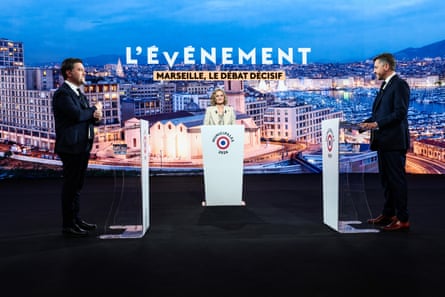
The dynamic is very different in Marseille, France’s second-largest city, where the far-right National Rally (RN) candidate, Franck Allisio, finished barely one percentage point behind the outgoing centre-left mayor, Benoît Payan, in the first round.
Like Grégoire in Paris, Payan ruled out an alliance with LFI – but its candidate, Sébastien Delogu, withdrew, saying the RN must be kept out at all costs. And a conservative candidate, despite RN calls for her to stand down, has stayed in the race.
The RN, the largest single party in the French parliament, also has high hopes in Toulon and the Riviera city of Nice, where its ally Éric Ciotti, running as a joint candidate for his own breakaway conservative party and the RN, is the frontrunner.
Bruno Retailleau, the national leader of the main conservative party, Les Républicains (LR), has refused to back the outgoing centre-right mayor of Nice against Ciotti, potentially clearing the way for a conservative and far-right electoral alliance next year.
In some cities, the radical left is seen as the force to resist, with the PS merging its list with Macron’s centrists in Strasbourg to fight off an LFI threat, and the Socialists uniting with the Greens in Lille to try to block the radical-left party.
But elsewhere, local alliances between the mainstream and radical left could have successes in cities such as Avignon, Brest, Nantes and Toulouse, France’s fourth-largest city, while LFI could win the northern city of Roubaix under its own steam.
A final key race to watch is in the port city of Le Havre, where the mayor, the former prime minister Édouard Philippe, is well placed to keep his job – and may become a leading presidential contender against the RN’s Jordan Bardella or Marine Le Pen.
Polling stations are due to open at 8am local time and will close in the major cities at 8pm, with results expected in the course of the evening.