2 months ago
72
2 months ago
72
I’m on a tram on Vienna’s Ringstrasse as towering facades, columns, statues and domes drift past, each more ornate than the last. Here, the State Opera; there, the Austrian parliament, built in the Greek neoclassical style.
As I gawp, I shove cake in my mouth. After all, Vienna isn’t just the city of music, or lavish architecture. Thanks, in part, to its centuries-old coffeehouse culture, it’s also one of Europe’s finest pastry destinations. Cake (or more precisely, torte, kuchen or Mehlspeisen) has its own day here – “Sweet Friday”, the most delicious of Catholic customs, when meat dishes are replaced with sweets. I have been introduced to it via the medium of Marillenknödel – apricot dumplings.
It’s my first visit to Vienna, my boyfriend Wolfi’s home city. The priority is checking out the old neighbourhood and making a good first impression on his granny. Always keen to fit in, I have identified the national obsession and offered to test Austria’s most famous cake: Sachertorte.
According to legend, it was created in Vienna in 1832 by the 16-year-old apprentice chef Franz Sacher for Prince Metternich. It went on to great acclaim and sparked a decade-long cake war.
In the 1950s, the Hotel Sacher and Demel pastry shop battled over the torte’s trademark, thanks to Franz’s son Eduard, who had refined the recipe while working at the Demel, then offered it on the menu when he opened the Hotel Sacher in 1876.
In 1963, an out-of-court agreement stipulated that the Sacher could market their version – with a layer of apricot jam below the icing and another between the sponges – as the original. The Demel could market theirs as the “Eduard-Sacher-Torte” – featuring one layer of apricot jam below the icing. A big fight about jam, for good reason.
These days, Sachertorte is often decried as dry and overhyped for tourists. Blame that on infantile modern tastes – overindulgent “death by chocolate”, endless cronut-style hybridisations. I’m a fan of the Sachertorte: dark chocolate sponge covered in fondant, tangy apricot jam, whipped cream on the side. It has no need to shout. But is it just for tourists? As I ponder, a call comes from Wolfi’s gran, inviting us for Sunday lunch.
Anna, 82, a Klimt devotee and string enthusiast (she played in her youth), is Vienna born and bred. “For dessert,” she announces, “Sachertorte.” It is a local cake! I’m swiftly corrected. “It’s not a cake! A torte is a torte.” Immediately recognising her superior judging potential, I recruit Anna into my testing team.
Aïda
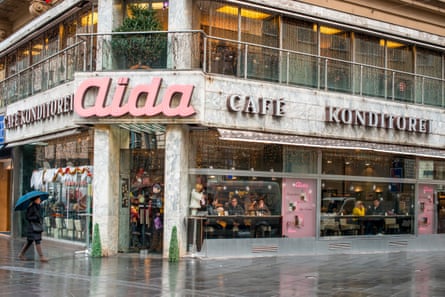
First stop is Stephansplatz, with its stunning gothic cathedral. Nearby is the unmissable Aïda shopfront, a riot of pink. It is billed as the world’s first coffee shop chain. Inside, there’s neon-pink lettering on pink walls, pink lighting, staff dressed head-to-toe in pink. The atmosphere is chaotic – a group of Germans complain about seating and Wolfi manages to lose a euro in the pay turnstile to the loos.
We opt for takeaway. The torte, unforgivably, comes without cream (€1 extra, in a pink pot). We retreat to the shadow of Stephansdom. Smooth chocolate icing, jammy layers. Looks good. I bite. The sponge is … dense. I’m glad of the cream. It’s on the dry side. Anna concurs: “The pores are too close and small.”
€6.10 (takeaway), 4.5/10
Demel
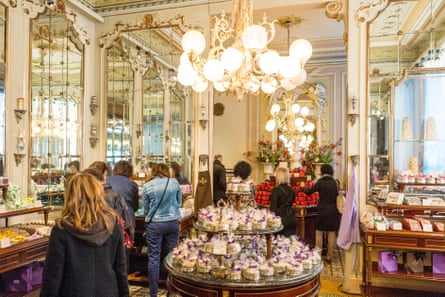
The smell of Kaiserschmarrn (pancake) is strong in the bustling Demel patisserie and the queue snakes up the stairs to the cafe. It’s going to be another takeaway. I’m disappointed to find creased icing on the torte, but happier on first bite. It’s far superior to Aïda – moist, with a fruity tang. I look again. What I see is shocking. Two layers of apricot jam, one under the icing and one in the middle! What’s going on? I check Demel’s website. “A thin layer of apricot jam sandwiched between two layers and beneath the chocolate glaze.”
Evidently, they have updated their recipe. I hope I don’t spark a sticky lawsuit because I don’t blame them: the extra jam is welcome. “It’s a bit too sweet,” Anna counters. “The cake is not fluffy or airy enough,” she concludes, severely.
€8 (takeaway), 5.5/10
Café Landtmann
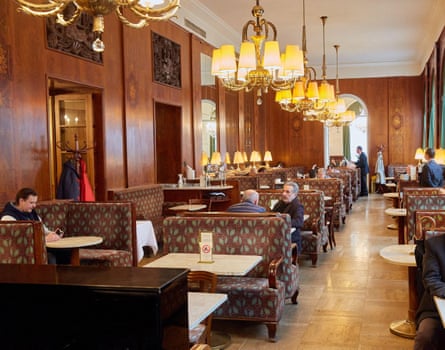
We are swept to a snug booth in an elegant panelled room, all 1920s mirrors and Thonet chairs. The room design muffles chatter, but snatches of Viennese dialect indicate plenty of locals. Snowflakes fall prettily outside the window.
We order Melange (for the sake of argument, a cappuccino) and one Sachertorte. “With three spoons,” the waiter offers, “if the ladies will allow.” I’d heard Viennese waiters were renowned for perfectly honed sarcasm and slight disdain; I wasn’t expecting next-level charm. These guys have a timeless quality, like smooth magicians – utterly hypnotic.
The coffee comes in dainty porcelain and I focus on the (“lactose free”) torte. A wee bit thin on the jam, but the fondant is thick and fudgey, with a decent sponge. I browse newspapers on the old Zeitungshalter (traditional wooden paper rack), trying not to be influenced by my surroundings – and then get giddy in my marking.
€8.10, 8.5/10
Vollpension
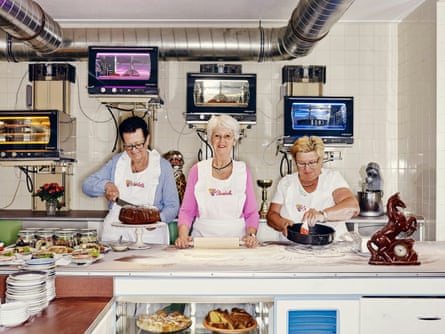
Coffeehouse culture has evolved through this social enterprise – a “granny cafe” set up to combat loneliness and supplement the pensions of senior bakers. Genius. These places have been taken to the city’s heart, judging by the stream of fashionable youngsters coming through the doors. It’s lively, with a cosy retro vibe.
But forget the feelgood factor; we’re here to judge their “Sachertorte master”, Mr Johannes, 72. Things start well when Wolfi declares the Melange the best he’s had in Vienna. Now to the torte. Oh my. It delivers and then some. The apricot jam is fairly oozing, the chocolate icing almost caramel-like with a velvety sheen (made with untraditional-but-delicious butter and cream). It’s one of four he baked fresh today. A delicious bargain!
€6, 8/10
Café Sacher Wien
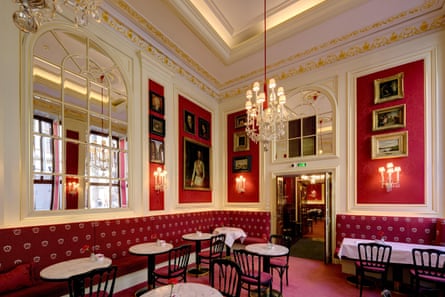
Across from the beautiful Staatsoper (Vienna State Opera), Hotel Sacher is as plush as you’d hope: red velvet, white marble, gold relief. Tourists queue in the cold to get in (book to avoid this fate). The handsome torte arrives complete with seal. The thickest-yet layer of chocolate fondant holds everything nicely in place. Orderly. An excellent balance of fruity jam and rich sponge that also manages to be light.
The internet is awash with complaints that the Sacher’s torte is dry. I can’t agree, but agree it’s overpriced. “More airy than all the rest,” declares Anna. “With every bite,” she proclaims, “we know we are in the Sacher.” We chat about the archduke Otto von Habsburg wandering the hotel naked at the turn of the 20th century. Lots of history; lavish surroundings; technically, the best torte we’ve tried (one of 1,000 produced daily) – but something is lacking. I miss the heart of the Vollpension and old-world elegance of the Landtmann.
€10.50, 8/10
Coppenrath & Wiese
An anonymous family member (it’s Auntie Linda!) tips me off to a budget option “better than Hotel Sacher’s” that’s available in the supermarket. Nothing beats an underdog winning the taste test, so we thaw out this frozen Sachertorte in anticipation. Not this time. But it’s good. Fruity and moist, decent ganache. More chocolate cake than Sachertorte, I’d venture, but a highly competitive price point.
About €1 a slice, 5.5/10