3 months ago
58
3 months ago
58
There are certain problems you might expect when rehearsing a West End musical. Then there are the problems arising today, regarding the flaccidity of a prominent performer. “This one’s too floppy,” protests actor Noah Harrison, who is struggling with the choreography because his dance partner lacks backbone. No offence is taken, mind you: the culprit is made of felt. It’s time to swap out this cloth character for a sturdier one, and there are plenty to choose from. Row upon row of Sesame Street-alike puppets flank the room, each awaiting its moment in the spotlight.
This is Avenue Q, the Broadway-to-London hit, with songs by Robert Lopez and Jeff Marx, and book by Jeff Whitty, now revived to celebrate 20 years since its West End premiere. When it first launched, its mixture of multicoloured kids TV puppets, real-world problems (sex, racism, the housing crisis, existential drift) and outrageous songs felt truly out of the blue, and secured it Tony awards for best musical, best book and best score. But the young people to whom its story was addressed are now all grown up, and a new generation could benefit from the tale it has to tell.
So argues director Jason Moore, who helmed the show first time around, when he too was a rosy-cheeked up-and-comer, and is now back in the director’s chair aged 55. “It’s unusual for a director to revisit a show they did the first time,” he says.
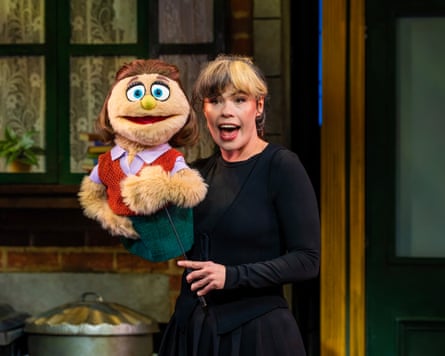
The revival is billed as “a love letter to the original”, implying something other than a straight remount. “Well, it’s not a reinterpretation,” Moore clarifies. “I’ll let [radical theatre auteur] Ivo van Hove do his version.” Please do: I can imagine nothing finer. “But there are some things that need to change about the show, and we now have an opportunity.”
I wonder whether he means the presence of one Gary Coleman among the show’s dramatis personae – a joke about the star of 1980s sitcom Diff’rent Strokes that may mystify Gen Z. But no, Gary (fictionalised as a down-on-his-luck building janitor) is intact, with context added. What Moore refers to are the show’s scale and technical ambition – which are both now upgraded – and its cultural sensitivity, or otherwise, to which we will return.
For the revival, Moore required of his young cast a specific set of attributes: “One of Avenue Q’s currencies is that it has an innocence to it. I look for actors with that hopeful, expectant quality you have in your early 20s.” He also sought an aptitude for puppeteering, a skill for which “a lot of an actor’s instincts are no use to them”.
Once a teenage Avenue Q obsessive, the actor Emily Benjamin later played Sally Bowles in the West End. Today, she is singing a broken-hearted ballad (“There’s a fine, fine line between reality and pretend”) on behalf of a puppet, Kate Monster, who has been dumped by her boyfriend, the show’s questing hero Princeton. “Puppetry,” Benjamin says, “involves ego death for an actor. There’s a removal of what you got into performing for, which is being the central thing that people are looking at.” But there are pluses: “Singing is such an exposing thing. There’s fear, and there’s voice anxiety. But when you have something else to think about, in this case the puppet, I worry about my voice less than I ever have before.”
And an unusual brand of puppetry is required for Avenue Q, says puppet coach Iestyn Evans (puppet conception and design is by Rick Lyon), which takes a form of animation familiar from TV and puts it on stage with the animators in full view. “So you’ve got puppet characters, you’ve got humans who are operating those puppet characters, and you’ve got humans who are interacting with them.” It’s a lot – and that’s before you throw in lyrics and 00s-era attitudes that “I have exclamation points around” as Benjamin says judiciously, and “that I don’t think will necessarily sit well”. She reports that there have been whole-company conversations to adjudicate on songs such as Everyone’s a Little Bit Racist and If You Were Gay. And while both she and Moore have faith in the show’s essential good nature, they acknowledge sensitivities have changed and it may need tweaking in dialogue with its new audiences.
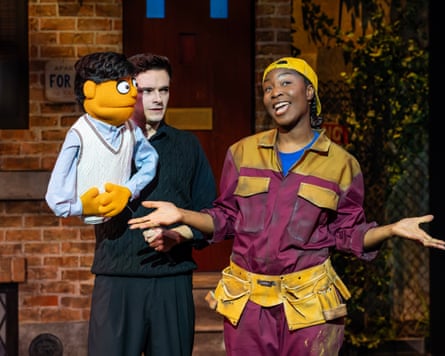
“Avenue Q got noticed,” says Moore, “because its subversive kind of comedy hadn’t been seen in a Broadway musical before. Seeing naked puppets having sex felt transgressive. Now you have Oh, Mary! and The Book of Mormon, that tone is not unknown,” he admits. “But the transgressive parts are still transgressive. We’re still having the same cultural conversations. There’s a different set of sensitivities around it, but really what the show is asking is: could we do better in these areas?”
That’s why he is confident the musical will still resonate. “Young people are always trying to figure out their way in the world. These themes of ‘how do you give your life meaning?’, they’re never going away.” And can the antics of a group of hand-and-rod puppets, floppy or otherwise, encourage a new generation to engage with them?
“They might just be little cloth things,” says Benjamin, “but people can often empathise with something that isn’t real more directly than with a human being telling the same story.”