3 months ago
90
3 months ago
90
Abdul was the first to fall sick, in February 2025, four months into his first ever stint on a longline tuna fishing vessel in the Indian Ocean. Told he was “weak” and “overreacting” by other crew members, he forced himself to keep working, even when he could barely stand, his legs swollen and bruised.
In the months that followed, other crew members of the Tia Xiang 5, a Chinese vessel belonging to Shandong Zhonglu Oceanic Fisheries, a large state-owned fishing company, allegedly began to suffer similar symptoms: swollen, painful limbs and debilitating weakness, with some becoming very short of breath. They were offered no proper medical care, claims Abdul, 36, nor rest from the gruelling 16-hour days, for which they earned 4.6m Indonesian rupiah (about £198) a month.
The fishers were fed “bait” fish which was not fresh and “tasted bad” and few vegetables, says Abdul. They were also suspicious of the water they were given to drink; distilled from sea water it was “too salty” when the machine broke down and “yellow” or “dirty” in colour.
Then, one by one, some of the ill crew members began to deteriorate, says Abdul.
The first to die was Isko*, a Filipino fisher. He was “brave” to challenge the captain and declare himself unfit for work, says Abdul. But he was “punished”: ostracised and forced to sleep on deck, with just a tarpaulin to protect against the rain and scorching sun.
Joko*, 34, a friend of Abdul’s from the same town in West Java, claims that there was no bedding, “just blankets”. “The captain didn’t allow him to go to his sleeping quarters for four days,” he claims.
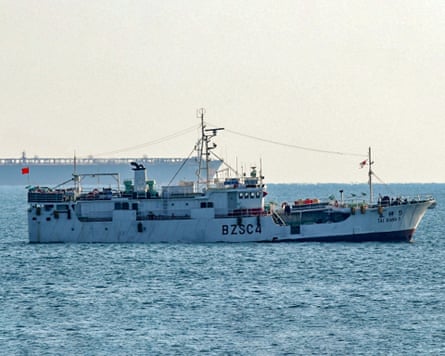
Yet, despite pleas from the sick fisher, according to other crew members interviewed by the Environmental Justice Foundation (EJF) and seen by the Guardian, the captain did not return to port, nor allow Isko to go home.
Isko died four days later, Joko claims.
In all, according to these multiple witness testimonies, three fishers, including another Filipino and an Indonesian, died onboard the Tia Xiang 5 on that voyage, all from undiagnosed illnesses. The symptoms suffered by the fishers are typical of beriberi, an illness caused by a vitamin deficiency and often seen in migrant fishers as a result of an insufficiently nutritious diet, according to EJF.
Abdul, a former laundry house worker from Pelabuhan Ratu, in the Sukabumi region of West Java, who had never worked at sea before, spoke of his sadness at their deaths.
“During those eight months, despite coming from different countries, we were together,” says the father of one. “When my friends left me, I felt sad. I cried. They all had plans, of things they would do and places they would go. They were just gone.”
He was fearful that “it was my turn next. I might not live another day.”

A harrowing video, obtained by the EJF and seen by the Guardian, shows a dead man, identified as Isko by crew members, lying in a corridor. The person filming tries to rouse him, then, finally, in what is understood to be an Islamic funeral rite, crosses the man’s hands over one another. The footage pans away, to below deck, where crew are busy fishing.
By cross-referencing other footage of the vessel and and crew taken by fishers, including one showing a life ring with “Tia Xiang 5” written on it, EJF says it has verified the video as taken onboard the Tai Xiang 5.
“After work, we went upstairs,” says Joko, who said he felt numb. “Everyone who had finished work came to help.”
They constructed a makeshift coffin from wooden pallets, wrapped Isko in a blanket and laid the coffin in the vessel’s freezer.
After Isko’s death, fear spread among sick crew members. It was only after a third fisher deteriorated that the vessel returned to Singapore but the fisher died en route, according to crew interviewed by EJF.
By the time Abdul disembarked with one leg swollen “like an elephant’s foot”, he was so weak he had to use a wheelchair at the airport in Singapore. Once he reached Jakarta, he was taken to hospital and treated for lymphatic disease, he says. He says it took him two to three months and additional costly treatment to fully recover from his ordeal. His salary after deductions, including 6.5m rupiah for hospital treatment, came to just 11.9m rupiah for eight months at sea.

Abdul, who agreed his first name could be used, hopes that speaking out will lead to an improvement in working conditions for migrant workers.
Steve Trent, CEO and founder of EJF, described the situation onboard the Tia Xiang 5 as an “inexcusable case of extreme neglect” of workers and a “violent assault on people’s rights”.
“This is a brutal case, but the sad reality is that it is very typical of what is happening across the Chinese distant water fleet,” he says.
Hundreds of crew testimonies, cross referenced with contracts, passport details and satellite tracking by EJF have revealed that, says Trent.
“You have these appalling conditions where, rather than being transferred to shore, they are forced to keep working,” says Trent. “And you have this tragic situation where three of them have died. It is inexcusable.”
The fish caught by this crew could be entering the European Union market place, he says. “In this instance, we know they [Shendong Zhonglu] have access to Japan, the EU, South Korea and the UK. They are licensed to enter those markets. So the product could be ending up on our plates.”
The EJF are calling on the UK and other countries to endorse a Global Charter for Transparency. A report published last year found the critical checks on seafood coming into Britain have dropped to alarmingly low levels since the UK left the EU.
Each year, the UK receives about 1,000 “catch certificates” from China, equating to an average of about 58,000 tonnes of seafood. Yet, despite the fleet’s serious track record for illegal fishing and labour abuses, the UK has refused only four seafood consignments from China since 2012, indicating such imports are not being properly screened, according to the Coalition for Fisheries Transparency.
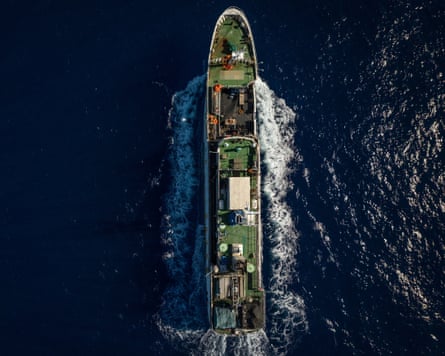
Fishers on longline tuna fishing vessels are particularly at risk of excessive working hours due to the considerable amount of time required to set and retrieve fishing lines.
“The reality is that it is a major global challenge,” says Ben Harkins, a technical specialist at the International Labour Organization (ILO). “The key starting point is to put in place a legal framework about conditions of labour.” With the exception of Thailand, the ILO’s work in fishing convention, its international labour standard for fishing vessels, is not ratified across south-east Asia, the ILO has found.
“There are a lot of constraints, both legally and practically, for migrant fishers to organise, but experience shows that it can be a driving force for better wages and working conditions,” says Harkins.
Shandong Zhonglu Ocecanic Fisheries, the companies that recruit workers on their behalf and the Chinese embassy in the UK were contacted for comment.
* Some names have been changed to protect identity