3 months ago
90
3 months ago
90
The announcement on Sunday, fittingly, was made by Pakistan’s government, a reminder that this episode goes well beyond a game of cricket. In a post on X, the government approved the national side’s participation at this month’s T20 World Cup, but with a significant caveat.
“The Pakistan cricket team shall not take the field in the match scheduled on 15 February 2026 against India,” read the statement. The disintegration of this global tournament continues, that one line prompting serious concern for the sport’s economy. No further explanation was provided.
There’s plenty of untangling required here. When the Board of Control for Cricket in India (BCCI)instructed Kolkata Knight Riders to release Bangladesh’s Mustafizur Rahman in early January, amid escalating tensions between the two countries, it set off the first boycott of this World Cup.
Cue the Bangladesh Cricket Board’s refusal to travel to India, citing security concerns and the advice of its government. The explanation didn’t match with the security assessments commissioned by the International Cricket Council (ICC), and the governing body refused to budge: Bangladesh would not have their matches moved to Sri Lanka, co-hosts of the tournament. Scotland were told to stuff their suitcases and hop on over.
For Mohsin Naqvi, the chair of the Pakistan Cricket Board (PCB), Bangladesh’s removal was an “injustice”, a show of “double standards” that favoured India. He would take the matter to his government. India, of course, did not travel to Pakistan for last year’s Champions Trophy. It was a decision the ICC did not feel the need to publicly explain when it announced, in December 2024, the adoption of its hybrid model for tournaments from now on: Pakistan would not visit India and vice versa.
Naqvi, who wants “sports and politics to be kept apart”, is Pakistan’s interior minister. The ICC is led by Jay Shah, the former secretary of the BCCI and son of the Indian home affairs minister, Amit Shah. It was during Shah’s reign at the BCCI that India hosted the 2023 men’s 50-over World Cup when, in the words of the journalist Sharda Ugra, “cricket became a platform for the political ideology of the ruling Bharatiya Janata [Indian People’s] Party”. In the middle of all this, the two countries occasionally play a bit of cricket, breaking viewing records in the process.
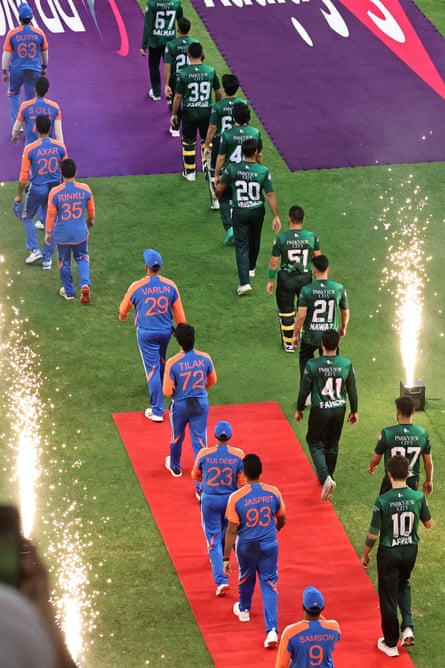
It’s somewhat amusing how important this fixture is when the contest has become such a one-sided watch, India having lost only once to Pakistan at a men’s World Cup. The gap in quality between the two teams at present is vast. But the commercial benefits remain – the match is said to be a key part of the ICC’s $3bn (£2.2bn) rights deal with media conglomerate JioStar – and so they face one another at every tournament, a legitimate draw be damned. The two sides have conveniently met in the group stage of every ICC men’s event over the past 13 years. It jars when the governing body then states that its events “are built on sporting integrity”.
“It’s all about maximising eyeballs and tournament revenue,” Sami Ul Hasan, the former head of media and communications at the ICC, told Al Jazeera last year. “When the ICC plans a global event, organisers do not consider rankings or any other factors. It’s all about making sure India and Pakistan play against each other at least once.”
The fixture’s potential absence threatens those revenues, something the ICC hinted at in its response to Pakistan’s call. It said the “decision is not in the interest of the global game or the welfare of fans worldwide, including millions in Pakistan”. The statement added: “The ICC hopes that the PCB will consider the significant and long-term implications for cricket in its own country as this is likely to impact the global cricket ecosystem, which it is itself a member and beneficiary of.”
The welfare of the “millions in Pakistan” is a fascinating point to touch on. Last year’s Champions Trophy marked 29 years since the country had last hosted a global event, yet the hybrid model used by the ICC meant those supporters missed out on watching a final in Lahore, with India’s presence forcing the match to be played in Dubai. Pakistan ended up playing just one match on home soil; they flew out for their India clash and watched rain ruin their meeting with Bangladesh in Rawalpindi. Even if Pakistan’s boycott does not last, Indian supporters will still be denied a contest at home between the two, that fixture designated for the R Premadasa Stadium in Colombo.
Meanwhile, those worldwide have watched the game grow toxic courtesy of the jingoism at play. Take Narendra Modi, India’s prime minister, comparing their Asia Cup victory last year to Operation Sindoor, a series of military strikes on Pakistan and Pakistan-administered Kashmir. “Operation Sindoor on the games field,” Modi posted on X. “Outcome is the same – India wins!”
Sussex hit with points deduction
ShowSussex have had points deducted before the 2026 season after entering into a three-year framework with the England and Wales Cricket Board - as first reported by the Guardian - to tackle the county's financial problems.
The club will start the Rothesay County Championship campaign on minus 12 points and will also lose a point in each of the two limited-overs competitions after agreeing an arrangement with the ECB which includes safeguards and controls and closer oversight, and which will remain in place until 2029.
Sussex, who finished fourth in the First Division last summer, suffered sustained operating losses in the last financial year and have moved to protect their future while changes are made.
Interim chief executive Mark West said: "We fully understand how disappointing this news will be for everyone connected with Sussex.
"Since taking on the interim role at the end of last season, it has become clear that a combination of internal decisions and wider economic pressures have contributed to the position the club finds itself in today.
"The points deductions will be an unexpected blow to the players and supporters, but we accept the ECB's decision.
"We are sorry - it hasn't been good enough. Our responsibility now is to put things right and ensure the club is in a stronger position going forward."
The club will be subject to a salary cap and will have to provide the ECB with a three-year business plan "demonstrating sustainable year-on-year operating profits by 2027-28" among a series of requirements which must be met in order to avoid a suspended £100,000 fine. PA Media
News of Pakistan’s boycott filtered through during England’s second T20 victory against Sri Lanka in Pallekele, which is one of the venues for the forthcoming tournament. There was a fairly wholesome scene during the rain break as supporters, home and away, danced on the grass banks and stands, the kind of thing you love to see at a World Cup. There will be more of that in the coming weeks and the action itself will drown out a lot of the noise.
But questions persist: are Pakistan open to facing India later if they meet in the knockouts? What does the ICC mean by “long-term implications”? What does a “mutually acceptable resolution” look like when the answer last time round was that cursed hybrid model? How does a sport end up so reliant on one specific fixture? For now, this tournament is something to be endured.