3 months ago
76
3 months ago
76
‘When I moved to Berlin 19 years ago, it felt like some kind of revival of the Weimar period,” says Mary Ocher, referring to the cultural glory days of pre-Nazi Germany. But then she saw “the tail end of this beautiful period. Now in Germany, they try to deport EU citizens who participated in pro-Palestine protests. From where I am, it’s pretty scary.” To Ocher, it was the right time to call her new album Weimar, to draw parallels between the rise of fascism in the 1930s and our own era, tied to her experiences as an immigrant artist in Berlin.
Ocher has never seen making political work as a choice. Born in Moscow to Jewish-Ukrainian parents, she is an Israeli citizen who grew up in Tel Aviv, where she was exposed to intense nationalism that appalled her. “I hated everything around me,” the 39-year-old says of her teenage years in Israel. “There was no accountability, no possibility to change anything. I could see that people who migrated to Israel wanted to integrate and to become part of that society, which means not criticising it, and actively joining the mainstream that is preaching hate.”
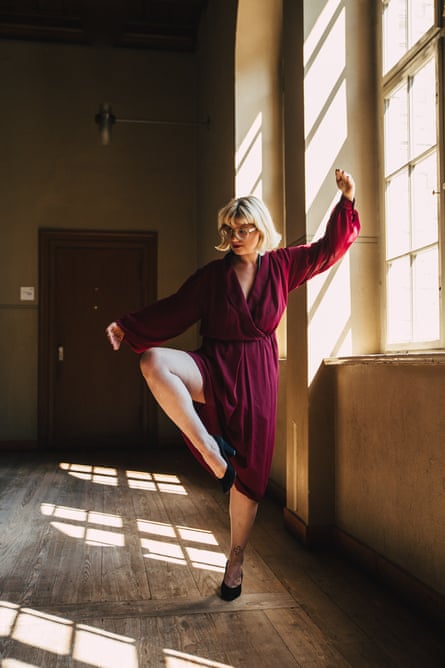
She was due to be drafted in the IDF, but she refused and emigrated to Berlin in 2007 with her industrial folk band Mary and the Baby Cheeses, who blended acoustic instrumentation with theremin and percussive household objects. Ocher and her bandmates moved into a community house and immersed themselves in experimental Berlin culture. “We grew up listening to Nina Hagen, Einstürzende Neubauten and Faust, so it was really exciting to be in close proximity with this musical history.”
Her bandmates returned to Israel but Ocher was determined never to go back. She started making avant-pop solo music, releasing her debut album War Songs in 2011: “I burned my own CD-Rs and sold them in the streets.” She has since released seven studio albums, all led by socio-political ideas and accompanied by deeply researched essays expanding on their themes. Her 2023 EP Power and Exclusion from Power is baroque and angular, with an accompanying essay about post-Soviet inequality in the context of the Russian invasion of Ukraine (“Power which rules by force and terror never lets go … [it] resorts to notions of masculinity, suppresses everything that isn’t in line with such notions”). Released the same year, her album Approaching Singularity: Music for the End of Time considers post-humanism via a Laurie Anderson-esque space opera. “Soviet culture believes that you cannot do any kind of art unless you have the proper training,” she says – so she took the opposite approach. “I wanted the freedom of playing my own music, so I ignored everybody else’s opinions.”
Growing up, Ocher’s father told her she would never be able to play the piano – the instrument Weimar is built around. Ocher started writing the album in 2022, after buying her first (secondhand) piano. Her albums are generally maximalist but Weimar is compelling in its starkness, from jaded cabaret opener The Dance to the three-part minimalist instrumental The Narrative. Two of the tracks are “more rounded and mature” reworks of early songs, including On the Streets of Hard Labor from War Songs, which fits the album’s context with its imagery of crumbling social order.
This imagery also populates the song’s AI video made by Boris Eldagsen – for which Ocher expects some pushback. “I’ve been curious about these new technologies for a very long time,” says Ocher, whose album Approaching Singularity addresses AI from a more speculative position. “I don’t use AI to make my own art. There is a lot of really terrible, cheap stuff out there. But at the same time, I think that it would be very irresponsible to say ‘Never use this technology’, because it’s all-encompassing. I think the truth is somewhere in the middle.” She cites the AI optimist Raymond Kurzweil as the kind of black-and-white thinker on the subject whom she is sceptical of. “Humanity uses technology in all different ways: it can be both useful and dangerous.”
In the essay that accompanies Weimar, Ocher discusses her “moral duty” to address politics – and specifically the danger of Israeli nationalism – in her work. “Very often the German press will say, ‘Be quiet and make your music.’ It’s very condescending, and very frustrating as somebody who grew up in Israel. I think that there is a lot of shame involved in some German people’s personal histories, which causes trauma. Interestingly, I think we have that in common, because the Holocaust is also our trauma. Unfortunately it seems like people are constantly looking for someone to blame.”
As an artist whose work has personal political foundations, Ocher feels strongly about current debates around apolitical art. “Whenever I see an artist make a statement about art not being political, it’s just kind of embarrassing and disappointing. We can do so much with politics. If we can break out of personal narratives, we could be united in how fucked up it all is.”