3 months ago
77
3 months ago
77
Chopping chives, I notice my weak wrists for the first time. My knife is connected to my hand which is connected to my wrist, which is flopping about like an overcooked piece of asparagus.
“You’ve got to keep them more sturdy,” says chef Trisha Greentree. “Lock in that line.”
We’re in the kitchen of Sydney restaurant Fratelli Paradiso, where Greentree is executive chef. Lunch service is about to start but she stays by my side, scrutinising my posture (“squeeze those glutes”), my wrists and my knife skills.
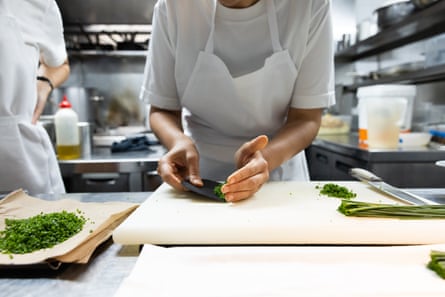
I gently grasp the green spindly stalks in my left hand, keeping them bunched together with my pinky and thumb, while my remaining fingers rest on top. I attempt to slice the chives into immaculate, exacting circles. Because a pile of immaculate, exacting circles is how one scores a 10 out of 10 on Rate My Chives, the Instagram account that rates sliced chives like a competitive sport – and Greentree has committed to showing me how the pros do it.
Rate My Chives has more than 93,000 followers including top-end chefs such as Grant Achatz of Alinea in Chicago, Australian-born Matt Abé, formerly of Restaurant Gordon Ramsay, and Australia’s Mark Best (in return, Rate My Chives follows only five accounts, including two chefs and Taylor Swift). Almost every day, chefs and home cooks submit photos of their chives to the “number one authority on chives worldwide”; and almost every day, its anonymous founder rates them.
The Rate My Chives founder, a UK-based chef, started the account in 2022 after noticing poorly cut chives on a dish while dining out. They are a herby harbinger of a bad meal, a green canary down the mine.
“If the chefs don’t care about the little things like how to chop chives, then the rest of the food’s going to be crap as well,” he says over the phone. But this philosophy applies more to top-end establishments: “If you just go into the pub around the corner and they garnish the potatoes with some averagely chopped chives, you’d just get on with it, wouldn’t you?”
For many chefs, chopping chives is comparable to a musician knowing their scales. It’s a foundational skill for those trained in the western canon of cookery – get it right, and only then can you set your sights on the sous vide machine.

In restaurants, you might find chopped chives quivering atop oysters, smattered across tartare, dancing on gougères. They should be light and fluffy “like green confetti”, says Greentree; on the tongue, they should have a “herbaceous, light pop”. Chives that are irregularly cut, or are wet and bruised, will have an unpleasant mouthfeel.
“When people talk about getting exquisitely cut chives, it’s not so much about showing off your chops … but more about showing you care,” says Greentree.
In their past chive lives, Greentree and her colleagues at Brae, a regional fine-dining restaurant in Victoria, would be outside at 7am, picking fresh chives from the restaurant’s regenerative farm.
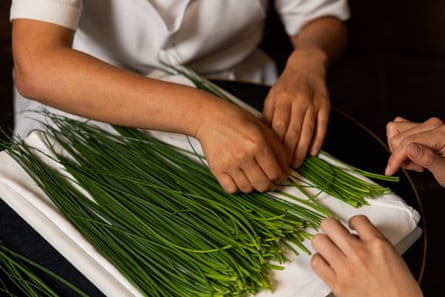
Back at the Fratelli Paradiso kitchen, she unravels chives from their bundle, pointing out where the rubber band has left an indent on their bases – she’ll lop them off later. She lays out the chives in a single layer and runs her fingertips over the stalks, picking out the imperfect specimens: wilted, slimy, under-coloured. Anything less than pristine goes.
Chives were king at Tetsuya’s, the now-closed Sydney fine-dining restaurant run by chef Tetsuya Wakuda. They crowned the confit of ocean trout, the restaurant’s signature dish, and the kitchen would go through 10 large bundles of chives each service. “They weren’t just a garnish, but a key component of the dish,” says Derek Kim, who was Tetsuya’s final executive chef before its closure in 2024. He details the chopped chive criteria: the length and thickness had to be completely uniform; the chives had to have a clean cut; and if the chopping board showed green staining – a sign of mishandled chives – they would redo the batch.
At Rate My Chives, the founder says he scores on consistency and thinness. Chives must be sliced to the same size, and thinner chives demonstrate better knife skills. “You’re not going to get a 10 if they’re all one centimetre,” he says.
Bruised chives receive a bruising score. Chives are marked down if they’re unevenly chopped, or crushed into an oval or square shape.
“To get a 10, you need a knife that’s like a razor. It needs to be ridiculously sharp,” he says. “If you’ve just got a medium sharp knife, there’s going to be pressure going on to the chive, which is then going to crush it.”
Which, after my wobbly wrist, is the second of my problems. Greentree hones her Nenox Japanese knife with a sharpening steel, and when she cuts the chives, I hear a satisfying snap with each slice. She’s gliding, her hand making a smooth, almost circular motion with the blade.
I step up to the chopping board with my knife, a Global knockoff that hasn’t been sharpened since my son was born (he’s 15 months old). When I slice – or rather, seesaw – it sounds like concrete boots stepping through lawnmower clippings. I produce the dreaded “train tracks”, when a blunt blade has dented rather than sliced through a chive, resulting in a long stem with rail-like markings. My tight left-hand grip squashes the chives so they become warped diamonds rather than perfect circles. The board is stained green – is it because the chives have been bleeding, or crying?
We compare our chives. Greentree’s pile looks almost homogenous, like she programmed a chive-generating algorithm. Next to them, my bruised and contorted chives stare at me agape. It looks as if they are screaming.
“You could put them in a dumpling,” says Greentree.
I send my chives to Rate My Chives for a score and analysis. “I mean, I’ve seen worse,” he says. “I was expecting [your score] to be in the negatives.” He scrutinises the pokey long tails, the uneven slices. He gives me a two out of 10.

The delivery is as blunt as my knife, but Rate My Chives contains multitudes.
Scrolling through the posts, some days it’s like entering a gladiator arena. “The more I look at it the worst it gets”, reads one post about a particularly sad-looking pile. In the comments, followers add to the chive pile-on: “Did you cut those with your teeth?” Other days, it’s an encouraging online space where apprentices and interns are applauded for their efforts. Some chefs display their Rate My Chives scores on their Instagram profiles, like a badge of honour.
Cliff Lyijynen was the first chef to receive a 10 out of 10 in 2023, about a year after Rate My Chives was established. The Finnish-Singaporean chef, who’s based in Helsinki, says he submitted his photo during a slow day of prep in the kitchen. He would have been happy with an eight, so was “proud and elated” with his perfect score. “I was expecting to get roasted,” he says.
But he is circumspect about chive-chopping prowess. “In Asia … your grandma or auntie takes out the scissors and they’ll just cut the chives straight into the pot, and they’re still amazing cooks,” he says. “Even if you can cut chives, it doesn’t mean you can get wok hei.”
As far as he’s aware, he hasn’t ever been hired exclusively for his chive-chopping chops. But he has been twice recognised in public by non-chefs: once at a rock-climbing gym, and another while moonlighting as a DJ. “Instead of commenting that it’s a great set, they said: oh, my God, you’re the chive guy.”
I don’t necessarily want to be the chive guy. But I do like the idea of chive-maxxing, of turning an everyday task into an exercise in mindfulness, of pursuing chive-powered self-improvement while procrastinating on other, more substantial areas of self-improvement. I sharpen my knives. I buy some chives. I lock my wrist. It’s time to turn my alli-ums into alli-yums.
My household does not not typically consume chives, but for three consecutive dinners, I sprinkle my herby glitter on stir-fries, pastas and rice. I present a plate of chopped chives for my four-year-old’s discernment. How are they, I ask. Good, she says.
I send Rate My Chives a direct message on Instagram, hoping a second appraisal will improve my previously dismal score of two.
I snap a picture of my chives. I hit send.
He writes back with my new score: “2.3”.