3 months ago
59
3 months ago
59
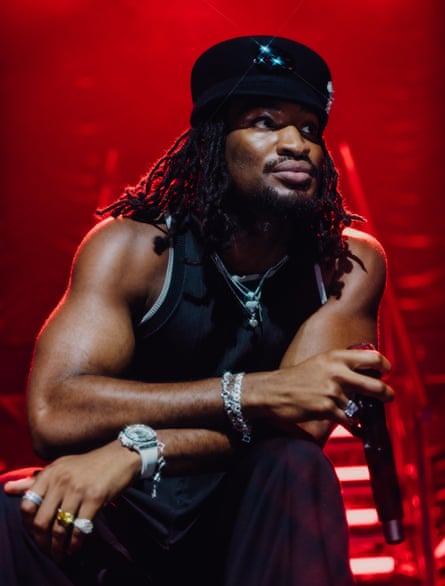
“I’m not looking at a crowd tonight,” Odeal says hours before his first ever Brixton Academy performance in late March. “I’m looking at my people; aunties, uncles, friends, peers and supporters.”
Dressed in loungewear and stretched across a leather sofa backstage at the south London venue, the British-Nigerian singer seems calm, as if he’s exactly where he expected to be. The 26-year-old has the type of fame particular to the British R&B scene: adoration and many millions of streams from the genre’s global fanbase, to the point where he’ll soon play arenas across the US in support of R&B megastar Summer Walker – though is yet to have much mainstream recognition beyond that.
His music sits loosely within R&B, also drawing on Afrobeats, neo-soul and contemporary pop. Across his catalogue – culminating in his 2025 sister EPs The Summer That Saved Me and The Fall That Saved Us – love is rarely conclusive. Instead, songs live in emotional grey areas. But he encourages listeners to lean into their feelings, however conflicted they may be. “If you wanna heal, you’ve got to feel quicker,” he sings on one of his most popular tracks to date, Miami.
Born Hillary Dennis Udanoh in Germany, he was raised in Spain, south London and Nigeria as his parents moved for work. He started taking music seriously at 13, squeezing in studio time after school and selling his PlayStation to buy a laptop. Friends and relationships all came second. “I’ve never made a sacrifice that wasn’t in favour of music,” he says. Much of that discipline was inspired by his mother. “She worked three different jobs to look after me and my brothers: she’d wake up before me, go to sleep after me and still cook.”
In November 2017, he went into septic shock from malaria that had lain dormant in his body for two years. “I nearly didn’t make it,” he says. “That experience shifted everything.” He set up his club night Ovmbr, named as a nod to the month his life was saved. It also provided the title of his 2020 debut mixtape, Ovmbr: Roses, but after its release, he was dropped by his major label. “I was very sure about what I wanted; a label was never the end or be all,” he says, and he’s since built an audience on his own terms. In December he made a deal with Sony to manage his publishing (ie songwriting), but he remains an independent recording artist. If he’d been signed to a record label, he says, “a lot of the songs I have out probably wouldn’t have come out, or there’d have been a lot of pushback. A lot of A&Rs push for hits. Do I lose myself in the process of trying to find that?”
The sense that he sits apart from the industry was underlined at the Brit awards, where he was conspicuously absent from the R&B category despite being arguably the genre’s leading British act. When I ask him about the snub, he bats back diplomatically: “It doesn’t bother me; everyone who was nominated deserved it.” Brit award voters tend to pick big label acts over independent artists, and R&B is often seen as a niche interest in the UK. Does his omission reflect something deeper about how the industry operates? He pauses, flashes a knowing smile, the kind that suggests he has a longer answer he’s chosen not to give. “Something like that. But I can never really take it personally. I’ve got my own goals. Awards are dope, but I want people in every corner of the world to relate to my music. When people come to shows, sing the lyrics and it’s sold out, that’s the award.”
Other collaborators and admirers have included US stars such as Leon Thomas, Justin Bieber and SZA, and at the Brixton gig, a multicultural audience spans all ages. Couples dance intimately, friendship groups bellow out their favourite lines, strangers make friends and there’s an Usher-esque moment during In the Chair when Odeal pulls a fan on stage, cueing up a venue full of screaming hopefuls. Ovmbr, now in its seventh year, has expanded to festivals including Portugal’s Afro Nation and Paris’s Fête de la musique, as well as Lagos and South Africa. The photographers, creatives and marketers behind it are largely drawn from Odeal’s own orbit.
He sees this energy and enthusiasm spreading across the R&B genre globally, characteristic of “football back in the day when Brazil would play – the creativity, the skills, new tactics, it’s so incredible to watch”. But like many artists, he doesn’t want to be boxed in by a genre tag, and claims his music “isn’t [in] a genre – it’s a feeling”. That’s backed up in Brixton, where the audience end up screaming the lyrics louder than Odeal. Whether the industry catches up or not, that human connection seems to be enough for now.