3 months ago
107
3 months ago
107
Fresh sheets smelling of fresh air or fabric softener (or both) with hospital corners are one of life’s great pleasures. As are fresh sheets of egg pasta – the sort that comes in squat boxes protected by clingfilm and found in the fridge section alongside ravioli. They are also one of the most useful and certainly the most multi-talented of all the pasta shapes.
That they are labelled lasagne is limiting; of course, they can be lasagne, but they could just as easily be numerous other shapes. The most easy-going of which is maltagliati, meaning badly cut, which tells you everything you need to know about the approach required as you cut them (using a knife, pizza wheel or pair of scissors) into uneven bits that are ideal in all sorts of soups, but especially those with beans. With slightly more precision, the sheets can be turned into 1cm-wide ribbons (short tagliatelle, if you like) for meat or vegetable ragu. Similar ribbons, made with a fluted pasta cutting wheel, can be mafalde, while thicker ribbons create a sort of ersatz pappardelle. All ribbons, though, can be cut into quadrucci (little squares) – another shape ideal for soup. Larger squares can be mandilli de sea (silk handkerchiefs), which are great dressed with pesto. If the pasta is fresh enough, rectangles can also be pinched into farfalle (butterflies), although I think bow ties is a better description.
Alternatively, the sheets can be rolled around a generous, well-seasoned filling and turned into cannelloni. “Bigs tubes” cannelloni is a relatively recent shape, first mentioned in dictionaries in the mid 1800s and defined as a large shape of pasta to be filled and baked. It was only in the 20th century that recipe books featured the cannelloni we recognise today: fresh or dried tubes stuffed with meat or cheese and vegetables, covered with sauce or bechamel and gratinèed in the oven. As useful and good as the dried tubes are, I think cannelloni made with sheets of fresh egg pasta, both tender but with bite, are more of a treat, especially if the dish is for a feast day. The other beauty of cannelloni is the practicality of preparation, which can be done a few hours or even the day before.
Ignore any instructions that suggest no par-cooking; plunge the sheets into fast boiling water for two minutes, then lift them into a bowl of cold water and then on to a clean cloth before rolling around a spring-loaded filling of spinach, peas, ricotta and lemon zest. Par-boiling means you don’t need an extremely liquid sauce in order for the tubes to cook through, rather a blanket of bechamel and Jackson Pollock splatters of basil pesto.
Serves 4
Salt and black pepper
8 sheets fresh lasagne
200g fresh or frozen peas
300g spinach
250g ricotta
6 tbsp grated parmesan
Zest of 1 small lemon
40g butter
40g flour
500ml whole milk, warmed
Nutmeg
Butter, to grease
200g mozzarella
For the pesto
1 big handful basil
3 tbsp olive oil
A pinch of salt
Bring a large pan of salted water to a boil, prepare a bowl of cold water and lay a clean tea towel out on the worktop. In two batches, par-boil four lasagne sheets for two minutes, then lift them into the cold water and lay them on the tea towel.
Pour boiling water over the peas, then drain. Wash then wilt the spinach in a large pan with the lid on, stirring regularly; drain thoroughly. Chop the spinach and mix with the ricotta, peas, three tablespoons of grated parmesan, the lemon zest and salt and pepper to taste.
Make the bechamel by melting the butter and flour, stirring until a thick paste forms. Whisk in the warm milk and keep whisking until the milk thickens and coats the back of a spoon. Add two tablespoons of parmesan, a generous grating of nutmeg, and some salt and pepper.
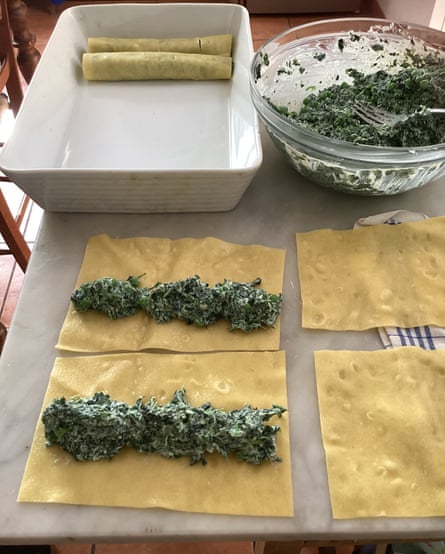
Construct the cannelloni by putting a line of spinach filling the bottom half of each sheet and rolling them up and over to form a neat tube. Arrange the tubes seam side down in a buttered baking dish.
Pour the bechamel over the tubes then rip over the mozzarella and sprinkle over the final tablespoon of parmesan. Bake at 200C (180C fan)/390F/gas 6 for 20 minutes, or until the edges bubble and top is spotted with gold. To make the pesto, blend all the ingredients together, then use this to dot over the cannelloni for the final few minutes of cooking.