3 months ago
76
3 months ago
76
It’s an interesting move that Netflix has taken recently, buying the rights to WWE programming while simultaneously commissioning documentaries about how fundamentally flawed its stars are. Nevertheless, after the success of its Vince McMahon series, it was only a matter of time before it made a series about wrestling’s biggest and most complicated star. And now it is here, in the form of Hulk Hogan: Real American.
Few wrestlers have risen quite as high or fallen quite as low as Hogan, born Terry Bollea. For a considerable stretch of time, Hogan was the WWE; a bundle of imminently marketable tricks and quirks that gave him the nod over all the other grunting men in pants who made up the sport.
But at the same time, when Hogan’s life fell apart, it really fell apart. Hogan died last year, and his final two decades were a barrage of every strain of scandal imaginable. Personal, public, political; you name it, he managed to blunder into it.
If you don’t find yourself with four full hours to dedicate to watching a Hulk Hogan series, then the fourth episode is where you’ll find all the increasingly messy meat. But to skip straight there would be to miss a hell of a lot of context; namely, what a genuine phenomenon Hogan was in his pomp.
Never the most photogenic of characters, with his male pattern baldness and bizarre skin (at once the texture of rhino hide and the colour of a well-boiled saveloy) that made him perpetually look 60 years old, Hogan nevertheless possessed an uncanny understanding of what the punters wanted. And so he became the shirt-ripping, catchphrase-spewing hero – regularly brought back from the brink of professional defeat by the love of the crowd alone – while espousing such unblinking all-American Reagan-era patriotism that it even seemed a little over the top back then.
There were Hulk Hogan toys, Hulk Hogan cartoons, a short-lived Pastamania restaurant in the Mall of America. He was everywhere, and the documentary absolutely revels in his rise. When things are going well, Real American closely mirrors The Last Dance, the seminal Michael Jordan documentary. It’s full of peers and fans and commentators marvelling at the sight of someone carving themselves into Mount Rushmore in real time.
Clearly, though, that is half the story. For what essentially amounts to the final half of his life, Hogan found himself on the back foot. His body was battered by his professional obligations. His steroid use was through the roof. But, trapped by both his reputation as an all-American good guy and his love of fame, he clung on tighter and tighter to his position, even when it curdled everything around him.
We see the rise of Bret Hart, a purely skilled technician of a wrestler, come to a halt because Hogan couldn’t bear to cede the spotlight, and hear Hart call him a “backstabbing, knife-wielding piece of shit”. We see him embroiled in a steroid scandal that took the shine off his reputation. We see him join the WCW and turn heel, diving to lower and lower depths – Viagra matches, getting covered in fake blood – to stay relevant. And we see him get slower and slower through all of this, like a past-its-prime circus bear brought out one too many times. It’s tragic to watch.
But then it gets worse. Although he could have gone the way of Dwayne Johnson and made it as a film star, he instead made a reality TV show – Hogan Knows Best – which only ended up exposing and magnifying all the flaws in his home life. Suddenly Terry Bollea the human, not Hulk Hogan the wrestler, was fair game.
Terry Bollea was, without question, a far messier proposition. He broke up his marriage by having sex with one of his daughter’s friends. He made a sex tape that leaked into the world, and then he teamed up with a billionaire to destroy the media empire that leaked it. He drank. He took so much fentanyl that medics said it should have killed him. He publicly sympathised with OJ Simpson. He was caught being so unspeakably racist that the WWE cut ties with him.
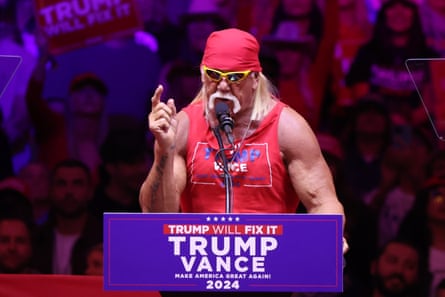
And then he went Maga. We first see Donald Trump in episode two, signing a programme in the front row of Wrestlemania IV in 1988 as Hogan roars “Thank God Donald Trump is a Hulkamaniac!” But by 2024, this has ossified into something much darker.
Hogan’s final chapter comes during the 2024 Republican national convention, where he rips off his shirt and howls “Let Trumpamania run wild, brother,” at 20,000 screaming fans. It wins Trump’s favour – Trump sits for a half-hearted interview in the White House for the series, which begins with him grumbling that “I have a big Russia meeting going on” – but it decimates his fanbase.
Hogan’s last big public appearance came at Netflix’s big WWE launch. And, after years of letting the world see the man and not the brand, he was booed out of the building. After a mournful attempt to justify himself, Hogan stands up and ends the interview. Three months later, he died.
What’s left, despite the show’s attempt to finish with a hagiographic montage, is a portrait of an undeniably broken man. It’s a lesson that, the harder you try to present yourself as an invincible force, the more people will notice the weakness behind it. No wonder he felt such an affinity with Trump.