3 months ago
76
3 months ago
76
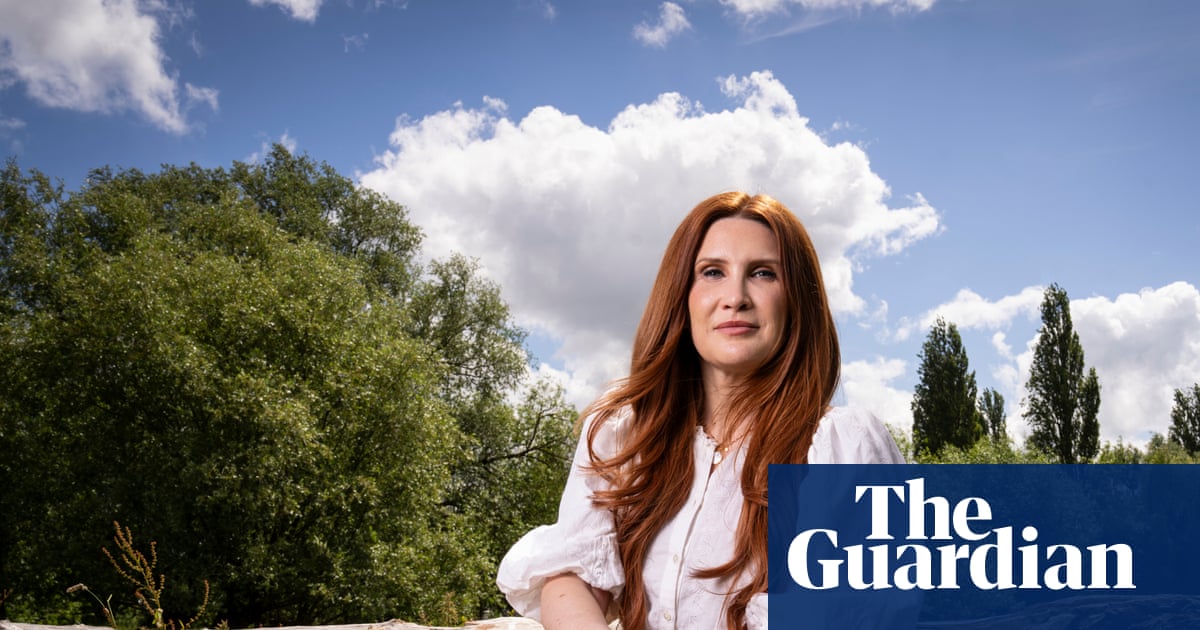
Zanele Muholi has been named the winner of the 2026 Hasselblad award. The South African artist, who identifies as non-binary, now takes their place within the pantheon of the world’s greatest art photographers, from Carrie Mae Weems, Hiroshi Sugimoto, Wolfgang Tillmans and Sophie Calle all the way back to the forebears of the art form, Henri Cartier-Bresson and Ansel Adams.
It’s the kind of accolade that codifies the breathless reception with which Muholi’s work has been heralded to date. When their 2020 survey show at London’s Tate Modern was stymied by pandemic visitor restrictions, the gallery brought it back four years later. One critic likened their arresting self-portraits to Rembrandt’s.
Muholi isn’t swayed by much, and doesn’t see the award as a win. “I can’t say it’s winning, because that’s like you entered a competition,” they say. “This is more a recognition, that is a dream for most of us who are doing photography or who are visualising a work that is not often recognised. It’s an honour for our people, for the Black LGBTQIA+ community from home – it’s for all of us, the queer and trans community in Africa.”
That the artist should greet this kind of personal career high with a “we” speaks volumes about the beating heart of their oeuvre. Muholi has spent nearly 30 years not just documenting the people they love, but commissioning, empowering, supporting, educating: working, for and with the collective. “I’m made by the community. I’m shaped by women, who are the forces in all that I do. I move with the community, with or without resources, with or without recognition. It’s how it has been. I love my people. I love being part of movements, because that’s where we heal, really. It never makes sense to me to be alone.”
Muholi was born in 1972 in the township of Umlazi, south-west of Durban in the province of KwaZulu-Natal, at one of the bloodiest moments of apartheid. The artist was four when the 1976 Soweto uprising saw schoolchildren take to the streets, in protest against being forced to study in Afrikaans; as many as 1,000 were killed by the end of the year. Muholi was just starting primary school when the anti-apartheid activist Steve Biko was tortured to death in 1977.
Muholi’s mother, Bester, would have turned 90 this year. She was a domestic worker for 40 years, often living away from home. “I remember being at home without my mother, because she was working for a white family. The image I remember is of her being at workplaces with swimming pools I wasn’t allowed to swim in, and her reminding me: ‘Don’t go close, because it’s work and it won’t be good for my Madam to see you.’ I remember the dogs that were trained to bite Black people. I remember the different beaches, the north for the white people, the south for Black people.”
Muholi also remembers the challenges around their schooling, the segregated Bantu education “that led me to being nowhere, and how I so much wanted to go to Durban Girls and I couldn’t qualify because there was no one to guarantee that the school fees would be paid in time”.
Where lazy or unthinking descriptions will often land on “poor” to qualify a background such as Muholi’s, the artist purposefully chooses instead “under-resourced,” thereby underscoring the systemic inequalities at work. They also emphasise what they have gained at every stage: a DIY urgency – a sense of responsibility – to keep making work, driven by the certitude that it really can change lives. As a child Muholi was cared for by aunties and neighbours, and the wider township community. This sense of belonging to a constructed, chosen family is itself expanded throughout their work.
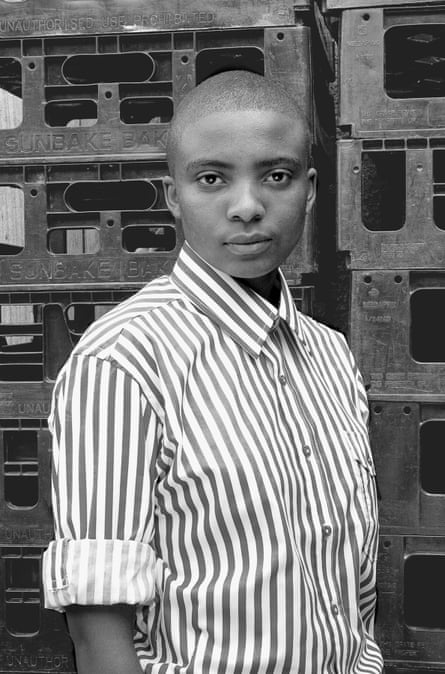
Their longrunning portrait series, Faces and Phases, documents professionals and experts who play crucial roles in the queer community. Lerato Dumse (KwaThema Springs Johannesburg), shot in 2010, depicts Muholi’s former producer, whom they describe as “my child / my niece / my friend, someone that I have spent most of my creative time with”. Most importantly, though, Dumse is a photojournalist in her own right. Muholi’s ability to capture a person’s presence is remarkable.
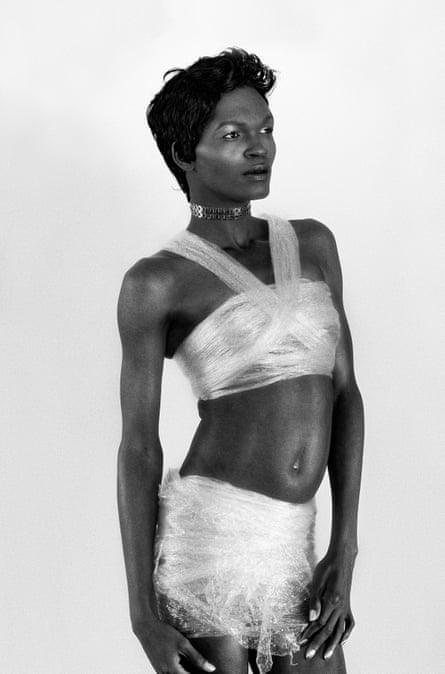
“I always ask people to look good,” they say, “because most images that were done previously by visual anthropologists, they really distorted Africa. You often find that the photographer’s name is there but the person being photographed, their name is not there. I’m trying to fix that and make sure that we are done beautifully in the most amazing way.”
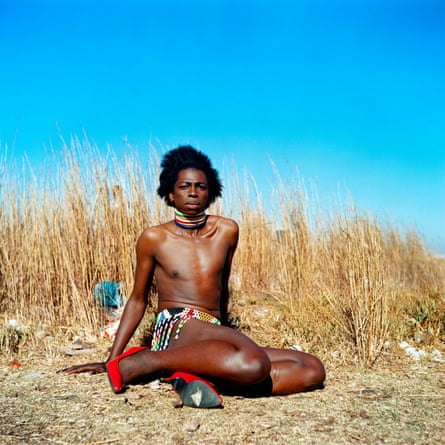
In 2007, Muholi shot a series of portraits of Miss D’Vine, a dancer who worked in the gay bars and drag houses of Johannesburg. Muholi was intrigued by how these performers were cultural activists without knowing that they were: “Their performances make people happy; it changes lives for those who thought that they were alone.”
Shooting Miss D’Vine outdoors, using the landscape, was about “undoing the closet” and allowing the subject to be seen. In one image, the dancer wears a beaded isigege, a Zulu maiden’s skirt traditionally worn by young girls during the Reed Dance, when they dance for the Zulu king. “Trans people have not been able to be part of those ceremonies because they are either pre-op, and therefore they don’t qualify, or if they do go there, they might be seen as something else that they do not connect with.”
Muholi duly treasures this image, shot on film, for many reasons, not least because it is one of the few to have survived the brutal burglary of more than 20 hard drives of their work from their home in Cape Town in 2012. The thieves left behind several expensive items (a TV, a printer, a projector, a camera), leading the artist to suspect a homophobic motive.
Muholi was not cowed, however. “We are a growing nation,” they said at the time. “There is a struggle that needs to be fought here.” Losing that work couldn’t become an excuse to stop working: “I have a responsibility. I have a duty.”
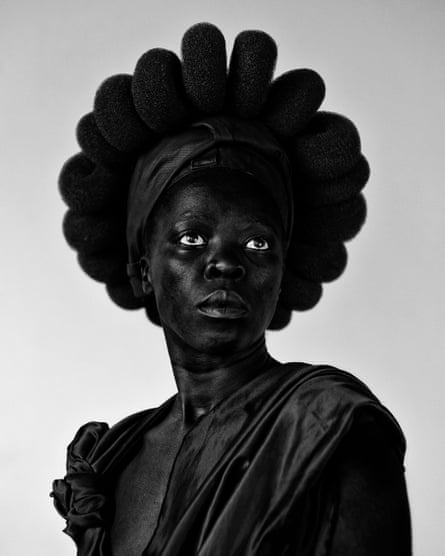
Somnyama Ngonyama is a series of self-portraits, many of which are inspired by Muholi’s mother. In them the artist poses in bold attire: here a headdress of a dozen combs or two-dozen wooden clothes pegs; there a headwrap and neckpiece made of deflated bike tires. The images ask sharp questions about conventions of beauty and fashion: “What is beauty to you might not be the same to the next person. What is fashion in the west might be ritual to us, or part of the culture and traditions of the Bantu people.”
The series’ title means “Hail the Dark Lioness” in Muholi’s mother tongue, isiZulu. “The naming is political,” says Muholi. Photography is often held to be a western thing. “But when we think, when we plan, when we produce, when we play our music, it is in Zulu – or whatever your native language is.”
In “Julile”, which translates as “the one who thinks deeply”, the artist lies naked on a rug clasping to their body plastic bags blown up like silken balloons. The pose draws the ancient curves of a beautiful nude against a backdrop of piled-up newspapers. “This was in my lounge, a few days before I had an operation to remove fibroids. I was in a state, counting down the days before that big operation, thinking deeply of what was about to come and how my body was to change for worse or the better. It made me think about sexuality and illnesses and the sicknesses that consume us. When you have fibroids, it’s like something in your blood is consumed by these forces that live within your body, caused by trauma or stress. So I was thinking deeply about the sense of self and belonging and about existence, you know – my experience, my pain, my survival.”
When setting up Ntozakhe II (Parktown), Muholi was thinking about the Statue of Liberty and improvised a headdress out of a pair of jeans, then used hair buns as the crown. “‘Ntozakhe’ could be ‘your precious belonging’,” Muholi says. “It’s the main cover of my book. For every beautiful Black girl to be a cover is an honour. I’m surprised when I look at myself – I want to connect but disconnect at the same time because as I photographed myself, I never thought this image would become this iconic, having seen images of Black women captured by other people.”
As painful and vile as the past is, Muholi sees her camera as a weapon and photography, a responsibility, “to change whatever is unjust towards our bodies, ourselves”.
Zanele Muholi is the winner of the 2026 Hasselblad award. Their work will be on view at the Hasselblad Center, Gothenburg, from 10 October.