2 months ago
72
2 months ago
72
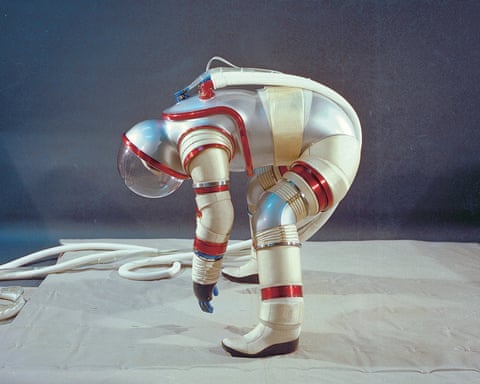
As the Artemis II astronauts return from the moon, we celebrate the science, suits and spirit of endeavour that took them there, all brought together in a colourful new book called Space Journal
Love the hoops … designer ‘Vic’ Vykukal models the AX-3 spacesuit at Ames Research Center in 1977. Photograph: Lee Joncs/ NASAThu 9 Apr 2026 08.00 CEST
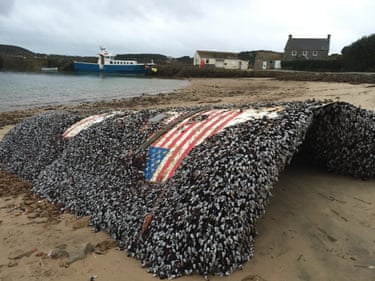
A piece of SpaceX’s Falcon 9 on a beach at Tresco, Scilly Islands
Space Journal is a visual celebration of our perception of the cosmos, and our efforts to reach it, from the 17th century to the present day. BBC presenter Dallas Campbell weaves together archive memorabilia, revolutionary experiments and spectacular scenes to map both real and potential encounters in our celestial backyard. Space Journal: The Art and Science of Cosmic Exploration, is published by Thames and Hudson Photograph: Courtesy Tresco Island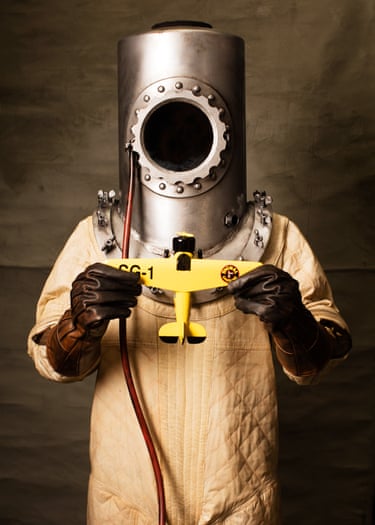
American artist and prop-maker Ryan Nagata
Nagata is modelling his replica of aviator Wiley Post’s 1934 pressure suit, made for the Stafford Air and Space Museum, in Oklahoma. Nagata’s obsessive spacesuit-making quest began at the age of 14 while watching the film Apollo 13. The museum is named after test pilot and Nasa astronaut Thomas Stafford, who flew two Gemini missions and commanded the Apollo 10 mission, which orbited the moon in 1969Photograph: Jackson Adair/Ryan Nagata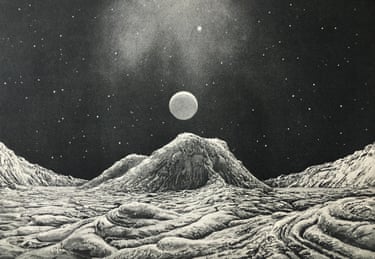
An image from Lucien Rudaux’s 1937 illustrated book Sur Les Autres Mondes (On Other Worlds)
Rudaux’s work would prove an important reference for other artists, including Chesley Bonestell. In May 1944, Bonestell presented his own astronomy-based artworks in Life magazine, showing six spectacular views of Saturn as they might be seen from its moonsIllustration: Lucien Rudaux, Sur Les Autres Mondes, Paris, Larousse, 1937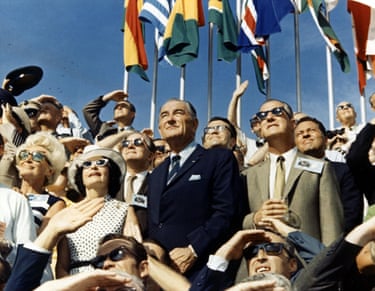
Former US president Lyndon B Johnson, centre left, watches the Apollo 11 liftoff in Florida, 1969
The recently retired president holds centre stage in a VIP viewing site at Kennedy Space Center on 16 July 1969, as the mission to make the first manned moon landing sets off. He is flanked on the left by his wife Lady Bird, and on the right by vice-president Spiro AgnewPhotograph: KSC/Nasa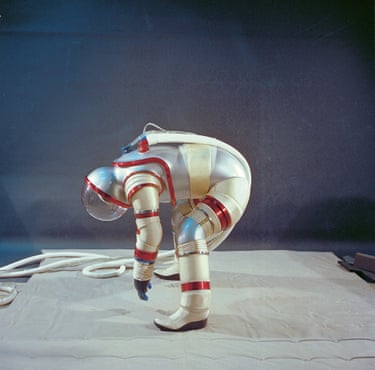
Designer Hubert ‘Vic’ Vykukal modelling the AX-3 spacesuit at Nasa’s Ames Research Center in California, 1977
The 20th century demonstrated that space travel was possible. But the 21st is showing that it might be profitable. We now depend on our space activities for everything from communication to navigation, as well as Earth observation, science, finance and defencePhotograph: Lee Joncs/Nasa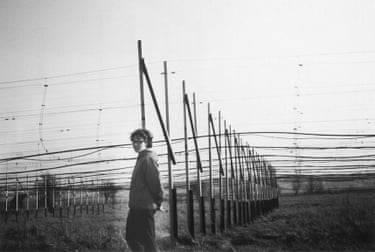
Jocelyn Bell Burnell and the Cambridge array, 1967
Bell Burnell, a physicist, stands in front of the radio telescope array she helped build at the University of Cambridge. It first detected the radio wave emissions of pulsars. She became president of the Royal Astronomical Society from 2002 to 2004Photograph: Jocelyn Bell Burnell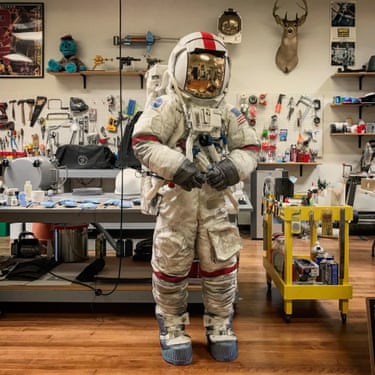
Ryan Nagata modelling his high-fidelity replica of an Apollo A7LB spacesuit in his workshop
A spacesuit has been described as a ‘wearable spacecraft of the smallest possible dimensions’. It has to provide oxygen, get rid of carbon dioxide, regulate extreme temperature fluctuations and protect against the micrometeoroid flux density in the vacuum of space or on the lunar surface. It has to maintain an airtight bubble of atmospheric pressure flexible enough for an astronaut to be mobile, while keeping a constant volume. No easy taskPhotograph: Ryan Nagata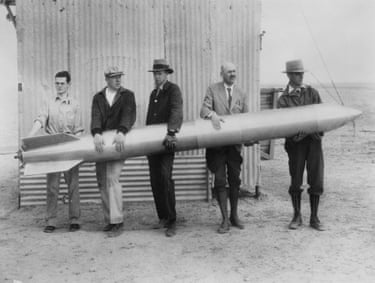
Dr Robert H Goddard and colleagues holding a rocket used for flight, 1932
In 1919, the US rocket scientist Dr Robert H Goddard wrote A Method of Reaching Extreme Altitudes, a scientific paper that contained a footnoteexplaining that, as far as rockets were concerned, the sky was no longer the limit Photograph: Nasa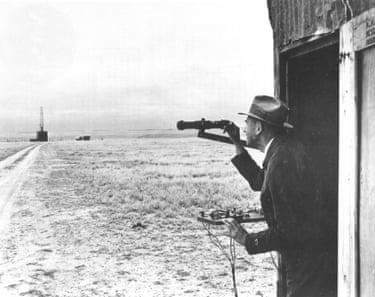
Dr Goddard observes a launch site, c 1930s
The physicist looks out of his launch control shack at a rocket on a launch tower. The New York Times was at first amused by Goddard’s 1919 claim about the limit of flight. The newspaper told readers that, in fact, a rocket couldn’t work in a vacuum because – obviously – there was ‘nothing to push against’. After Neil Armstrong and Buzz Aldrin stepped on to the moon in 1969, it printed a correction: ‘Further investigation and experimentation have confirmed the findings of Sir Isaac Newton in the 17th century … The Times regrets the error’Photograph: Nasa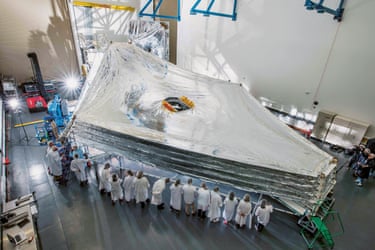
The sunshield on Nasa’s James Webb Space Telescope
The sunshield is about the length of a tennis court and was folded up like an umbrella around the Webb telescope’s mirrors and instruments during launchPhotograph: Nasa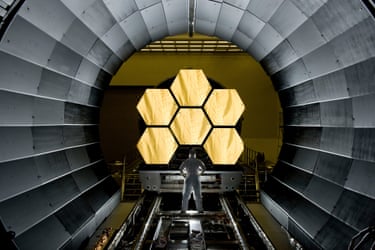
Nasa engineer Ernie Wright and six primary mirrors, 2011
These flight-ready primary mirror segments are prepped to begin final testing at Nasa’s Marshall Space Flight Center in Alabama. In all, 18 segments formed the James Webb Space Telescope’s primary mirror for making space observationsPhotograph: David Higginbotham/NASA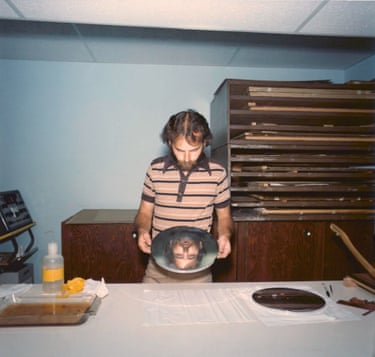
Production of the Voyager Golden Record, 1977
Records detailing spoken greetings in various human languages, nature sounds and music selections were placed aboard each of the two Voyager interstellar probes that took off for Jupiter and Saturn in 1977. The spacecraft were allowed to continue beyond their targets and are now travelling in interstellar space. Read more about the golden records herePhotograph: JPL-Caltech/NASAExplore more on these topics