3 months ago
88
3 months ago
88
Satellite images of Tehran show toxic fires caused by Israeli bombings on oil depots were still burning days after the strikes, which have caused fears of serious health complications for millions of residents in the Iranian capital.
Clouds of smoke from bombings on 7 March on multiple facilities blanketed the city with pollutants ranging from soot to oil particles to sulphur dioxide. Hours later, a passing storm showered Tehran with poisonous, oil-filled rain.
The Guardian spoke to residents who described having headaches, eye and skin irritation and difficulty breathing. Experts have warned those symptoms could be just the beginning, with longterm risks of cardiovascular disease, cognitive impairment, DNA damage and cancer.
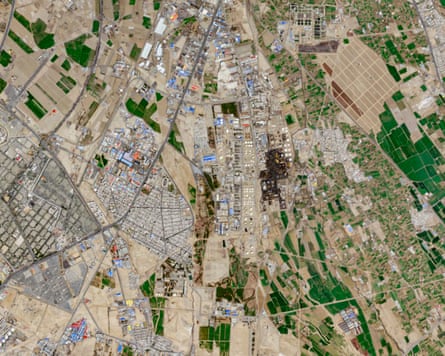
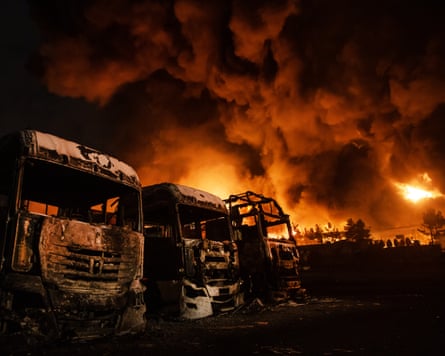
Four fuel facilities in and around the capital were hit, with Shahran depot in the north-west spewing a thick column of smoke into the atmosphere. The Aqdasieh oil depot in the north-east, Tehran refinery in the south and Shahid Dolati facility in the west were also hit.
Iran has described the attacks as “ecocide”, which is described as wanton acts of environmental destruction.
Satellite images from two days after the strikes showed the Shahran depot and the Tehran refinery were still burning.
Another image taken by the European Space Agency satellite on Tuesday – 10 days after the strikes – showed those two fires had smouldered. However, smoke and flames were visible at the Aqdasieh oil depot in the north-east.
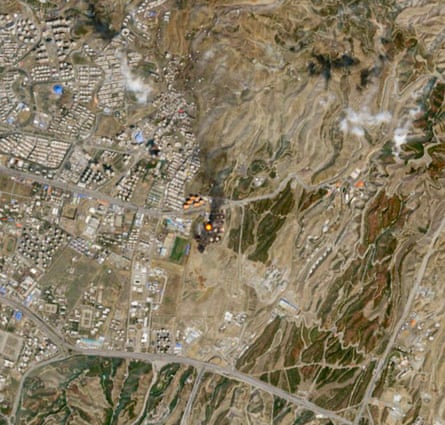
Footage posted on social media on 8 March showed a violent fire at the Aqdasieh site.
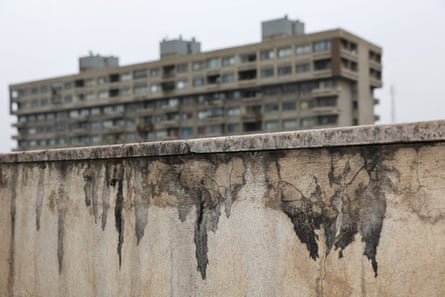
Residents say the capital’s air has been unbreathable for years – Tehran’s chronic air pollution has long been exacerbated by the use of “mazut”, a low-quality heating oil. But the particles released by the explosions this month were on a different scale, and have accumulated on cars, roads and roofs across the capital.
Bombings on fuel infrastructure that is relied on by civilians, and in a densely populated city, have shocked the world. Inside Iran, some anti-regime residents in Tehran who initially supported military intervention said the strikes had led to a turning point.
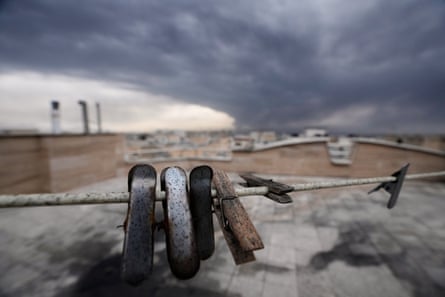
Iranian doctors have been sharing information on the dangers of acid rain, with instructions such as not staying outside, getting rid of polluted clothes, using N95 masks and not standing under trees.
A resident of Tehran told the Guardian that an outdoor pool they used as an emergency water source had turned black after the fallout from the strikes. She also said that the streets were black and slippery.
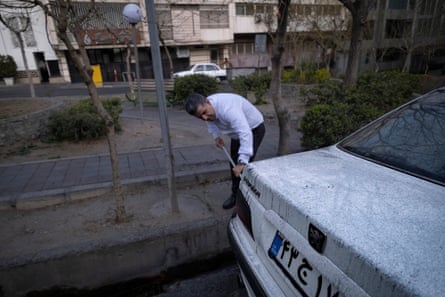
Akshay Deoras, a research scientist at the University of Reading, said symptoms reported by residents of Tehran were consistent with oil fires that produce sulphur and nitrogen compounds that could form acids if they dissolve in rainwater. Raindrops from the storm, said Deoras, acted “like little sponges or magnets, collecting whatever was in the air as they fell, which is why residents observed what’s being described as ‘black rain’”.
The head of the World Health Organization, Tedros Adhanom Ghebreyesus, has said the attack risked “contaminating food, water and air – hazards that can have severe health impacts especially on children, older people, and people with pre-existing medical conditions”.
Israel has claimed responsibility for bombing fuel tanks in Tehran, and posted an image on X of one of the sites, an oil refinery in the south. It is not clear if the US was involved. When asked by CNN the day after the strikes, the US energy secretary, Chris Wright, said: “These are Israeli strikes, these are local fuel depots to fill up the gas tank.”
The United Nations Environment Programme (UNEP) has warned that heavy smoke from burning oil was “directly inhaled by people in Iran – including young children – raising serious concerns about long-term impacts on both human and environmental health”.
Other strikes have caused serious environmental damage, which will have health implications for humans. Iran has attacked the UAE’s biggest port and oil storage facility, Fujairah, with satellite images this week showing large smoke plumes over the sea. US-Israeli strikes on ships have led to oil spills in the sea, while an Israeli strike on Wednesday hit an Iranian production facility for the world’s largest natural gasfield.
UNEP said experience from other conflicts “shows that large oil fires and spills can cause extensive environmental contamination and pose significant health risks from exposure to smoke, particulates, and toxic emissions”.
“Pollution from uncontrolled fires may also enter soil and water, leach into groundwater, and be absorbed by crops, contaminating food supplies,” it said.
Andrea Sella, a professor of inorganic chemistry at University College London said the long-term health risk “will depend strongly on how long and serious the exposure of any individual is”.
“There is the potential for contamination of drinking water supplies,” Sella said. “There is no question that the smoke from such fires is very harmful and we can anticipate a lingering legacy of respiratory and other illnesses into the future.”