2 hours ago
11
2 hours ago
11
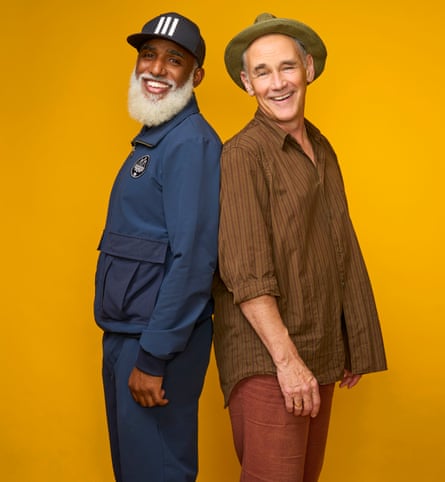
Darren Raymond doesn’t remember having any significant interest in acting when he was growing up. And when he met Mark Rylance for the first time, on Christmas Eve 2004, he had never heard of the multi-award winning actor. These days, things are very different: Raymond is the artistic director of Intermission Youth, the London-based arts charity and theatre, and is directing his friend Rylance in the lead role of Tartuffe (Remixed), Raymond’s adaptation of the Molière play, which opens at London’s Marylebone theatre this week.
It’s fair to say neither could have anticipated they’d still be in touch this long after their initial meeting. “Unlikely companions” is a tired cliche by this point, but that doesn’t make it any less true to say that on the surface, the two had very little in common. Raymond was a young twentysomething raised on an inner-city housing estate and serving a prison sentence at HMP Brixton. Meanwhile Rylance was twice his age, a successful professional actor, and artistic director of Shakespeare’s Globe. Nevertheless that meeting, at a Shakespeare workshop in the prison, turned into a professional connection, which soon evolved into a solid friendship.
Rylance has been a supporter of Intermission, the charity Raymond set up 20 years ago – which helps to transform the lives of young people aged 11-30+ through theatre – since the very early days. Its flagship programme takes 80 trainees a year for a regular schedule of masterclasses, pastoral support and professional performances. In a 2008 interview on Radio 4, Raymond mentioned the positive impact of his and Rylance’s Christmas Eve meeting and how it inspired his vision for Intermission. Rylance was listening, and was prompted to visit the theatre’s headquarters at St Saviour’s Church in Knightsbridge. “I was really knocked out by it, the production was everything I’d been looking for,” Rylance says of the performance he saw. We’re speaking today at Intermission’s temporary base at Omnibus theatre in Clapham – the organisation has struggled to secure a suitable permanent home since being asked to leave the church in 2019.
Intermission’s output is why Rylance thinks it holds such a critical place in the context of the industry. It offers free-of-charge, rigorous, professional-standard training that produces high-quality results. For many, particularly those from working-class backgrounds, such an opportunity would be otherwise unaffordable. Rylance firmly believes in giving back, but in the current climate his preference is to invest in grassroots arts initiatives over major institutions. For him, that feels more impactful. “I don’t support my drama school, I don’t support the Globe any more, or the RSC,” he says. “In terms of my debt to Shakespeare, my debt to all the great teachers I had as a young person, this is it for me – this will be it until the day I die.”
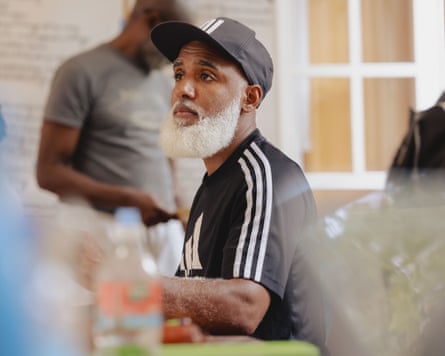
Raymond’s own debt to Shakespeare started with that workshop he reluctantly attended while in prison. He was confused when his friend told him he’d signed them both up for drama classes, but saw it as an excuse to get more time out of their shared cell. On the day of the workshop about 20 prisoners were greeted by Dr Bruce Wall, co-founder of the London Shakespeare Workout – a charity that uses work by major cinematic, musical and choreographic writers and thinkers, along with Shakespeare, to promote confidence and relationship-building among its participants.
Casting his mind back to the first session with Wall, Raymond and his friend didn’t know what to expect. “This guy’s come in, like, ‘Drama!’, all flapping hands and flamboyant. I dunno how he got away with that because it’s just him and there’s 15 to 20 inmates in there. All serious inmates.” The group was initially hesitant, but Wall’s upbeat energy proved irresistible – the enthusiasm soon spread. Raymond remembers an exercise where participants were given a line of Shakespeare’s text and had to respond using their own words. The group reacted to Raymond’s contribution with a chorus of oohs and aahs. “When I look back, that was a really profound moment in my life because it was the first time I knew my words could have any kind of impact. When I left the session, Bruce said: ‘Well done, I thought you were excellent.’ I don’t know if he said it to everybody – probably did. But it meant something to me.”
Back in their cell, Raymond and his friend were energised by their first drama workshop experience. “Normally we’d be talking about how to get one back over the system, but that day we were talking about Shakespeare,” he remembers. Wanting to replicate that feeling, he returned every week, eventually becoming an advocate for the group – encouraging others to get involved, petitioning the prison to keep the initiative going when it was under threat of closure, and even declining relocation to a lower category prison with fewer restrictions as well as privileges such as home visits, knowing that the move would mean he’d no longer be able to attend. Nobody had ever turned down a move to a “D-Cat” prison before, the governor told him, adding: “You must be really into this drama thing!”
Raymond’s commitment earned him the opportunity to represent the prison in a poetry convention, where he first met Rob Gillion, an actor turned reverend who maintained an active interest in the life-changing power of the arts. “For some reason there was a lot of clergy present, I don’t know why. I remember [Gillion] showing a real interest in my story, but I didn’t think anything of it,” he says. He didn’t know it at the time, but that was the beginning of his artistic journey.
At one of the final Shakespeare sessions Raymond attended, he met Rylance, who was guest-facilitating the session along with his late wife Claire van Kampen. The group had been told Rylance was an acclaimed actor and the artistic director of Shakespeare’s Globe – “nobody knew what the Globe was!”, Raymond laughs. He describes his first impression as an anticlimax: “He’s come in with his shorts and sandals, looking like some dishevelled guy off the road. None of us really paid any mind to his stature. Nobody knew any Shakespeare, and that was a good thing – it made the playing field more even.”
Rylance remembers that first meeting well. “It was a small workshop, with just four young men,” he says. “Each had learned a soliloquy and I listened to them. There was a definite marriage of what’s mortal and immortal, because of the interweaving of their own language right next to Shakespeare. The Shakespeare stuff will live as long as humanity lasts on the planet, but the mortal lives of these young people brought alongside the immortal, is very thrilling and delightful to me. That’s what was happening with those four guys that day”.
The exercise was a revelation for the group. “We could talk to him very quickly” recalls Raymond, “and that was testament to how he came to us in the room. The way he spoke to us about Othello … it was riveting listening to these stories because he related it to us and the situation we were in and the lives we were living. At the end of it, he said: ‘Look, we don’t have to revere this work in the way people make you think you need to. Use whatever you want from it – take whatever you want and use it however you want.’ That’s what I do now. That’s what saved me.”
Some time after his release from HMP Brixton, Raymond received an out-of-the-blue call from Wall – an invitation to audition for London Shakespeare Workshop’s national tour of Othello. “I really didn’t know what it meant. I didn’t know what an audition was really, I didn’t know what a UK tour was. But I went, met him, done the audition – and then they cast me as Othello.” Rehearsals took place at St Saviour’s Church, where Gillion was the resident vicar.
The relationship between Raymond and Gillion would be transformative – “I was really inspired by Rob, he was a role model to me,” Raymond says. They stayed in touch following the end of the tour, and when Gillion later took a sabbatical to do some international travelling, he asked Raymond to move into the vicarage and keep an eye on the place while he was away. With hindsight, he realises they both knew the vicarage probably didn’t need anybody to look after it but rather the “favour” was a calculated act of kindness in the knowledge that a young Raymond would have been too proud to accept the help he needed. In 2006 Gillion invited him to run Intermission theatre.
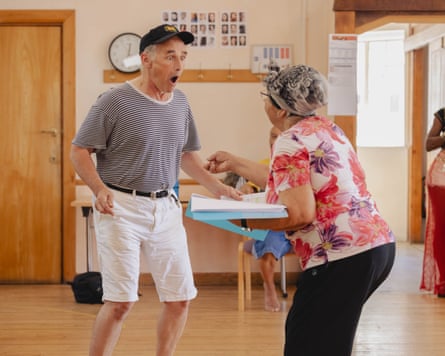
Staging full productions has always been part of Intermission’s regular activity. Over the years Raymond has adapted 15 Shakespeare plays, each time weaving contemporary issues into the classical texts in order to demystify the language and make the pieces feel more relevant for a new generation of actors. The upcoming production of Tartuffe (Remixed), however, is the company’s biggest production to date, and a rare instance of a cast that brings together Intermission graduates and actors who have taken other, sometimes more traditional routes into the industry.
Rylance wasn’t sure if he’d return to do any more theatre. “This is the first time I’ll be directed by Darren. First time back in the theatre since my wife has died, too.” Van Kampen passed away in early 2025 after being diagnosed with cancer. “When you lose your wife of 35 years – I keep thinking of wonderful Joan Littlewood who, when she lost Jerry Raffles, stepped out of that theatre and never stepped in any theatre again. And that’s a temptation – but it’s like when you think you have a death wish but its not that you want to kill yourself – but you want to kill a certain way you’ve been living.”
Returning to stage acting feels like part of a ritual of remembrance for his wife, who was also a passionate supporter of Intermission’s work: “It was something we gave money to, something we supported. And so this feels like a natural path forward for me as I try to figure out a new story to my life. What’s the story of my life without her?”
For Rylance, Intermission is part of the journey of his life, and he’s not alone. When it comes to the organisation’s impact, there have been many success stories that have come from the training programme. The actor Tosin Cole graduated from the very first Intermission cohort in 2009, and has since worked consistently across TV, film and theatre. His CV includes series regular roles in Hollyoaks, Doctor Who, and most recently as the lead in Supacell on Netflix. “I never really had aspirations to become an actor,” he says. “It was just a cool thing to do on a Saturday.” It was going to Intermission that helped him not only realise his talent but also supported him to develop the tools he needed to take advantage of the opportunities that came his way.
Asked what he thinks he would be doing if he wasn’t an actor, Cole laughs heartily as he says “Boy!”, elongating the short syllable as he diverts his gaze. That’s south London speak for let’s not even go there. Does he think there are still challenges facing young people who want to pursue a career in acting? “For a start, we need a lot more different types of stories from different types of cultures. [As Black people] our history is rich and full of those stories, and we are capable of telling them.”
He’s also an advocate for more spaces like Intermission’s original venue to exist, lamenting the loss of the city’s youth clubs and adventure playgrounds. “That place was super special. It’s sad now when you’re in Knightsbridge and you walk past and see the place vacant.” The church has since been converted to a luxury home and was on the market for £35m last year. “Look at any artist or musician that’s come from an inner city and a lot of their skill and their success has come from resources being accessible. A lot of talent came out of the youth clubs where things were free.”
“But every success is relative, right?” says Raymond. While he’s keen to note the commercial success of Cole and others, he also wants to spotlight the young person “who came to me from a youth offending team and was no question on the road to prison, or death. Now they have a job and a family. They’re not acting or working in the industry, but that’s also success to me.” For Raymond, the definition of success isn’t limiting, it’s expansive.
Tartuffe (Remixed) is at Marylebone theatre, London, 4 September to 24 October.