2 months ago
102
2 months ago
102
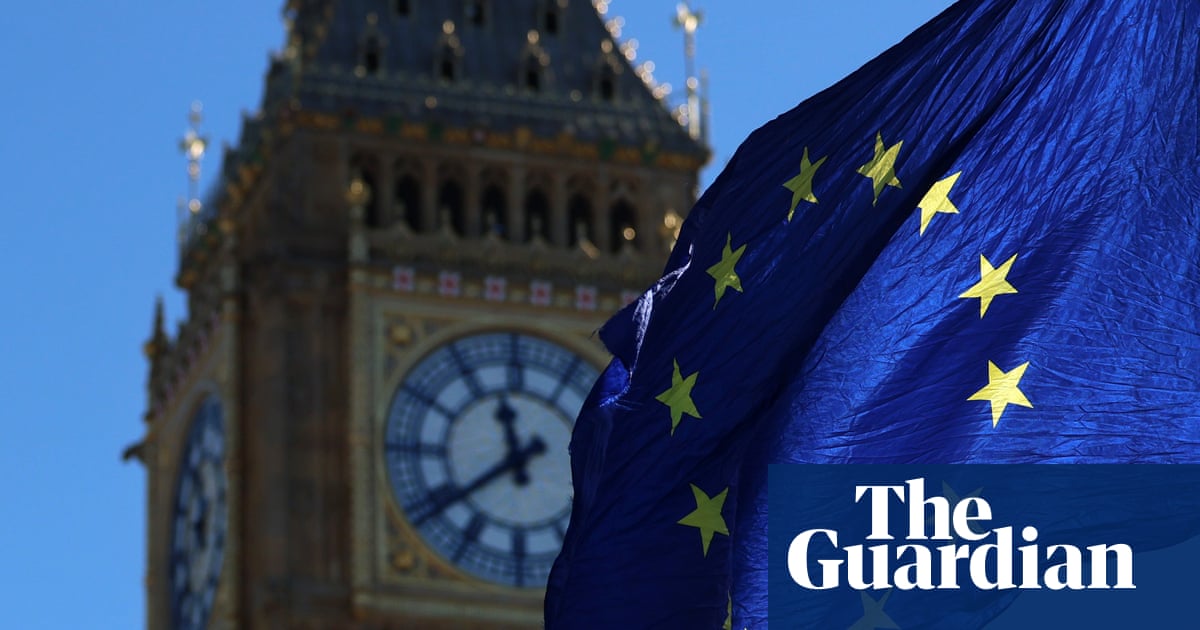
For Brexit’s true believers, Ireland will always be the spoke in the wheel that set everything off course, the green tarnish that took the shine off the golden age. Without the vengeful and malicious obstructionism of the Irish, all the promises of freedom and prosperity would have been fulfilled.
To understand how nonsensical this is, it is necessary to go back five years before the referendum of 2016. Back, that is, to the sense of an ending. In May 2011, Queen Elizabeth made a four-day state visit to Ireland. This should not have been remarkable – the heads of state of neighbouring countries visit each other all the time. But no reigning British monarch had set foot in what is now the Republic for almost exactly a century.
The weight of too much history pressed on these formalities – too much condescension, too much resentment, too many raw nerves. But the queen’s visit, when it finally came, was an exquisitely choreographed exercise in statecraft. It was obvious that the British state had thought very deeply about how it would make clear that Ireland and the UK now related to each other as equals.
For many of us in Ireland, this felt like an exorcism. The ghosts of a colonial past were banished and with them went the demons of Anglophobia. The ordinary experiences of adjacent islands whose people’s lives are deeply entwined through family and friendship, through culture and commerce, could now be the political realities too.
This moment didn’t come from nowhere. Two big things had made it possible. One was the extremely close cooperation between the two states in the Northern Ireland peace process. Dublin and London had understood that the Troubles could be ended only if they worked together as inseparable partners. They had to learn to speak with one voice.
The other was the European Union. Its peculiar nature is that it gives small nations most of the same rights as big ones. Over nearly half a century, Irish and British officials discovered how to work together to advance their countries’ mutual interests. They were not merely sitting at the same tables – they were often arguing for the same things.
The shock of Brexit for most Irish people wasn’t so much the event itself. We know too much about the distorting logic of certain kinds of nationalism on our own island to feel superior to anyone else who is in the throes of such passions. We also know that deciding to leave a larger union (which is what most of Ireland did a century ago, after all) is not a simple calculation of economic losses and gains – emotional satisfaction and collective pride matter, too.
The shock came, rather, from the sheer recklessness of the Brexiters. It was obvious in the referendum debates: any time Northern Ireland came up (which was rarely enough) they simply changed the subject. The Irish question wasn’t even a question. It was at best an afterthought, to be settled after the fabulous UK-EU trade deal (“the easiest in human history”, according to Liam Fox) had been wrapped up.
David Davis’s assertion that there was “no downside to Brexit at all, and considerable upsides” was, from an Irish perspective, terrifying – not because he was lying but because he actually believed it to be true. Such confidence was possible only if it was rooted in blithe ignorance.
Only those who knew nothing of Ireland (or of the great success of British-Irish cooperation over many decades) could believe that turning the meandering, uncontrollable Irish border into one of the EU’s main external frontiers had no downside. Only those who had no sense of the human price that had been paid to get to a point where the people of Northern Ireland believed that they would be left in peace to decide their own destiny could think it was fine to drag them out of the EU against their will.
The Irish state thus had little choice but to enter damage limitation mode. Strikingly, the Irish government and diplomatic service prepared for Brexit far more thoroughly than their British counterparts did. They got in ahead of the referendum to convince all the other EU members that avoiding the reimposition of a hard border must be a precondition for any exit agreement.
Hence, of course, the tortuous (and tedious) crisis over the backstop and the eventual concession that Northern Ireland would remain, in effect, in the customs union and the single market and that the border would be in the Irish Sea.
This was a dreadful outcome for unionism – and in the tribal mentality of the zero-sum game that had to mean that Irish nationalism won. There is, it must be admitted, a limited sense in which Ireland did win. For the first time ever, it was (because of the solidarity of all the EU member states) in a stronger position than Britain in a crucial tussle.
But in truth nobody won anything. Damage limitation is not victory. Ireland managed to make the best of a bad job. Yet very few people on the island were unaware of what had been lost – the trust that had been built over decades, the deep sense of common purpose, above all that feeling in 2011 that a lot of bad history was now properly acknowledged and therefore capable of being transcended.
In fairness to the departing Keir Starmer (not a phrase much used in Britain now) his government has done a great deal to rebuild trust. The dominant feeling about Brexit in Ireland is, I think, not anger but sadness. There is no pleasure in being proved right about the economic stasis and political instability it created. If Britain wants to move back into a closer relationship with the EU, Ireland will be there to help in every possible way.
But there is the fear in Ireland that one of the delayed consequences of Brexit could be Nigel Farage in Downing Street. It feels from our side of the Irish Sea like the aftershocks of Brexit – and of its comprehensive failure – may be not diminishing but strengthening. Having seen what a reactionary British government can do to the delicate fabric of our relationships, we cannot be complacent about that prospect.
-
Fintan O’Toole is a columnist with the Irish Times and the author of Heroic Failure: Brexit and the politics of pain