1 month ago
67
1 month ago
67
Four years ago, Tony Schumacher, a former taxi driver and police officer turned novelist, made his television writing debut with The Responder. It was a five-part series starring Martin Freeman as a police officer on the edge of a breakdown, his mental, emotional and physical resources worn away every night by the ceaseless tide of crime – swelled by misery, desperation and selfishness – that he and his colleagues are supposed to be turning. It was a drama that dissected just about every social and psychological issue that drives our despair, and dared you not to look away. It was profoundly compassionate, harrowing and brilliant. Which makes it a lot to live up to.
Schumacher’s new offering, The Cage, however, does so. Ostensibly it is the tale of the robbery of a casino by two of its employees, cashier Leanne (Sheridan Smith) and manager Matty (Michael Socha). In reality it is, like The Responder, an astonishing, deeply angry, deeply moving state-of-the-nation piece merely masquerading as a mesmerising, perfectly paced and plotted thriller.
Leanne and Matty come to realise that they have both secretly been cooking the casino’s books and stealing cash from the safe for months. Leanne is a widowed mother of two children. Her own mother died 18 months ago and she now takes care of her grandmother who has dementia, on top of everything else. Bills are mounting and because their council home tenancy is tied to Nanna (Eileen O’Brien), when she goes into a care home in two weeks’ time, the rest of the family will be evicted.
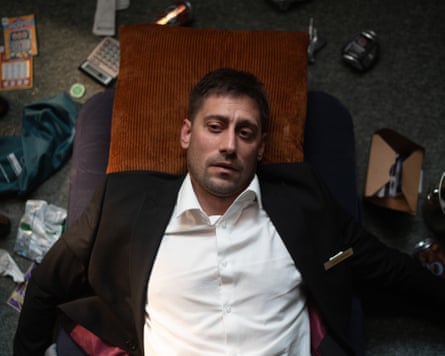
Matty is the son of, and is himself, a recovering drug addict, still in the grip of a gambling addiction. Drink too, really, but it hardly makes the list of problems that need attending to when his life is already so chaotic. He has a teenage daughter, Emily (Freya Jones), whom he loves dearly and who loves him back, but he is too ashamed of himself to see her often. Schumacher has a rare talent for fleshing out every character and relationship, however peripheral, and the ones between Matty and Emily and especially between Matty and Emily’s mother, Trace (Mona Goodwin, who does so much in such a small amount of screen time that I can only hope the latter factor does not count against her at awards time), are perfect examples of it. You feel the years of love and frustration between them every time they meet.
Matty’s gambling has put him deeply in debt. It’s due to be collected by Paul (Louis Emerick), who is also – again because of Schumacher’s unwillingness to let any moment or character pass without seasoning or thickening it – a friend of sorts; hence his provision of a cold compress before he delivers the punch to Matty’s head that the job demands. Paul gives him a choice: help out the local drug dealing gangster to work off his debt. Or. Actually, there is no choice at all.
From there, things go from bad to worse for just about every character. Savings are stolen by returning boyfriends, the true nature of the casino is revealed, teenage children flirt with danger and bring trouble to the door, and everyone becomes further and further boxed in by fear, consequences and fate. But things only get better and better for the viewer, thanks to the emotional richness that attends every scene. Smith gives, as usual, an infinitely credible performance as Leanne, whom we first meet standing at the edge of a car park roof but who cannot step into oblivion when there are so many people depending on her.
Socha, however, is phenomenal. He is always great, and always interesting, but this is a gift of a part and he excavates every layer of Matty with matchless delicacy; his humour (Socha’s timing is immaculate and he is impossibly nimble as he pivots between light and dark), his dragging sorrows, his weaknesses and the strength dimly glimpsed beneath it all as the reason behind his addictions is gradually revealed. The story becomes one not just of present-day fragility but of the experiences that shape and damage people, and how they damage others in turn – and, ultimately, in an unexpected but wholly plausible finale, a story about how, if surpassingly rarely in this godforsaken world, redemption can still be found.
The Cage works as a companion piece to The Responder, giving a voice to and empathising more with the people Freeman’s character likened to whack-a-moles in trackie bottoms than with those attempting to corral them. A state-of-the-other-nation piece, perhaps.