3 months ago
77
3 months ago
77
Lace up your gumshoes! Hard-boiled detectives are back on the scene, fedoras pulled low, cigarettes sparked up. Nicolas Cage is leading the charge in Prime Video’s Spider-Noir, a shadowy spin on Spider-Man that drops in May – available to stream in black-and-white for the diehards. It promises all the hard-edged hallmarks of a good film noir: fast-paced, slangy dialogue, femme fatales, and a heavy-drinking detective at its centre – albeit one with web shooters rather than a snub-nose revolver.
He’s not the only PI in the frame this year. Apple TV is adapting Philip Kerr’s Berlin Noir series into a series starring Colin Firth, while a new NBC pilot promises Jake Johnson as a “cynical and heartbroken” sleuth. And Brad Bird’s animated noir, Ray Gunn, is finally hitting Netflix after almost 30 years in development.
So what’s prompted this return to darkness? Perhaps it’s a sign of the times. When Marvel first published the original Spider-Noir comic in 2009 – itself set during the Great Depression – the world was in the throes of a recession. That, it seems, is the noir rhythm: hard-boiled fiction swells in popularity at times of social strain, growing cynicism and shaken trust. When the going gets tough, the saxes start playing.
Charles Ardai, who co-founded publishing house Hard Case Crime in 2004, says this cycle began with hard-boiled crime fiction’s Depression-era debut. “It emerged in the pulp magazines of the 1920s and 30s,” he says of the genre, “where it was a reaction to the perhaps excessively urbane and intellectual British mysteries of the time: murders in vicarages and drawing rooms, puzzles to be decorously solved.” In contrast, hard-boiled stories were rough and rugged, and initially enjoyed by hard-up readers who relished “the vicarious thrill of looking in on a life even worse than theirs”, says Ardai.
It’s no coincidence, he adds, that these gruff, rumpled characters tend to re-emerge “when the world is going to hell and it isn’t at all clear if the good guys are going to prevail”. Sadly, history has provided many such hellscapes. In the shadow of Auschwitz and Hiroshima, noir flourished. “Less two-fisted action then, and more grappling with existential dread,” Ardai says. During the cold war, Mickey Spillane’s Kiss Me, Deadly tapped into the paranoia and uncertainty of the time. And post-Watergate, with cynicism at its peak, Chinatown, Night Moves and The Long Goodbye all hit cinemas in rapid succession.
Today, the cycle is faster, the shocks coming quicker. The “war on terror”. The recession. Trump. #MeToo. Covid-19. Ukraine. Trump again. Epstein. Iran. It’s hardly surprising that hard-boiled detectives are out in force for 2026. Such characters are machine-tooled for these moments, when our faith in the system collapses and the truth feels particularly out of reach.
Take as an example author Jonathan Lethem, who published his hard-boiled thriller The Feral Detective in 2018. A review in the Guardian, noting that the novel had arrived in the midst of Trump’s first term, called it “a thumping political allegory for a divided nation”. As with all good noir, it wrestled with real-world turmoil, but did so through the eyes of a morally ambiguous, murky-past investigator.
“This figure is dominant in our culture,” says Lethem of the archetype. “It may wax and wane, but it never goes away.” And, after coalescing in the wake of the first world war – hence the tradition of trenchcoats among noir PIs – the character has never lost that original battle-scarred psyche. “It’s a figure shaped by postwar trauma and shattered romanticism,” Lethem explains, “but that brokenness, marginality or isolation becomes their equipment for coping.”
Because of this, the hard-boiled detective can be transposed effectively across genres. “It’s a versatile ‘super story’ that can be turned in many directions,” says Lethem, whose debut novel, Gun, With Occasional Music, fused Philip K Dick-style sci-fi with gloomy-alley noir (think highly evolved, pistol-slinging marsupials). It’s a similar genre-crunching flavour to that of Spider-Noir, and Lethem – who has written for Marvel comics in the past – notes that Spider-Man’s duality makes him a natural candidate for the hard-boiled treatment. “He’s resilient, but he’s the ‘superhero as impostor’,” the author says of the wall-crawler. “And hard-boiled characters often get to have it both ways, to be an outlaw and existential loner figure.”
Recent examples of the genre abound. Bran Nicol, professor of English literature at the University of Surrey and author of The Private Eye: Detectives in the Movies, cites Jo Nesbø’s Harry Hole character, a brilliant but self-destructive investigator grappling with corruption and tracking serial killers, and Dept Q’s Carl Morck, a physically and psychologically damaged cold-case detective (both Detective Hole and Dept Q are available on Netflix). Apple TV mystery Sugar, in which Colin Farrell plays a PI drawn into the disappearance of a Hollywood producer’s granddaughter, also leans noir. “Culture is more global than ever,” Nicol explains. “So a successful model and style – such as Nordic noir or true crime – can quickly become a blueprint.
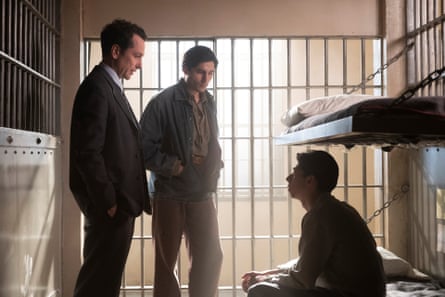
“But our fears and anxieties are also increasingly globalised,” he adds. “The Iran war makes that especially clear. Noir gives us a way of processing these emotions. We’re confronted every day by things out of our control that threaten to harm us, and it’s the perfect form to encapsulate this anxiety – and is there anything more noir on a global scale than the Epstein files?”The genre, then, is a cathartic way to exorcise the anxieties of our time. Take HBO’s gritty, period, corruption-centric Perry Mason, starring Matthew Rhys. The show debuted in mid-2020 – a mere three days after Donald Trump launched his re-election campaign, and as the pandemic raged. When its second series arrived in a Covid-free, Trump-less 2023, viewership fell by two-thirds, and the show was swiftly cancelled. Make of that what you will.
But there are further reasons behind the current “re-noir-ssance”. In January, Dashiell Hammett’s The Maltese Falcon entered public domain, putting Sam Spade back on the case in the legacy sequel Return of the Maltese Falcon, written by mystery author Max Allan Collins and published by Hard Case Crime. In the next decade, more hard-boiled icons will follow: Perry Mason himself and Raymond Chandler’s Philip Marlowe are set to shrug off their copyrights, opening the door for new stories.
“It’s probably not quite as big an effect as you think,” says Ardai of the public domain effect. “It’s not like a dam will burst. If anything, I think the bigger effect might be in the estates of these deceased authors trying to publish authorised sequels in a hurry before the characters enter the public domain – while they can still charge a fee for the privilege of writing about them.”
The real pull of these stories, though, isn’t legal or logistical – it’s emotional. When all hope feels lost, noir doesn’t offer escape, it offers recognition. It lets us wallow. Because, as Ardai puts it: what reader, “bitterly disappointed or frankly terrified”, would choose a story of order and justice when the world outside suggests neither?
Spider-Noir streams on Prime Video from 27 May.