3 months ago
81
3 months ago
81
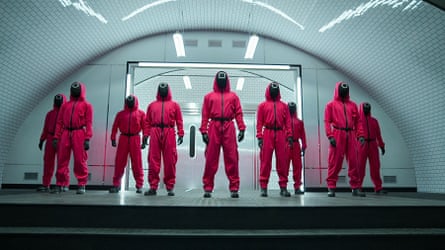
If you were among the 265 million viewers who made Squid Game Netflix’s most-watched series so far, you were likely left mentally and aurally scarred by first season’s end, traumatised by the discordant whistle of a child’s recorder; the sheer banality of a primary school music room reimagined as a herald of human carnage.
That sound was the work of composer Jung Jae-il, whose career has been defined by this sort of strange and unsettling contradiction; he is a master in the art of subverting all that is musically familiar – recasting the naive, the genteel, and the elegant into the chilling harbingers of horror.
And in April, after a world tour that saw him sell-out solo performances at the Barbican in London and Carnegie Hall in New York City, he will be making his Australian debut at the Sydney Opera House, conducting a 41-piece orchestra in the soundtrack he composed for the most Oscar-decorated non-English language film in history, Parasite.
Jung, 43, a graduate from the Seoul Jazz Academy, is a formidable multi-instrumentalist, having mastered the piano, guitar, bass, drums, traditional Korean percussion, and even the musical saw. Yet for Squid Game, he reached for an instrument he has never mastered.
It was not a child playing the show’s opening theme, but Jung himself. He had expected he would be ordered back into the studio with a professional recorder player.
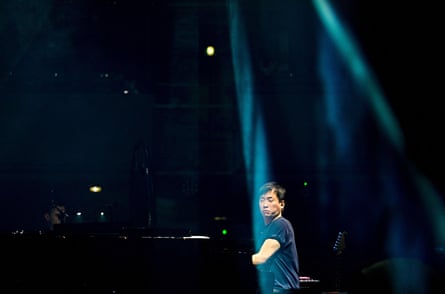
“I’m not a professional or an expert recorder player,” he says, through an interpreter. “We actually tried to correct it with auto-tune later on. But the director [Hwang Dong-hyuk] decided that the correct sound did not sound right.”
The resulting opening theme to Squid Game is a masterclass in calculated imperfection, a series of thin, piercing notes that frequently break into shrill, unintended squeaks. These are the sounds of an amateur struggling for breath, for control, that became an auditory metaphor for the desperation of the doomed contestants on the screen. That sense of extreme unease was baked into the very flaws of the recording. While most scores strive for digital perfection, Jung leaned into the human fallibility of the instrument, a deliberate subversion of his own technical prowess.
Jung’s career path was unconventional: at 15 he joined a rock band, and he has never formally studied composition. His creative practice is rooted in improvisation, something he says he learned to accept while composing the Parasite score.
“I was very much in despair,” he says, of his struggle with the conventional composition process while creating Parasite’s distinctive sound. “Then one day, I sat down in front of my computer and improvised as much as I could, and that actually got the OK from [director] Bong Joon-ho … I thought, maybe this is what I am destined to do. Maybe there’s something wrong with me or my way of working, but this is my path to follow.”
If Squid Game was built on the broken sounds of childhood, Parasite utilised the cool formality of the baroque to illustrate class divide, providing the soundtrack to a scathing critique of modern Korean society. Parasite became the first South Korean film to win the Palme d’Or at Cannes, and the first non-English speaking film to win best picture at the Academy Awards. Director Bong also collected Oscars for best director and best original screenplay.
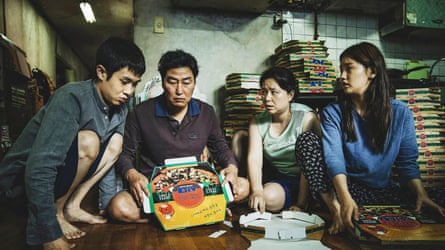
Jung was catapulted from studio hermit to global stage presence.
“After my work in Squid Game and Parasite, my music gained global recognition – not necessarily my name, but definitely my music,” he says.
In 2025, his third collaboration with Bong – the sci-fi comedy Mickey 17 – was released. Here, Jung shifted towards the grand with the London Symphony Orchestra. Swirling waltzes, romantically classical in style, added a disturbing veneer of elegance to scenes depicting what was essentially a human printing factory.
In December, his new orchestral piece, Inferno, had its world premiere with the Seoul Philharmonic Orchestra.
“I believe that had I gone to any kind of formal musical institute or conservatory [to learn composition], I would not have been able to write a piece like this,” he says. “The fact that I start with a clean slate or a blank page means that I can tap into all kinds of music that I’ve been listening to since my childhood – rap, heavy metal, rock, and very modern, avant garde music. At the end of the day, having no identity very much defines my identity.”
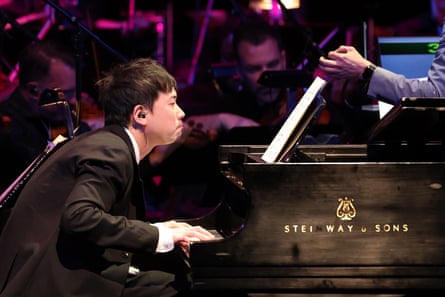
As he prepares for his next chapter, including a project with Burning director Lee Chang-dong and a new album with Decca Records, Jung is increasingly focused on live performance as a bulwark against the rise of artificial intelligence. His transition to the stage is more than a victory lap; it is a strategic act of preservation. He views the concert hall as one of the last bastions of what is authentically human in music.
“I think we are all very much in the dark,” he says. “AI can be seen as a threat when it comes to music composition or music creation. With that in mind, I think it’s all the more important that we look for something fundamentally human, something only humans can do.”
For Jung, that fundamentally human element is found in the very discordance that defined his rise; the improvised, the unpolished, the squeaky mistakes that no machine would think to make, and no auto-tune could ever improve.
By stepping out from behind the screen, he is offering his audience a final, defiant assurance: that the man at the piano is not an algorithm but a human being, still at work in the dark.
-
Parasite: Live in Concert plays at the Sydney Opera House on 24 and 25 April