3 months ago
131
3 months ago
131
US crude oil hits $110 a barrel
US crude has surged over $110 a barrel today, for the first time in over three weeks.
The price of a barrel of West Texas Intermediate has jumped by 10% today, after US President Donald Trump vowed to hit Iran “extremely hard” for the next few weeks, dashing hopes of de-escalation and an early end to the conflict.
US crude is trading at $111 a barrel, the highest level since 9 March.
This puts a barrel of WTI above the international benchmark, Brent crude, which has jumped more than 8% to $109.32 a barrel.
Although Trump pledged last night to finish the operation in Iran “very fast”, traders seem disappointed by the lack of detail about how the conflict may end.
Daniela Hathorn, senior market analyst at capital.com, says:
Markets are increasingly pushing back against the idea that Trump’s latest address signals de-escalation. In fact, price action suggests the opposite.
Despite attempts to frame the situation as manageable and short-lived, the tone of the speech was more consistent with a war rally, reinforcing the likelihood of further escalation rather than resolution. The renewed threats to strike Iranian energy infrastructure if negotiations fail have shifted the narrative back toward rising geopolitical risk, which is now clearly being reflected in markets.
That helps explain the current configuration: oil higher, equities lower and the dollar stronger.
Key events Show key events only Please turn on JavaScript to use this feature
US stock market drops at the open
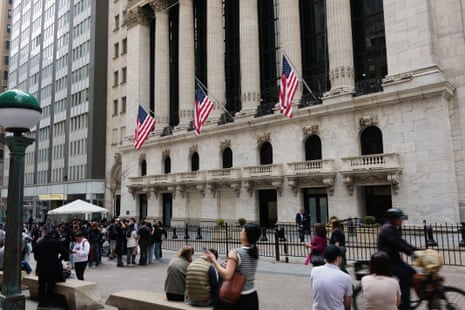
Wall Street has opened with a bump, as traders react to Donald Trump’s address to the nation on the Iran crisis last night.
The Dow Jones industrial average has dropped by 624 points, or 1.3%, at the start of trading as it falls to 45,941 points (further from the 50,000 point mark hit in February)
The broader S&P 500 index has dropped by 1.25% at the start of trading.
The sell-off highlights that investors’ hopes of de-escalation, which build up earlier this week, are wilting.
David Morrison, senior market analyst at financial services provider Trade Nation, says Trump signalled an escalation, not a wind-down, last night:
Hopes had been raised that Mr Trump would announce an end to hostilities, and this had contributed to gains across risk assets earlier in the day, building on those made on Tuesday. But the President confirmed earlier statements made by him and members of his administration, that military operations would likely continue for another two or three weeks.
He reiterated that US objectives in Iran were almost met but warned that the US would hit Iran “very hard” and would only agree to a ceasefire once the Strait of Hormuz was ‘open, free and clear’.
IMF: Trump tariffs will reduce US economic activity
The International Monetary Fund is warning the White House that Donald Trump’s trade war will slow the US economy.
In its latest assessment of the US, the Fund says:
Directors expressed concern about the shift in U.S. trade policy, noting that the increase in tariffs and in trade policy uncertainty are expected to reduce U.S. activity and create sizeable negative spillovers on its trading partners.
The Article IV Consultation also points out that “tariffs boosted goods prices”, which wiped out the benefits from falling services inflation.
The IMF also voiced concern about the Iran war, saying:
Directors expressed concerns about the heightened domestic and global uncertainties posed by the significant ongoing policy shifts and the war in the Middle East.
More happily for the White House, the IMF also predicts growth will rise to 2.4% in 2026, up from 2% in 2025.
But…, they are also calling for “determined actions” to address fiscal imbalances.
UK diesel price now up 30% since start of Iran conflict
Back in the UK, drivers will feel the impact of Donald Trump’s attack on Iran when driving during the Easter break.
Motor fuel prices have risen again today, meaning that diesel prices are up 30% since the conflict began.
RAC head of policy Simon Williams has the detais:
“Petrol has now gone up nearly 22p a litre - or 16% - to an average of 154.45p since the start of the conflict in Iran on 28 February. It was last this high at the end of October 2023.
“The diesel story is even more dramatic, having shot up by almost 9p in the last week alone. It’s now risen by 30% since the end of February, with 43p a litre being added, taking it to an average 185.23p - a price last recorded at the end of November 2022.
“Finding the cheapest forecourts by using the fuel finder in the myRAC app has become vital as it can save several pounds at each fill-up. Driving fuel efficiently by keeping steadily within the speed limit in the highest gear possible and avoiding harsh use of the accelerator can also make fuel go further.”
US-based employers announced 60,620 job cuts in March, up 25% from 48,307 cuts announced in February, new data from recruitment firm Challenger, Gray & Christmas shows.
But AI, rather than the Iran war, appears to be to blame.
In March, Artificial Intelligence (AI) led all reasons for job cuts, with 15,341 announced during the month, 25% of total cuts. Closings followed with 13,931, Restructuring was cited for 8,726, and Market and Economic Conditions accounted for 6,597 planned layoffs.
US crude oil hits $110 a barrel
US crude has surged over $110 a barrel today, for the first time in over three weeks.
The price of a barrel of West Texas Intermediate has jumped by 10% today, after US President Donald Trump vowed to hit Iran “extremely hard” for the next few weeks, dashing hopes of de-escalation and an early end to the conflict.
US crude is trading at $111 a barrel, the highest level since 9 March.
This puts a barrel of WTI above the international benchmark, Brent crude, which has jumped more than 8% to $109.32 a barrel.
Although Trump pledged last night to finish the operation in Iran “very fast”, traders seem disappointed by the lack of detail about how the conflict may end.
Daniela Hathorn, senior market analyst at capital.com, says:
Markets are increasingly pushing back against the idea that Trump’s latest address signals de-escalation. In fact, price action suggests the opposite.
Despite attempts to frame the situation as manageable and short-lived, the tone of the speech was more consistent with a war rally, reinforcing the likelihood of further escalation rather than resolution. The renewed threats to strike Iranian energy infrastructure if negotiations fail have shifted the narrative back toward rising geopolitical risk, which is now clearly being reflected in markets.
That helps explain the current configuration: oil higher, equities lower and the dollar stronger.
'Effective closure' of strait of Hormuz would probably push the euro area into recession
The eurozone could be pushed into recession if the strait of Hormuz remains effectively closed for months, Morgan Stanley economists have warned.
Morgan Stanley have cut their growth forecasts for the euro area today. They now expect GDP in the zone to rise by just 0.6% this year, down from 1% forecast before the invasion. Growth is then expected to pick up to 0.9% in 2027, down from 1.2% in their “pre-March view”.
This ‘baseline scenario’ is based on the assumption that 80% of tanker passage through the strait resumes within a month, with Iran retaining influence in the crucial waterway (through which a fifth of global oil and gas used to flow.)
Under this baseline, Brent crude would peak at $110 a barrel in the April-June quarter. The scenario does not entail a global recession, but predicts that demand will be lower everywhere.
But, Morgan Stanley add, the situation could be resolved faster, or slower…
A rapid “de-escalation” would likely come with a short-lived slow down and growth back to 1.2%Y in 2027. Conversely, an “effective closure” of the Strait, would likely push the euro area into recession for the remainder of 2026.
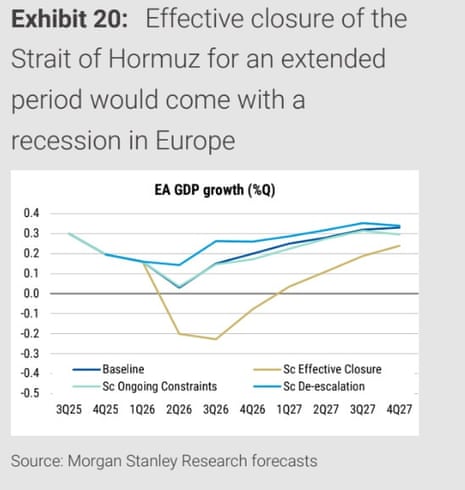
Something for leaders to ponder as the UK convenes 35 countries today to explore ways to reopen the strait of Hormuz:
Various agricultural prices have jumped today, as hopes of an early end to the Middle East conflict drop.
Wheat prices on the Chicago Board of Trade have risen by 1.6% today, with corn up 0.7%. The most-active soybean contract has gained 0.3%.
Farmers have warned that the surge in fertiliser prices since the Iran war began will drive up their costs, and could lead to shortages.
Oil is pushing higher – Brent crude is now up 8% at more than $109 a barrel.
Traders are continuing to price in a longer Iran war than hoped, and more persistent disruption to oil supplies.
“It may be that the most likely outcome is some sort of messy compromise,” suggests Mark Dowding, BlueBay CIO at RBC BlueBay Asset Management.
He says this would mean:
The U.S. exits the fray, declaring a win in terms of the degradation of Iran’s military and nuclear capability but leaving the situation in the Strait of Hormuz unresolved and requiring messy deal-making between Asian and European countries and Iran to get ships flowing again.
The pound is continuing to lose ground against the US dollar.
Sterling has dropped by 0.9% now to $1.319, a fall of more than a cent today.
Raffi Boyadjian, lead market analyst at Trading Point, says:
The US dollar… is once again capitalizing on the increased risk aversion, recouping a good chunk of the losses from the previous two sessions against a basket of currencies.

Sarah Butler
Travel operator Lastminute.com said today that 17,000 of its bookings had so far been disrupted by airspace closures and “shifting sentiment” linked to the Middle East conflict.
The company said the equivalent of almost two days of normal daily business in the region had been affected and it “remains vigilant” on the situation. However, Lastminute still expects to meet annual target of 10% growth in underlying profit as “intent to travel remains high”.
Instead of ditching holidays entirely, demand is shifting to alternative destinations such as the Canary and Balearic Islands, as well as Sicily, Sardinia and other European city
breaks.
Alessandro Petazzi, the chief executive of Lastminute.com, said:
“We continue to closely monitor the evolving situation in the Middle East, with supporting our customers remaining our top priority. At the same time, lastminute.com’s flexible, pan-European model enables us to adapt quickly as travel patterns evolve, with demand naturally rebalancing across destinations. This positions us well to respond to changing preferences and continue delivering value to travellers across our core markets.”
Tensions in the energy markets due to the U.S.-Israeli war on Iran could undermine financial stability, European Central Bank governing council member Fabio Panetta has warned today.
Panetta told a conference in Rome that changes in global investors’ risk perception could quickly lead to pressure on government bonds.
He says:
“There are already signs pointing in this direction, as the rise in the value of the dollar, pressure on long-term interest rates and capital outflows from emerging markets reflect a growing preference for safer assets.”
Traders are betting on several interest-rate hikes in the eurozone, as hopes of de‑escalation in the Middle East conflict faded.
The European Central Bank is expected to have raised its deposit facility rate three times by the end of 2026.
Reuters has the details:
Money markets priced in an ECB deposit facility rate of 2.73% at year-end, from 2.68% late Wednesday. The rate is currently 2%.
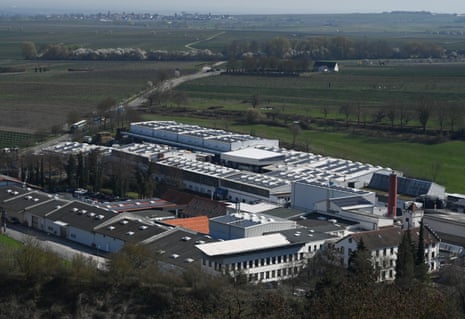
Germany’s chemical industry has been hit hard by the war in the Middle East.
Business confidence across the sector dropped sharply in March, a survey from economic research group Ifo show today, increasing the risk of job cuts.
The Ifo institute’s index for the sector dropped to -25.0 points from a seasonally adjusted -16.7 points in February, while business expectations turned more pessimistic, sliding to -17.9 points from -12.1 points.
Ifo industry expert Anna Wolf says:
“The consequences of the military hostilities in the Middle East are hitting the already struggling chemical industry with full force.”