3 months ago
63
3 months ago
63
von der Leyen gambles Marcosur deal's benefits will outweigh negative impacts before court takes view on legality - snap analysis

Lisa O’Carroll
The gamble Ursula von der Leyen has taken will be pay off if in a year or two years’ time the impact of Mercosur has not been as bad as opponents predict.
The European court of justice could take two years to adjudicate on the legality of the deal by which time the world will know how Mercosur has landed.
European farmers in the grain, beef, and poultry sectors have described themselves as “collateral damage” in the deal but within two years the level of that damage will be known.
So von der Leyen’s gamble is that the ECJ rules in favour of the deal, trade will deliver economic growth with limited impact on European farmers making it difficult for the European Parliament to then vote against the deal.
Key events Show key events only Please turn on JavaScript to use this feature
European Parliament's trade committee chair backs Mercosur's provisional application
German chair of the European Parliament’s trade committee Bernd Lange has also offered his backing for the commission’s decision.
He said:
“Decision [of the European Commission] to go ahead with provisional application EU-Mercosur is the right one. Many in [European Parliament] agree. We are in an exceptional situation where EP can only vote after ECJ. At the same time, international trade rules are constantly violated by others.
The time to reap the benefits of this agreement is now, not in a few months. Where others are breaking rules, we provide certainty, predictability and economic opportunities for our consumers and producers.”
Germany hails 'historic' deal with South America's Mercosur
In stark contrast to comments coming from France, German foreign minister Johann Wadephul hailed a “historic” deal with South America’s Mercosur bloc of countries.
He said on X:
“This is the hour of Europe: With the [European Commission] provisionally applying the EU-Mercosur FTA [free trade agreement] companies & people from both continents can finally benefit from more prosperity & growth.
Germany will work tirelessly to help tap the full potential of this historic agreement.”
von der Leyen gambles Marcosur deal's benefits will outweigh negative impacts before court takes view on legality - snap analysis
Lisa O’Carroll
The gamble Ursula von der Leyen has taken will be pay off if in a year or two years’ time the impact of Mercosur has not been as bad as opponents predict.
The European court of justice could take two years to adjudicate on the legality of the deal by which time the world will know how Mercosur has landed.
European farmers in the grain, beef, and poultry sectors have described themselves as “collateral damage” in the deal but within two years the level of that damage will be known.
So von der Leyen’s gamble is that the ECJ rules in favour of the deal, trade will deliver economic growth with limited impact on European farmers making it difficult for the European Parliament to then vote against the deal.
Provisional Mercosur implementation 'bad surprise' and 'disrespectful,' Macron says
Meanwhile, French president Emmanuel Macron said the commission’s decision was “a bad surprise” and considered it “disrespectful” towards the European Parliament.
He offered his take on the deal at a press conference with Slovenian prime minister Robert Golob.
Irish MEP says move to provisionally implement Mercosur deal 'no surprise'
Lisa O’Carroll
Irish MEP belonging to one of Ireland’s ruling parties said today’s decision by the European Commission to press ahead with Mercosur was “no surprise”.
Maria Walsh is one of several MEPs who believe the decision by the European Parliament to send the deal to the European court of justice was just a delaying tactic and a full vote should have been held in the European parliament instead.
Walsh, who is full member of the European Parliament’s Agriculture Committee, said:
“While I’m bitterly disappointed with today’s news, it comes as no surprise to me that the Commission has decided to provisionally implement the Mercosur trade deal. I warned that the court referral would not block this deal - it would only change the route by which it comes into force. MEPs who voted in favour of the referral should feel the full weight of their decisions today.
While provisional application is legally within the Commission’s powers, I believe it runs against the spirit of cooperation between EU institutions. MEPs should have had their say before any part of this agreement was activated.
The referral to the ECJ was a political gesture dressed up as strategy. Those who supported it knew it was highly unlikely to deliver meaningful protections for Irish farmers. In fact, we now find ourselves in a worse position - facing earlier implementation and prolonged uncertainty for our agricultural sector.”
Mercosur trade deal could go into provisional application by May - snap analysis
Lisa O’Carroll
Argentinian beef could be in the supermarkets in the EU by May after European Commission president Ursula von der Leyen took a major gamble that sets her on a collision could with the European parliament and farmers.
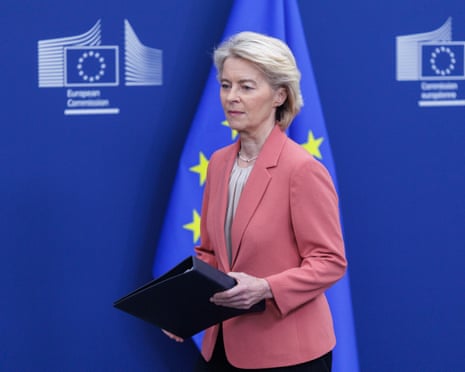
After consultation with member states she has decided to go ahead with provisionally applying the constested Mercosur trade deal with a group of South American countries after two of them, Uruquay and Argentina, ratified the deal at their end.
It was a bold move by the commission president on a deal that was approved by 21 of 27 member states but was effectively paused by a majority of MEPs in the European Parliament who voted it to send it to the European court of justice.
The commission’s trade spokesperson Olof Gill confirmed that the move now set up a process that could take around two months which would open the preferential trade deal.
According to the rules, the two sides must exchange “notes verbales”, an unsigned formal diplomatic communication, to say they agree to trade under the deal.
Then provisional application of the Mercosur deal would start on the first day of the second month following of the exchange of diplomatic notes. So if the notes were exchanged next week, the deal could go into provisional operation in May.
Zelenskyy moves to engage with Fico instead of Orbán - snap analysis

Jakub Krupa
Zelenskyy’s move of inviting Slovakia’s Fico to Ukraine will likely be seen as an attempt to de-escalate the issue while isolating Hungary’s Orbán as he faces a difficult parliamentary campaign.
As Orbán has been ramping up the use of fiercely anti-Ukrainian rhetoric – to the point of putting Zelenskyy on some AI-generated election posters and claiming that Ukraine could actively seek to harm Hungarian energy grid – it is almost certain to be easier for Ukraine to engage with the Slovak prime minister instead.
Let’s keep an eye on what comes out of that – and Fico will no doubt tell us what he thinks about all of this soon, as he is not usually one to hold back.
Zelenskyy invites Slovakia's Fico to discuss 'all existing issues'
In an almost immediate response, we are hearing from the Ukrainian president Zelenskyy’s office that he is now holding a phone call with Slovakia’s Fico.
He has invited Fico to Ukraine to “discuss all existing issues,” Zelenskyy’s office said, as reported by Reuters.
Hungary's Orbán teams up with Slovakia's Fico to put pressure on Ukraine over Druzhba pipeline
Back to Druzbha pipeline, Hungary’s Viktor Orbán has just announced that he spoke with the Slovak prime minister, Robert Fico, and the pair agreed to form “a joint investigative committee” to “clarify” the contested condition of the pipeline.
In a clip on social media, he said that both countries were affected by what he called “an oil blockade” by Ukraine, a claim contested by both Ukraine and the EU.
He also repeated his claim that Kyiv’s explanations that the pipeline is not operational due to Russian damage was “not true,” and alleged that it “has been shut down exclusively for political reasons.”
He urged Zelenskyy to allow the inspectors to access the pipeline for further inspections.
Remember: the spat with Ukraine comes amid a difficult electoral campaign for Orbán, who is at risk of being ousted after 16 years in power in the upcoming parliamentary vote in April.
France 'regrets' EU move to provisionally apply Mercosur deal
Meanwhile, we are getting first reactions from EU member states to the provisional application of the Mercosur deal, and France – which led the opposition to the agreement – is deeply unhappy.
“It is a decision that I regret,” French agriculture minister Annie Genevard told reporters at the Salon de l’Agriculture following EU chief Ursula von der Leyen’s announcement.
“It is not in line with the respect that should have been shown for the European Parliament’s decision.”
She denounced the provisional application as “very damaging to the functioning of our institutions and, above all, to the spirit of our European institutions,” AFP reported.
EU says Orbán’s proposal for joint inspection of Druzbha pipeline is 'welcome step' to de-escalate tensions over oil flows
The European Commission got also asked about Viktor Orbán’s latest plan to inspect the Druzhba pipeline for damage as he continues to question the Ukrainian explanation on why oil transit to Hungary and Slovakia is disrupted (10:21, Europe Live yesterday).
An EU spokesperson said it was “a welcome step,” and the bloc is “in contact with the Ukrainian authorities on this matter” to see how to take this forward.
However, they also stressed that they remain strongly of the view that the disruption was caused by Russian attacks on Ukrainian and European energy security.