3 months ago
42
3 months ago
42
There are few experiences on the professional tennis circuit more uncomfortable than being Alexander Bublik’s opponent. The task of deciphering one of the more talented and unpredictable players is challenging enough, but there is also a risk of being on the receiving end of a few stinging insults.
Over the years, Bublik has become notorious among Russian-speaking fans for his scathing rants about his rivals. There have been times when he has loudly wondered, to nobody in particular, how on earth his opponent could be ranked as highly as they were and others when he has focused on viciously skewering their games. He has also reserved plenty of scorn for himself and the sport as a whole.
Bublik’s foul mouth has become a source of much discussion over his career. Some people believe his candour is refreshing, particularly compared to his more closed-off colleagues, while others find his attitude abhorrent. This subject elicits little more than a shrug from Bublik: “I think emotions are emotions,” Bublik says. “I guess it’s just we live in a world where everyone tries to fake and I think there’s nothing wrong in just releasing your emotions in a way because it’s a stressful sport. We travel a lot, we play a lot, there’s a lot of things on the line so occasionally, if you release it, I guess there’s nothing wrong with that.”
Another shrug follows as Bublik considers whether tennis players are generally dishonest in how they present themselves in public: “I guess the entire social media is fake, so I guess all the people who are there pretending to be someone they’re not. I guess it’s fake,” he says.
Either way, the past 12 months have given Bublik fewer reasons to curse either his adversaries or himself. This has been, by some distance, the best year of the Russian-born Kazakhstani player’s career. This time last year, Bublik had fallen out of the top 80 and his dire form meant he had to take the disheartening step of dropping back down to the ATP Challenger circuit.
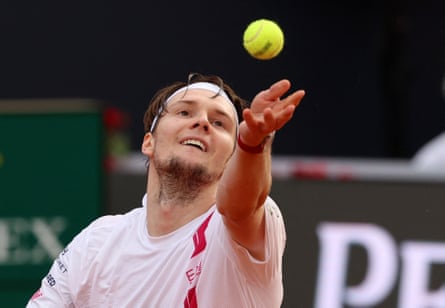
Bublik had already been widely considered an underachiever in his career, but this was a new, desperate low. His struggles forced him to make changes: “No one wants to be 80 in the world,” he says. “It’s a little step in my career. I’ve never been there. I guess I was out of the top 50 for the first time in seven years. So for me, it was a hit.”
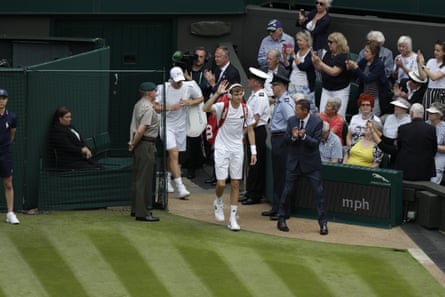
Bublik spent much of his 20s declaring his lack of interest in anything related to tennis outside making money. He did not apologise for his relative lack of commitment to the sport, from his poor diet to a lack of consistency on the court. A pertinent example of his questionable professionalism came early in his career, the first time he competed at Wimbledon in 2017. After reaching the main draw as a lucky loser, Bublik headed back to St Petersburg and spent his days hanging out in the city. He returned to London only a day before his first round match against Andy Murray, the world No 1 and defending champion, naturally losing in straight sets.
It is a reflection of his enviable talent that, after years of not fully committing to his tennis, his transformation was so quick. Bublik ended the clay-court season last year by defeating Alex de Minaur and Jack Draper, ranked No 9 and No 5, en-route to his first grand slam quarter-final at the French Open. In his next tournament, Bublik toppled the No 1 Jannik Sinner on the way to winning the ATP 500 title in Halle. Having won five titles over the past year, the 28-year-old broke into the top 10 for the first time in his career in January. He now sits at No 11.
Reaching the top 10 is impressive, but as underlined by Sunday’s 4-6, 6-3, 7-5 defeat to the 19th seed Learner Tien in the third round at the Italian Open, it is far tougher to maintain that status week in, week out. The top players have targets on their backs and it is far easier to swing freely with nothing to lose. Bublik will have a significant amount of points to defend over the coming months, starting with his return to Roland Garros one year on from the most beautiful moment of his career. His handling of these new experiences will say plenty about him.
The one thing that has not changed with Bublik is his willingness to speak his mind. In a recent interview with Bounces, Bublik spoke disdainfully about his doubles specialist colleagues on the tour. The question of why he does not view doubles specialists as real tennis players leads to another scathing retort: “Because they’re doubles players,” he says. “It’s not tennis. It’s half tennis. If you can’t play singles, you play doubles. If you can’t play doubles, you play padel. Very simple.”
While most millionaire players are hesitant to speak about their earnings, money is another subject that Bublik often speaks freely on. During the earlier years of his career, Bublik knew he was not capable of competing for the biggest trophies, but that he could certainly make himself a wealthy person who could then invest in his career.
“I think you realise that quickly once you start making your first money playing tennis that it’s a big business,” he says. “It’s nice to win trophies, it’s nice to be playing in a beautiful arena, it’s all nice but at the end of the day you got to pay yourself and I think that was the very first motivation that I had when I became a professional tennis player.”
That motivation has changed. Bublik found himself on the right path because he finally understood that success meant viewing his career as work, and therefore applying himself to his work every day. In the process, something surprising occurred; having spent most of his 20s expressing his hatred of tennis to anyone who would listen, he actually came to find enjoyment and meaning in his chosen sport. The next challenge is maintaining the standards he has set despite the added pressure that comes with the new, great heights he has reached.