3 months ago
88
3 months ago
88
In one room of London’s Palestine House, a large screen plays looped news footage from southern Lebanon. Tanks and armoured vehicles plough their way through a rural landscape of hills and villages, amid frequent interruptions of mortar fire. As a person turns away from the screen, she says that “it’s like watching the news now”.
For all its similarities to current events, the archival video actually dates from 2000 – the year of Israel’s withdrawal from the region, following an 18-year-long military occupation. Another corner of the room plays host to broadsheet pages from newspapers of the time, including a front-page report from the Guardian’s then Middle East correspondent, Suzanne Goldenberg.
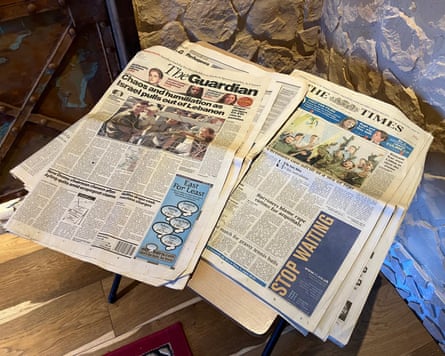
The exhibition, entitled Forget Me Not: South Lebanon in Memory and Motion, took place earlier this month, as this largely rural part of the Levant became a front in the US and Israeli war against Iran. Since then, Israeli tanks have returned to the beaten track in Lebanon – this time heading in the opposite direction, further into the beleaguered Arab country causing one in five residents to flee.
For co-curators Rasha Kotaiche and Ali Abou Khalil, who both have roots in southern Lebanon, the cycles of violence have prompted a need to retell the region’s history, although the project itself has been years in the making. Kotaiche says: “What was initially meant to be exhibited in 2020 came to life six years later with more depth and meaning.” The first iteration of Forget Me Not emerged as a film (which played on the opening night) in which Kotaiche used 30 years of footage to explore the impact of migration on her family as they moved from Lebanon to the UK via Kuwait.
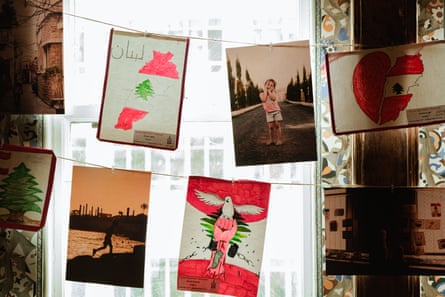
Diaspora is but one of the themes that Forget Me Not explored through its collection of photographs and audiovisual material, alongside displays dedicated to future generations and the land itself. In another room of the exhibit, windows were covered with drawings made by Lebanese schoolchildren in celebration of the nation’s independence day.
As Abou Khalil explains, Lebanon’s south – simply referred to in Arabic as “the south”, or al-Jnoub – holds particular significance in the history of the wider region. “The south has long been shaped by foreign intervention, occupation and deliberate neglect – producing a political culture rooted in self-reliance, resistance and deep mistrust of external authority.”
It is a culture that predates Lebanon’s independence from France in 1943, when “political and economic investment was concentrated in Beirut and Mount Lebanon, while the south was underdeveloped and treated almost as a rural buffer zone”. Its agricultural traditions, negatively impacted by state policies and Israeli raids against Palestinian guerrilla fighters based in the area, provided fertile ground for peasant revolts and support for radical organisations such as the Lebanese Communist party.
In that sense, Kotaiche acknowledges that Forget Me Not has taken on the task of “educating the community on Lebanon – its history, its beauty and its resilience – and in a way, reclaiming a mainstream narrative on south Lebanon and exchanging it with one written by its people.”
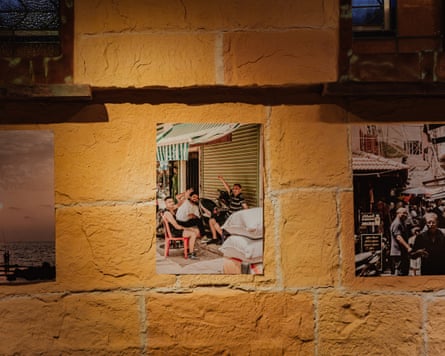
An example of that is Nor Nsralla’s video testimonial, entitled What Remains, which features residents of the south who experienced Israel’s last invasion in October 2024. One interviewee describes how “we are attached to this land just like a tree is rooted in its soil”. The exhibition’s framed images of this land – some of pomegranates and oranges in Bint Jbeil, others of the stony interior and the coastal shores of Naqoura and Tyre – are never far from sight or the popular memory of southerners.
That memory extends to previous large-scale Israeli invasions in the 1970s and 80s. Abou Khalil says: “Lebanese state institutions and the army proved incapable – and at times unwilling – of protecting the south. Southerners found themselves exposed to both Israeli aggression and the consequences of regional conflicts fought from their land, without any meaningful state protection. This absence of the state produced radicalisation, but also organisation – ultimately leading to the creation of Hezbollah in 1982.”
After the signing of a ceasefire agreement between Israel and Lebanon in November 2024, attempts were made for a withdrawal of warring parties from the region. The following January saw the election of General Joseph Aoun to the presidency, raising hopes that the Lebanese state might take responsibility for the south, but it “failed to materialise”. Instead, UN peacekeepers reported multiple ceasefire violations in the months that followed, mostly by Israeli forces, and southern Lebanon remained exposed to the consequences of future conflicts.
As diplomats and politicians tussle over a tentative ceasefire deal, Abou Khalil says that “today, the mood has shifted from tension to alarm”.
“Elsewhere in the country, the picture looks starkly different. Large parts of Lebanon function as if the war were distant. This divergence reflects a deeper issue: borders are perceived differently within the same country. For southerners, the border is literal and existential.”