3 months ago
63
3 months ago
63
On the evening of 29 December 2011, off‑duty Chicago police officer Clifton Lewis sat behind the counter of the M&M Quick Foods convenience store, working a second job as a security guard. He’d proposed to his girlfriend on Christmas Day and the extra income from M&M would help pay for the wedding.
His fiance, Latrice Tucker, chafed at all his side jobs, which also included a security gig at Walmart. She had scheduled an appointment to tour a potential wedding venue that afternoon, but Lewis kissed her on the cheek and told her he was running late for work. They’d reschedule.
The M&M – with its bright yellow sign – was in the Austin section of the city and one of the few places to buy food in the neighbourhood. Manufacturing plants had packed up and shipped off, leaving the mostly Black residents of Austin in a place where guns were more readily available than jobs. A gang called the Four Corner Hustlers controlled the streets surrounding the store.
Just three weeks earlier, another off-duty police officer had been at the M&M buying lottery tickets when two would-be burglars entered. The officer, Craig Williams, drew his weapon and fired. The two men fled on foot. The store’s owner decided he needed a security guard and offered the position to Williams. But Williams couldn’t cover every evening.
Lewis lived and worked in Austin. Standing 6ft 6in tall, colleagues called him a gentle giant – the officer who’d bring a sweater for a shivering young woman in a holding cell at a police station. If Williams couldn’t work, Lewis would fill in.
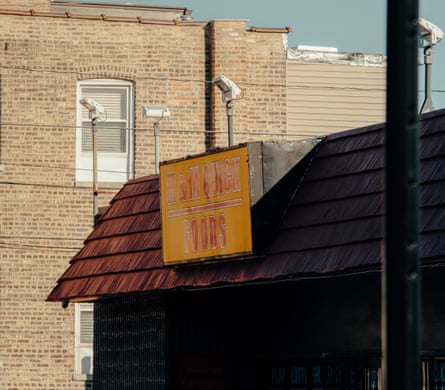
Which is how Lewis found himself perched on a stool behind the counter, watching the store owner count out his takings when the glass doors swung open at 8.32pm.
Surveillance cameras captured two masked men as they entered. Lewis drew his weapon.
“Chicago police!” he yelled.
One of the masked men placed his hand on the counter and vaulted over. He fired at Lewis, grabbed the officer’s gun, his police star, a fistful of cash, then fled.
“He didn’t stand a chance,” Chicago police superintendent Garry McCarthy said the next day as he announced Lewis’s death at a press conference.
Police set up a tip line. A $10,000 reward was offered. CPD brass issued an order that neighbourhood gang crimes officers “work ONLY this case … Let’s go get these cowards!!!”
After a few days police received a tip that a street gang called the Spanish Cobras had killed Lewis. Officers ran with it, arresting more than 100 Cobras, and interrogating them about the crime.
A week later, three men sat in CPD interrogation rooms making the same claim one by one: Spanish Cobra Alex Villa was the man seen jumping over the counter, killing Lewis. And each of them had helped.
Police knew Villa well. He’d joined the Cobras at age 13 and they’d arrested him more than 20 times but the charges had never stuck.
This time, though, they had recorded confessions to implicate him. But in the case of one suspect, Melvin DeYoung, detectives didn’t turn off the cameras after he’d repeated the same story as all the others. DeYoung noticed, then turned to the camera and whispered, “It was a lie.”
The Lewis murder would spawn a 12-year legal saga that would ensnare three men in a battle against alleged police misconduct, and raise questions about the prosecution and the analysis of digital forensic evidence – a cornerstone in many criminal trials over the last two decades. But this isn’t just another wrongful conviction story. It’s the story of what happens when the institutions we depend on fail.
Lewis died in 2011, yet the investigation into his murder foreshadowed Trump’s America.
The case shows that grave injustices don’t always need grand plans. Sometimes they need nothing more than tiny decisions, and to treat safeguards as constraints rather than protections.
Yet it’s also the story of what happens when people who do care about justice fight back.
When Chicago defence attorney Jennifer Blagg agreed to meet with Villa’s sisters in March 2020, she had no idea she’d be torpedoing her life as she knew it. Marisol, a probation officer, and Melissa, a dental assistant, explained that their brother had been convicted of murdering Officer Lewis a year earlier. The sisters had no illusions that their brother was perfect. In 2012, he had killed someone in a hit-and-run. They knew he belonged to the Spanish Cobras gang. In the Hermosa neighbourhood where they’d grown up, gang membership is often more of an assumption than a choice.
Their father had been in a gang. Their uncles, cousins, too. Villa was 10 years old when he saw his older brother, Steven, wounded in a shooting.
Though they knew it sounded crazy to people outside the neighbourhood, the sisters had long worried that police were after Villa, pressuring his fellow Cobras to turn him in. Six months before his arrest in the Lewis case, Villa and a friend had caught a late-night showing of The Hangover Part III in a nearby suburb. After the credits rolled, they headed back to their car. But Villa never made it. Four men jumped him in the stairwell of the parking garage, one striking him with a golf club and another slashing him with a blade. His friend wasn’t attacked.
“So there was, like, a bunch of guys that had attacked him who knew his location, which is odd,” Melissa says. “Who would have known that information?”

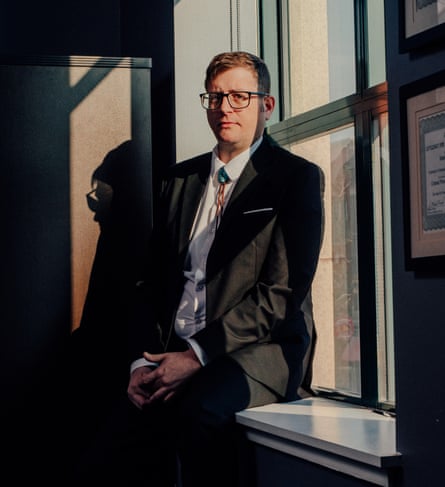
They had no way of proving their hunch, so they decided to stick to the facts when talking to Blagg about Villa’s case.
Marisol and Melissa told Blagg they’d identified gaping holes in the case against their brother. Without a new trial, he’d spend the rest of life behind bars. His two children, Liani, 15, and Damien, 10, wouldn’t know their dad beyond prison walls.
Blagg, a petite woman with a drawl that reveals her deep south upbringing, had heard cries of innocence from more families than she could count.
“What makes him innocent?” she asked them.
Marisol and Melissa told her a few key details: the man in the surveillance video of Lewis’s murder used his left hand to vault himself over the counter. Villa had been shot in his left hand six months earlier.
The sisters argued that Alex couldn’t even hold a spoon properly, much less lift himself over the counter the way the killer had.
Then, there was an issue with the shooter’s other hand. On surveillance tape, they say, it didn’t appear to have a tattoo on. Villa had got a big, dark tattoo on the back of his right hand long before the murder.
After Marisol and Melissa listed their evidence, they waited for what they figured was an inevitable no.
They had already asked no fewer than 10 attorneys to take on their brother’s appeal. But as soon as they said the words “cop” and “murder”, the attorneys politely declined.
However, Blagg made a mental note of the evidence about Villa’s hands. It seemed like a good starting point. There was something else that captured her interest. “Whenever there’s a cop murder, there’s shenanigans,” she said.
After the sisters said their goodbyes, Blagg called her firm’s only other employee, her associate attorney, Eric Bisby.
Blagg told him about Villa.
No, he told her. Absolutely not. The case would be too much work for two people.
“I might have already said we would,” Blagg said.
Against his better judgment, Bisby soon found himself on Blagg’s porch, staring down a stack of five bankers’ boxes jammed with CD-Roms, court transcripts and photographs. Bisby had joined Blagg’s firm as an intern. His dad had worked as an electrical engineer for Nasa and Bisby had inherited his analytical mind. Bisby was the kind of thinker who could spot logical flaws in arguments when evaluating cases.
He carefully read through Villa’s trial transcripts and didn’t see any. Three independent witnesses had taken the stand to testify that Villa had confessed to killing Lewis.
Worse, police records showed that Villa’s alleged accomplices had given detailed confessions that corroborated each other’s stories.
The case seemed straightforward. Villa was guilty. And Blagg had lost her mind.
But Blagg knew that this was Chicago, the false confession capital of the country. And that just because it was a confession didn’t make it the truth.
Blagg and Bisby didn’t need a history lesson about the dark chapters in CPD history. Above her desk, Blagg had hung framed photos and newspaper clippings of clients she’d helped exonerate based on coercive police tactics.
In the same interrogation rooms where detectives questioned Villa, dozens of people in the late 1980s through the early 2000s say they falsely confessed to murder after being beaten and threatened by CPD detective Reynaldo Guevara. Three of them were sent to death row but the state outlawed capital punishment before they could be executed.
With this history in mind, Blagg pressed play on Villa’s recorded confession. His face looked scratched. He said he had been dragged across the carpet when police busted through an apartment door to arrest him. He kept grabbing his ribs and coughing up blood. His left hand, the one the bullet had torn through six months earlier, looked swollen.
“I feel physical pain watching those interrogations,” Blagg says.
Villa would go on to deny killing Lewis roughly 200 times over the course of 48 hours. Without a confession, police had to let him go.
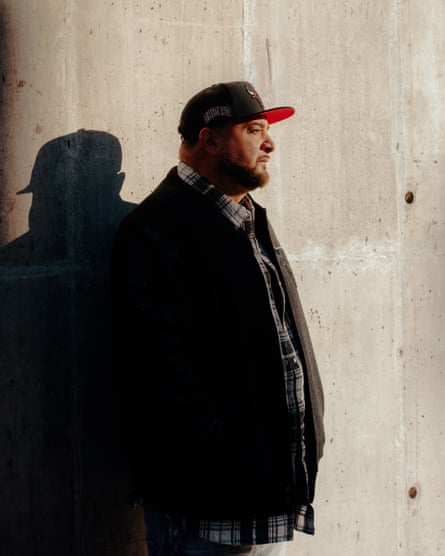
One of Villa’s fellow Spanish Cobras wasn’t as lucky. Thirty-four-year-old Edgardo Colon, who Villa hardly knew, described what happened when two detectives walked into the interrogation room. Colon says they started “feeding me a story, telling me, ‘We know you guys did this and that.’ And for the first 24 hours or more, it was just, like, No, no, no, I have nothing to do with that.”
Colon claimed that as the hours passed, with no food and little sleep, detectives threatened his family, telling him they could have his one-year-old daughter removed by social services or his mother’s government‑subsidised housing taken away. Colon’s mother had early-onset dementia.
“Some people say, ‘Why would somebody confess to something that they didn’t do?’” he said. “They have never been under pressure the way that I was.”
After 56 hours – eight hours after he would have been released had a judge not signed an extension – Colon cracked. He’d do anything or say anything to get out of that cramped room.
“I didn’t want to die in there,” he says.
He tried confessing but he couldn’t get the details right. He told police that DeYoung, who was Black, robbed the store with another suspect, Tyrone Clay, who was also Black. The man seen jumping over the counter on the surveillance tape had lighter skin than both Clay and DeYoung. Colon started having second thoughts.
“I asked for a lawyer and they brought me a hamburger,” he says. Nerves roiled his stomach. Colon vomited the burger. He felt his heart racing, his chest tightening. He claims police coached him on all the details until he got the story straight. Then detectives hit the record button.
According to court records in a civil case, lawyers for the detectives denied that they threatened or abused Colon and Villa.
Next, Blagg viewed the confession of Tyrone Clay. Villa had told her he was close with Clay – so close that Villa and his girlfriend were sleeping on Clay’s couch the night police arrested him. While police allegedly dragged Villa along the carpet, Clay said police threatened him. “We’re going to kill you,” he said the officers kept repeating.
Clay said he kept telling officers he could prove exactly where he was on the night of Lewis’s death: playing the video game NBA 2K most of the evening. Just check the PlayStation, he told them.
Nothing in the records Blagg had seen suggested the officer made any immediate attempt to verify Clay’s alibi. Instead, he sat in the interrogation room and, roughly 21 hours after his arrest, Clay started to repeat the story he later said detectives fed him.
Of all the men hauled into the station and questioned about Lewis’s murder, no one was faring worse than DeYoung, practically a big brother to Villa and the man Colon first tried to point to as the shooter.
Bisby had told Blagg about the end of DeYoung’s tape, when he looked into the camera and said, “It was a lie.” But as Blagg watched the interrogation video, that wasn’t the only shocking detail. DeYoung had type 1 diabetes that required no fewer than five insulin shots a day, yet he was locked in the interrogation room, hour after hour, with no insulin. Missing those doses could lead to a diabetic coma. Or death.
DeYoung asked a detective who entered the room if his wife could bring his medication, but he says the detective shook him off. “My blood sugar had gone way, way up, to the point my vision was blurry. My tongue felt like a piece of cardboard,” DeYoung says. “I felt my cheekbones sink in. I’m like, man, what are they trying to do? Kill me in here?”
Over the course of his 48-hour interrogation, detective James Gilger took DeYoung to the hospital on three separate occasions for insulin injections. Finally, DeYoung told police the story he says they wanted to hear: Villa was the killer. With those words, police charged DeYoung over some weed they’d found in his home during the arrest. For reasons he still doesn’t fully understand, police sent him home.
Blagg had checked the names of the detectives in the interrogation videos. The lead detective who questioned Clay and Villa was a car salesman turned police officer named Anthony Noradin. In 2005, Noradin investigated the death of a four-year-old boy. The boy’s mother claimed in court that Noradin coerced her into a false confession. She spent more than seven years in prison for killing her son, before her conviction was overturned on other grounds and a court deemed her innocent. A federal jury later found no misconduct by the officers.
In civil court filings, lawyers for Noradin and others denied officers did anything wrong and the case was dismissed.
Detective Gilger had failed to adequately investigate a killing in which the nephew of a former mayor was the prime suspect. The city’s inspector general recommended that Gilger be fired but he retired before that could happen. (Gilger declined to comment for this piece.)
These detectives worked under the supervision of sergeant Sam Cirone. An inspector general had found that Cirone had used a personal email address in 2011 to edit a police report in the case involving the mayor’s nephew. A police oversight board found unanimously that Cirone failed to adequately supervise his subordinates. The board issued him a reprimand, but it didn’t even cost him a day of vacation.
(The Chicago police department declined to make a representative available for an interview. Noradin, Cirone and their lawyers did not respond to repeated messages and a detailed list of questions from the Guardian. In civil court documents, lawyers for the officers denied any wrongdoing.)
Blagg knew that none of these past allegations of misconduct proved Villa’s innocence but they did raise questions about the actions not only of the detectives themselves, but also of the agencies charged with police oversight.
In Chicago, just 8% of all complaints filed by residents from 1988 to 2023 – from a quarter of a million complaints in total – resulted in discipline. “The Chicago police department does not want to change,” Blagg says. “They don’t want oversight. They think that putting the bad people away, it doesn’t matter how you do it, as long as you put them away.”
By the end of reviewing the videotapes Blagg and Bisby noticed a pattern in the way that statements Colon, Clay and DeYoung had given against Villa had morphed over time until they matched each other and the facts.
There was no physical evidence. No real motive.
But no matter how questionable she found the police interrogations, she couldn’t blame them for the decision to charge the men. That was the responsibility of the prosecutors.
When Villa’s sisters met with Blagg, they told her they didn’t like the prosecutors in the case, Nancy Adduci and Andy Varga. But Blagg did. She considered them friends. So much so that when she and Bisby finished going through all the boxes of materials from Villa’s case and noticed missing files and records relating to the suspects’ cellphone data, Blagg didn’t assume any malfeasance. She shot off an email asking for them.
Blagg knew there were two sacred tenets in the criminal court system. One, that prosecutors are supposed to seek justice, not convictions, even if that meant pushing back on police when evidence seemed lacking, dubious or the product of coercion. Two, that prosecutors must turn over any and all evidence helpful to the defendant. The principle, codified in a supreme court decision called “Brady” in legal shorthand, is so central to the American court system that withholding exculpatory evidence is grounds for a case to be tossed out.
Varga, a seasoned prosecutor who headed up complex criminal cases for the Cook County state’s attorney’s office, which includes Chicago, would have known this. So would Adduci.
“I’ve searched my emails every way I can imagine,” Varga wrote back to Blagg. He couldn’t find much of the evidence she requested.
Blagg and Bisby hit a dead end.
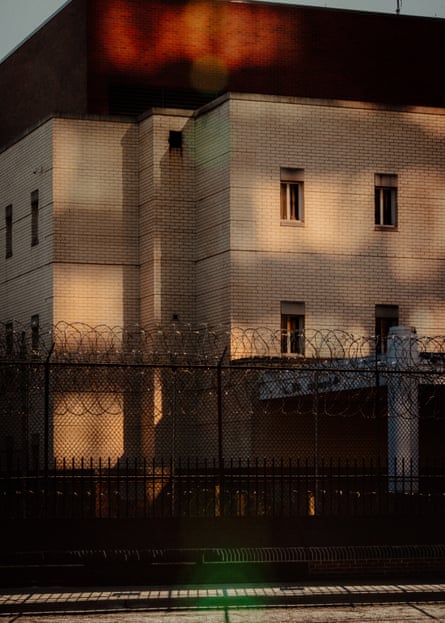
The attorneys seemed to be hitting a lot of them as weeks turned into months. So many basic documents were missing from the troves of paperwork they’d received from Villa’s previous attorney.
Blagg sent off a subpoena for the FBI’s cellphone analysis, which police had briefly mentioned in a report. Then she used the state’s open record laws to track down documents. She started small, asking for records containing the phrase “Alexander Villa”. Then “Alex Villa”. Then simply “Villa”.
Millions of records came back, including scores of emails from officers booking villas in vacation spots around the globe. Picking through the documents felt endless and, at times, pointless.
Then, one day as she worked in her office, she heard Bisby, who was working from Blagg’s living room, shout, “Oh my God!”
Bisby flipped his computer screen to show her an email chain sent by a senior officer in the gang investigations division to other officers the morning after Villa’s stabbing outside the movie theatre.
“Merely an FYI, but a 25th district copper was telling me that Flip [a nickname for Villa] got stabbed at the [movie theatre] in Rosemont last night. Not gonna croak though …”
Another officer replies: “I believe Operation Snake Doctor and 6580 has to take credit for this.”
Operation Snake Doctor. Blagg and Bisby had come across it as they worked their way through the case files. It appeared to be a police operation targeting Spanish Cobras in the neighbourhood shortly after Lewis’s death and until Villa’s arrest nearly two years later, in 2013. The so-called operation explained why 100 Cobras had been arrested in the days after Lewis’s murder. Some of those arrested had reached out to Villa warning that cops were asking about him.
Blagg took a second to be sure what she’d read. While there was no proof that police had tipped off Villa’s attackers about his location, it did indicate they had been closely monitoring him long before his arrest and seemed to have celebrated the attack on him.
While searching for leads among Villa’s associates in the months after Lewis’s death, police found three people who said Villa had told them he killed Lewis. Two of the witnesses faced criminal charges when they gave their statements, potentially providing them with an incentive to work with law enforcement to cut a deal in exchange for leniency in their own cases. But the third, Destiny Rodriguez, baffled Blagg and Bisby. She grew up in the suburbs and had a respectable job as an insurance broker. She testified that hours after Lewis’s death she was at a nightclub with her boyfriend when she overheard Villa lean over to her boyfriend and admit to shooting a cop.
This last witness may have been the one to seal Villa’s conviction. Blagg and Bisby couldn’t find any reason for her to come forward. She didn’t have any pending charges they could find or any other clear motive.
While working on this piece, I uncovered documents showing that police in the suburb of Franklin Park discovered drugs and ammunition in her apartment. A day later, accompanied by a Franklin Park police officer, Rodriguez met with the police to provide her statement. She never faced charges for the drugs or ammunition. Rodriguez did not respond when asked to comment for this piece. The boyfriend to whom Villa allegedly confessed told me that he can’t say whether Villa is innocent or not, but he can say that Villa never confessed to him.
Evaluating witnesses’ credibility fell to the prosecutors, as did revealing to the defence side any deals they may have received in exchange for their testimony. Even with the witnesses facing legal troubles of their own, prosecutors forged ahead, using their testimony in Villa’s trial.
As Blagg discovered more red flags in the case, she devised more aggressive subpoenas and records requests. She asked the police department for the metadata from the police reports in the case. The metadata could tell her when, why and by whom important reports had been accessed.
It turned out Villa’s arrest report had been changed. An arresting officer described difficulty in handcuffing Villa because his hand is “somewhat deformed and not functioning properly”. The final report had been changed to say only that Villa’s hand looked “abnormal”.
This wasn’t some semantic change. Villa’s original attorney argued at trial that his client’s injured hand made it impossible for him to have propelled himself over the M&M counter like the killer did. An arrest report describing Villa’s hand as deformed and “not functioning properly” would have bolstered that defence. Then Blagg saw who, according to the metadata, edited the report: her friend, Nancy Adduci.
Prosecutors are supposed to present evidence. Not edit it in ways that might be damaging to the accused. Blagg figured the prosecutors knew this on some level when she found yet another bombshell: emails showing Varga, Adduci, Cirone and some of the detectives on the case communicated via their personal email addresses. That might seem like an administrative error but it could also keep evidence out of the hands of defence attorneys.
“My naive ass thought these people were my friends,” Blagg said.
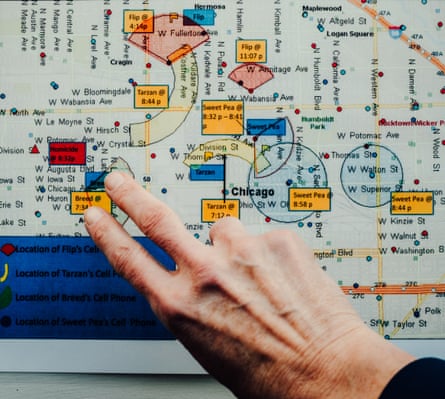
Blagg also received a response to her subpoena for the FBI. It included a cellphone map that showed the men – or at least their phones – were never together. A breakdown of the call logs indicated that none of them spoke to each other at any point that day. Or, in the case of Colon, any time that year. One of the dots placed Colon’s phone nearly three miles away from the murder scene minutes before Lewis was gunned down. Then Blagg saw the date of the cellphone analysis: 6 January 2012. Another document showed the FBI presented its analysis to police immediately. On that same day, Villa, Colon and Clay were in police custody, proclaiming their innocence. Had Varga or Adduci presented this evidence to Villa’s original lawyer? Did the prosecutors overlook the evidence? Or worse, did they hide it?
Lawyers for the defence side asked Adduci and Varga about it in September 2022 during a regularly scheduled court hearing. Adduci told the judge she never received that 2012 cellphone map from the police. She then said she knew about the map but didn’t think it would be allowed into evidence or proved much of anything. Varga jumped into the fray, arguing that the map was mentioned in an old police report; the defence could have used that information and requested the map themselves but they didn’t.
The prosecution had a responsibility to turn over the map, full stop, the defence side argued. And they didn’t turn it over.
Adduci, Varga and their lawyers did not respond to multiple interview requests. Both have denied any wrongdoing in federal civil court documents. The Cook County state’s attorney’s office that employed Adduci and Varga declined to comment but in court documents filed in August 2023, argued that there was no evidence the prosecutors acted in bad faith.
While Blagg dug through stacks of emails and cellphone data, Bisby noticed another digital evidence trail didn’t seem to go anywhere: the PlayStation Villa’s co-defendant Clay said he’d been playing at the time of Lewis’s murder.
The prosecution put it to Villa’s jury that Clay, DeYoung, Colon and Villa piled into a car and headed to the M&M. But what if the PlayStation proved that Clay wasn’t there?
“Proof that Clay didn’t do it was 100% proof that Villa didn’t do it,” Bisby says.

The Chicago police had sent Clay’s PlayStation to the Regional Computer Forensic Laboratory (RCFL) – one of 17 FBI-operated labs across the country dedicated to dissecting evidence from the digital realm. Bisby found a video recording of an analyst reviewing the device. His cursor clicked around but the agent scrolled past a folder containing data about when a game was played – the exact information to either substantiate or undermine Clay’s alibi.
“It’s like if you were trying to see if your spouse was cheating on you and you opened their cellphone and went to the text message folder, but didn’t read any of the text messages,” Bisby says.
The case against Clay had hit legal snags, technicalities and delay after delay. By this time he had been sitting in the Cook County jail for 10 years without having been tried, much less convicted. Bisby reached out to Clay’s legal team with an idea: get the PlayStation re-examined.
In spring 2022, prosecution staff wheeled out a special edition Spider-Man PS3 to a conference room. When they hit the power button, the machine made a screeching sound. The smell of burning rubber filled the air. According to the RCFL’s analyst, the PlayStation was broken beyond repair.
Bisby wasn’t so sure. He’d nerded out on YouTube videos of people repairing gaming consoles in worse condition. Bisby Googled until he found an independent repair shop on the city’s Northwest Side, with characters from Super Mario Brothers painted on the storefront windows.
There, a Cuban émigré named Raul Palma had the machine working within an hour and charged Bisby $35 for his work.
Palma found voice messages Clay – or the “realgoonass” as he called himself online – had sent to other players, along with an award he won for his gameplay, around the time Lewis lay dying.
“A local game shop owner fixes it in less than an hour for $35,” Bisby says. “So either the FBI and the RCFL are massively incompetent, or they didn’t want to see what was on there.”
(The RCFL declined to comment for this story.) Blagg and Bisby now had the cellphone maps showing Villa and his co-defendants weren’t near each other the day of the crime, nor had they spoken. They had prosecutors failing to disclose evidence. They had the PlayStation messages. One of those factors alone could be grounds to grant Villa a new trial, if not an outright exoneration.
In June 2023, all the evidence Blagg and Bisby had uncovered led to charges being dropped – just not for their client. Clay, who had never been tried for the crime, walked out of jail after 11 years, five months and 15 days.
Colon – who had been convicted, had his conviction tossed and was awaiting a retrial – cried as the judge finally dismissed the charges. His mother, the one with dementia whom he’d cared for, wasn’t there to see it. She died while he was in prison, and the baby daughter he’d left behind was now in middle school.
For various reasons, Villa still hadn’t been sentenced. Day after day, he sat in the Cook County jail.
His sisters and children paid regular visits. His son, Damien, had gone from learning his alphabet with his father behind bars to asking him for dating advice as he turned 14. During their phone calls, they talked about moving to Florida – far from the grip of the CPD – just as soon as the judge ruled on the new evidence Blagg and Bisby had uncovered.
The judge in Villa’s case, James B Linn, had a reputation as a law-and-order jurist who’d spent much of his career as a prosecutor. In their preliminary hearings, Blagg became convinced Linn had already decided against Villa and filed a petition asking him to step aside. (Linn did not respond to interview requests.)
Blagg’s attempt to remove him from the case was denied. He rejected the cellphone maps, the new evidence, all of it. He ordered everyone back to his courtroom three days later for a sentencing hearing.
The law made it clear: Villa, at age 35, would be sentenced to life in prison. He’d leave prison in a coffin.
Back at the office, Blagg and Bisby surveyed the detritus of their lives. The case had shattered their belief in the legal system they’d dedicated their careers to serving.
Just when it seemed things couldn’t get worse, the phone rang. It was one of Villa’s sisters, with terrible news about Damien.
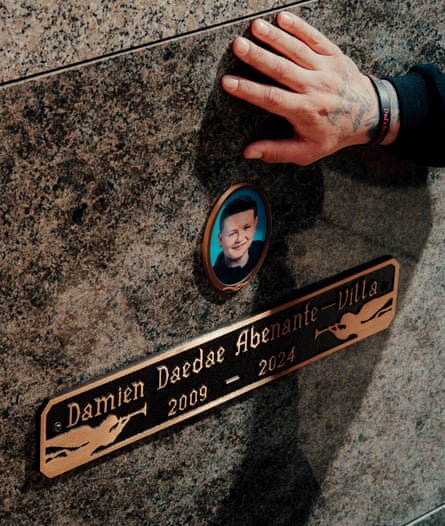
Seven months after Villa had been sentenced to life, Damien went to visit his cousins just over the stateline in Indiana while his mother, Amanda Abenante, worked. Damien and his cousins were walking to the park when a car drove up. Bullets flew. One caught Damien through the chest. He wasn’t even the target. But Damien was dead.
“Our son left us,” Amanda told Villa the next morning when he called.
“Left us?” he asked.
Then sounds of a fight breaking out drowned out the call. Guards demanded Villa get back in his cell. The prison was going on lockdown.
Left us. Villa turned the phrase around in his head while stuck in his cell. Did he hear right? Could it be a mistake? Could Damien still be alive?
The prison denied Villa’s request to attend Damien’s funeral. He watched his son’s burial through a video feed that kept buffering. All the while a question rattled in his head: would his son have ever been in Indiana if Linn had let him go?
By November 2023, Adduci and Varga had been replaced as prosecutors on Villa’s case. One of the prosecutors assigned to close out his case called Blagg. Prosecutors had been packing up the case files when they found a disc. It had a sticky note attached to it with what looked like former prosecutor Varga’s handwriting on it.
“It’s probably nothing,” Blagg remembered the new prosecutor, Kevin Deboni, telling her. Out of an abundance of caution, Deboni was turning it over to her, as required by law.
Blagg and Bisby popped the disc into a computer.
“Are you fucking kidding me that there’s nothing on this disc?” Blagg said she told Deboni after reviewing it.
It contained data from Villa’s phone showing he sent a lengthy text to his girlfriend, Monica, at the time of the Lewis murder. Most important to Villa’s case, the disc had those FBI cellphone maps showing Villa and his co-defendants had never communicated and suggesting none of them were at the crime scene.
Varga – known around the state’s attorney’s office for his love of sticky notes – had left one on the disc. “Raschke for rebuttal,” the note read. FBI agent Joseph Raschke appeared as a cellphone expert in dozens of cases. If Varga planned to use Raschke to rebut the FBI cell map, that meant he had to have seen it. And, if so, that meant he had a legal obligation to turn it over. Blagg now had evidence that could prove Varga had broken that sacred Brady rule. Villa’s case was heading back to court.
Blagg blasted Beyoncé’s Freedom on repeat all the way from her home to the courthouse the morning of 2 October 2024. “I’mma keep running, ’cause a winner don’t quit on themselves,” she sang at the top of her lungs.
Deboni had called her a few days earlier to tell her that prosecutors would be asking the court to overturn Villa’s murder conviction. Four years and thousands of pages of evidence later, Villa was coming home.
His sisters, Marisol and Melissa, along with dozens of supporters, filled the court gallery. Some wore black shirts with Villa’s face silkscreened across the front along with the words “Justice for Alex”.
Finally, the charges against Villa were dismissed. His supporters erupted into cheers. On the courthouse steps Villa and his family gathered around Blagg and Bisby for photos.
“Squeeze in, squeeze in,” they said as cellphone cameras clicked. But the smiles dimmed when members of the police union approached.
“You’re garbage!” John Catanzara, the president of Chicago’s Fraternal Order of Police, yelled at Blagg.
“Just wait, Alex is going back to jail,” someone among the pack of officers said to Villa’s family.
Melissa and Marisol stood shaking their heads as they watched the officers walk away.
“It’s disgusting how they don’t look at themselves and how they failed their own fellow officer,” Marisol says. “You know, I feel sorry for Officer Lewis’s family, right? Tremendous sorry for his family, because unfortunately that person who did it is still out there.”
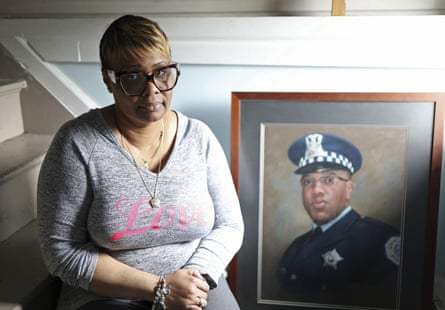
Lewis’s fiance, Tucker, died of breast cancer in 2023.
A year after his release, Villa has managed to get an apartment. “It was hard because I didn’t have two times the rent,” he says.
Next to his couch is a bookcase with totems of Damien. His Beyblades. Drawings Damien sent to the jail. A memorial card from his funeral. A blown-up picture of Villa holding Damien hangs from his dining-room wall.
He’s working as a security guard, and he and Amanda welcomed a baby boy last August. They named him Alex. He looks a lot like the big brother he’ll never know.
Villa says his ordeal has made him grateful for small things. Feeling the breeze on his skin. Trees. Grass. He remembers staring out of the window of his jail cell at a small patch of grass. “I’m more grateful than a person who never went through what I went through,” he said, “because I know what it feels like to have my freedom taken away.” But there’s stress, too. His trips to the gym help him manage his emotions. Recently he was on his way there when a police car pulled up behind him. He saw the blue and red lights on top of the police cruiser. His pulse quickened.
Then the traffic light turned green and Villa drove forward.
Blagg and Bisby are now knee-deep in a civil lawsuit they’ve filed against the police officers, prosecutors and other authorities they say had a hand in Villa’s conviction.
After five years of working his case, Blagg still doesn’t know why Villa landed in the crosshairs of the Lewis investigation. She’s made peace with that. Most days, at least.
“This was a solvable case,” Blagg says.
She has reread police reports with tips coming in the hours after Lewis’s death.
One tip mentioned the Four Corner Hustlers – the gang that controlled the area around the M&M. Eleven months after Lewis’s murder, the police officer’s gun had been found at a home near the M&M – a fact that seemed to support the theory that the Hustlers were involved.
The same tip mentioned the robbery attempt at the minimart three weeks before Lewis’s death. The shooters wanted revenge on the officer who broke up the robbery attempt.
They got the wrong guy, the report read.