3 months ago
85
3 months ago
85
More than two decades ago, the actor Martina Laird took a trip back to her past. As part of the ensemble on the TV drama Casualty, in which she played paramedic Comfort Jones, she was a household face with a rewarding job, yet she felt stuck in her life. “Things weren’t developing,” she remembers. “I went: ‘OK, there’s stuff to go and face in the past.’”
She travelled to St Kitts, where she was born, to look for the Black Caribbean mother from whom she had been separated at the age of three, when her white British father took her to live with his family in Trinidad. “It was a relatively privileged upbringing but there’s always questions. So I went to St Kitts and I met the family that I had not known was there. I thought that I could keep myself shielded and not let people in but that was not the case. It all had to just crack open. Afterwards, the world seemed to me beautifully upside down. Everything I knew to be feared was loved and everything that was down was up.”
Her mother died of pancreatic cancer within a year of that reunion; their second reunion would be the last. “I was able to go and spend a little bit of time with her when she was really ill. One day we were alone for a while and she was able to tell me all about herself.”
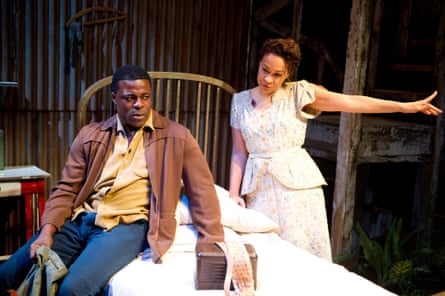
Those trips and conversations led Laird to write her first play, Driftwood, which is set in a gentleman’s club in Port of Spain in 1950s pre-independent Trinidad, and based around a meeting between an estranged son, Diamond, and his indomitable mother, Pearl. It has involved far-reaching research, with every event in the play in some way or other sourced from real life.
Two decades in the making, Driftwood remained in the proverbial bottom drawer for much of that time, partly because the industry saw Laird as an actor, not a writer. “The impostor syndrome is very real,” she reflects. It was only when a friend encouraged her to enter it for the Verity Bargate award for new writing in 2024 that she submitted it, “in the spirit of [receiving] more notes”. She was amazed when she came second out of 1,700 submissions. Now it is being staged by the Royal Shakespeare Company in Stratford-upon-Avon, before travelling to the Kiln theatre in London.
Sitting in the RSC’s London rehearsal studios, Laird is a relaxed presence with a light, Trinidadian lilt to her voice, and looks somewhat surprised still by the turn of events. She was laid up in bed last year in “screaming pain” due to complications from sepsis, when she got a phone call. “It was from Daniel Evans [co-artistic director of the RSC]. He said: ‘We’ve all read your play here and we love it.’”
Acting, for Laird, was an early passion, although she has also written, hitherto always privately, including a road movie called Three Suns to the Horizon and a darkly comic play, Fly Me to the Moon, about women and aggression that was staged in London earlier this year.
She performed as a child in Trinidad but didn’t imagine she would ever make a living from it. “We had some great actors that I grew up watching – I remember Derek Walcott’s plays being done and my parents were part of that world so I saw it all – but any actor had a ‘proper’ job as well, so they were also a teacher or an air steward.”
Laird left the Caribbean at 17 to study French at the University of Kent. “For strategic reasons, I ended up combining it with drama and that was the beginning of the end because that’s all I wanted to do.” She has since performed widely on screen and stage, including with the RSC and at the Donmar, the National Theatre and most recently the Globe in a gender-inverted version of Cymbeline.
Laird’s white Trinidadian family have always been very politically engaged, she reflects. Her father, an architect, was instrumental in his professional guild on the island, and in the 1970s led the call for them to boycott Apartheid-era South Africa. Her brother and brother-in-law have spent years creating cultural archives throughout the region. She felt confident as a mixed-heritage child there, but the shift to how she was perceived in Britain was jarring. “Coming from Trinidad, where the majority looks like me – the global majority – what I realised is that I came with a notion that I was entitled to define myself into a space in which I then found myself excluded or judged or lesser than.”

Laird’s play functions both as a drama about family and a metaphor for the toxic effects of colonial rule. Through each Trinidadian character you see the painful fight for self-determination in the face of British imperialists and American chancers. It captures a nation on the brink of change, too. Eric Williams, Trinidad’s first prime minister who hailed independence in 1962, is an important off-stage presence; his party was formed in 1956 – the year Laird’s play is set. “Anyone who was there at the time will tell you about the energy of optimism that was there. The second world war had blown things apart. Women had worked in factories and were then made to go back into their homes. Black people, the Commonwealth, had fought, and then were sent back with no thanks or rewards. This was now being fed back.”
Culture was essential to the creation of a new Trinidadian identity, she adds. “In those days, the steel bands were real warriors of the streets, and they were being brought into concert halls. Anthems were being written, flags were being designed. Calypso of this era [which features in the play] was very much social commentary. It was about confronting authority – governments and systems, from racism to women’s sexual habits.”
Strikingly, Driftwood is written in patois. Was that about capturing the authentic cadences of Trinidadian speech, or a statement on who it is written for? Laird reflects back on a seminal stage experience. “One of the first roles I got to play, of which I was very proud, was in Moon on a Rainbow Shawl by Errol John, a Trinidadian playwright, at the National Theatre. When I’d read that play as a child at school, I’d thought, ‘That’s just how we talk, what’s so clever about that?’” But going back to it as an adult, she realised that was exactly the point. “You can’t not try to reflect a truth about the language if you want to capture people’s souls. Because in that language and its constructions is the history and the psyche.”
Did she have any apprehension about writing in patois for a UK audience, nonetheless? No, because she wasn’t writing it for the RSC at the beginning, all those years ago when she first put pen to paper. “At that point, I was writing it because I needed to. It was like a crossword puzzle. I needed to get it out and solve it.”