3 months ago
67
3 months ago
67
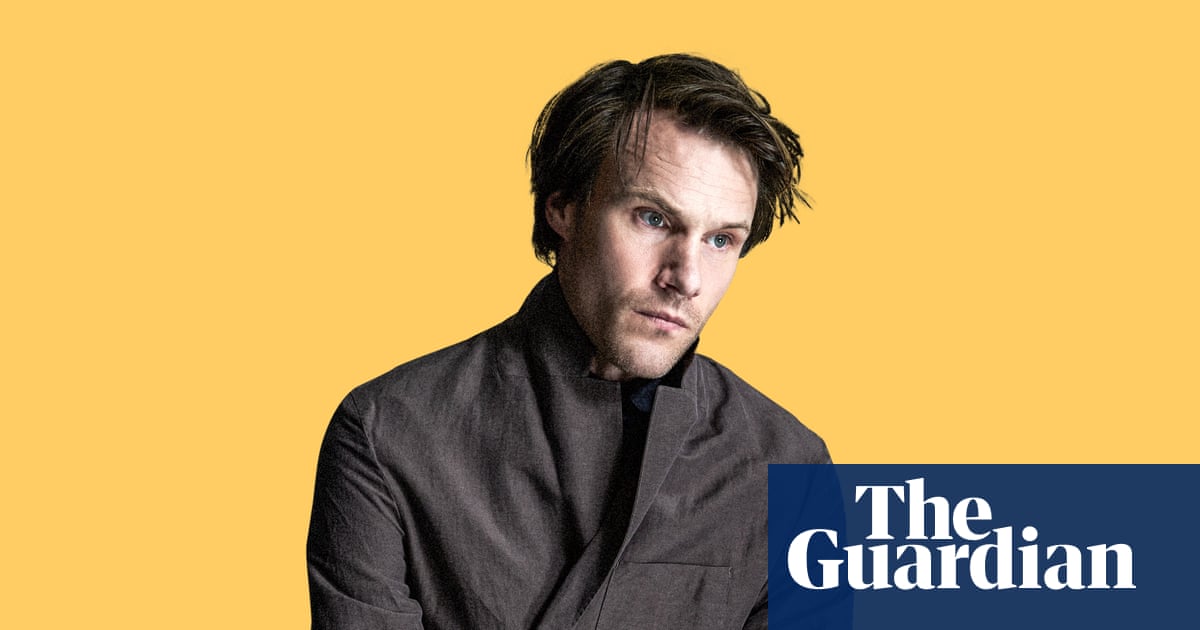
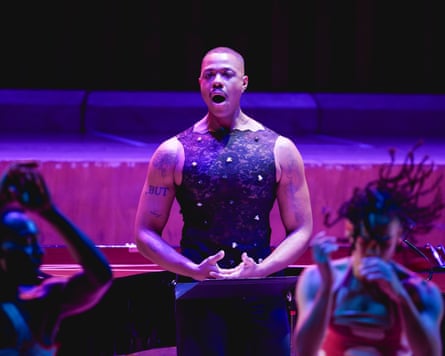
In performance, Davóne Tines is electrifying. In the first concert of the US bass-baritone’s 2025-26 residency at London’s Barbican Centre, he appeared at the back of the auditorium and then slowly descended towards the stage, spotlit and subtly miked. His unaccompanied voice fractured into stentorian booms, spat-out consonants and the violent crackle of mouth noises. This, unmistakably, was the musician whom the New Yorker announced back in 2021 was “changing what it means to be a classical singer”.
Since then, Tines has been named Musical America’s vocalist of the year, he has won a 2024 Chanel next prize for “international contemporary artists who are redefining their disciplines”. And he was awarded the 2025 Harvard arts medal for distinguished alumni of the Ivy League university who have demonstrated achievement in the arts. Recent winners of the latter include architect Frank Gehry and novelist Margaret Atwood. Unlike those cultural figureheads, Tines is not yet 40.
Other singers win major awards, of course, and others explore the technical and aesthetic limits of what is conventionally recognised as “singing”. But few in classical music are as openly determined to range freely across genres and professional activities – or as acutely aware of their own agency. Our video calls are sprinkled with substantial silences as Tines formulates answers delivered in long paragraphs, often presenting densely argued theories about aspects of classical music. It is a rare interviewee who uses words such as “preclusively”, “valences” and “reified” as a matter of course, or who attempts to explain feelings about his own performances in terms of a “quadratic function”. Davóne Tines may have the voice of an opera singer, but he talks like a philosopher.
We first speak as Tines is preparing to appear in a double-bill of works by Kurt Weill and William Grant Still at Detroit Opera. Tines rose to international prominence in the Dutch premiere of Kaija Saariaho’s chamber opera Only the Sound Remains in 2016 and more recently made his Metropolitan Opera debut in a 2024 production of John Adams’s opera El Niño. Yet he also performs spirituals and gospel and is working on a project “for a broader ear” with his band the Truth. His forays into what he calls “capital O opera” are strictly occasional. “For this project [at Detroit Opera] that is about presenting Black American love stories,” he says, “I’ll happily retake the mental baggage.” What keeps him at a distance the rest of the time? “Many cultural artefacts and practices that are upheld by institutions over time tend to be exclusionary because the populations, largely white and predominantly wealthy, have created systems and foundations for propagating their own perspective or interests.”
A few weeks later, I return tentatively to the question of “capital O opera”. Tines has previously said he’d be interested in singing certain bass-baritone roles such as Mozart’s Don Giovanni or even Wagner’s Wotan – is that still the case? “I’m open to all of those possibilities. It’s always been dependent upon context.” There’s a pause. He starts and abandons several sentences before musing: “You know, maybe there can be an assumption that I don’t like the operatic canon?” That is not the issue, he stresses. The problem is that “its supporters and its purveyors don’t continually reassert its value to humanity as a necessary part of storytelling and emotional and cultural social catharsis”. What’s too often missing for Tines in opera and classical music is an investigation into why treasured artworks remain valuable and what they may say today. What he’s not interested in, he concludes with a knowing cackle, is being “slapped into someone’s production of Don Giovanni. I want to understand that text through a very intentional process of evaluation.”
“Intentionality” emerges as a keyword in Tines’s capacious lexicon. When I ask about programming his current Barbican residency, he stresses that exercising his agency as an artist isn’t simply about what or how to sing. “It’s saying, ‘I have an engagement within the larger world and I’m choosing to exist in it in a certain way’.” He identifies two principles underpinning his artistic process: firstly, the fact that “the way something is constructed is as important as what is constructed”. And secondly? “I really do feel that everything is some sort of metaphor for everything else. Like, all ideas are transferable and scalable – and I think that’s why we have art.”
Tines is keen to emphasise that these big, abstract ideas are writ large in his Barbican residency. His first concert focused on works by Julius Eastman – a “Black, gay, triple-threat composer, pianist and singer,” as Tines has described him elsewhere. Like Eastman, Tines is Black, gay and works beyond the conventional boundaries of any single musical metier, billing himself as a “creator and opera singer”. Just as importantly, the performance was an entirely collaborative affair, featuring Tines amid a lineup of musicians and dancers, with the programme curated by Grammy-nominated cellist Seth Parker Woods. As an opening statement, Tines tells me, the concert was about “representing a point of view [and] a way of working”.
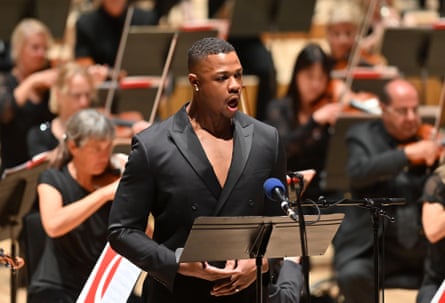
His devised work Concerto No 2: Anthem – the centrepiece of his second residency concert, with the BBC Symphony Orchestra – spotlights even more explicitly his vision for what he calls “lateral” artistic agency. The piece was commissioned by the LA Philharmonic for performance at the Hollywood Bowl in 2022. “What normally would happen,” he tells me, “is an orchestra would commission a composer to make a thing – and then I would be hired much later in the process to execute the thing, like a trained monkey.” He giggles. “I wanted to try a different way of modelling a relationship with an institution and so I had the orchestra commission me, personally as an artist, to create a piece for them.” Singers, he points out coolly, aren’t usually granted such a role.
For Anthem, Tines brought together three composers – Michael Schachter, Caroline Shaw and Tyshawn Sorey – and Mahogany L Browne, the inaugural poet-in-residence at Lincoln Center, to create a concerto for voice and orchestra that asks “what are we founding our sovereignty on?”. He issued his collaborators with a single sheet of detailed instructions. Inspired by the glamour of the Hollywood Bowl, he wanted “to do something big and shiny – like a magic trick. The magic trick is turning the Star-Spangled Banner into Lift Every Voice and Sing (the US’s Black national anthem) over the course of three concerto movements.”
The political landscape in the US has shifted considerably since Anthem’s 2022 premiere. What are his hopes for the US now, I wonder, in the nation’s 250th anniversary year? After so much nebulous theorising, Tines’s answer is almost shockingly direct: “I hope it can become a place where true empathy is exercised. I think if we all were better able to identify with and respect the struggles and lives of others, we would make worlds that were better for ourselves.”
Davóne Tines is at the Barbican, London, with the BBC Symphony Orchestra on 13 February and performs in Tyshawn Sorey’s Monochromatic Light (Afterlife) at St Giles’ Cripplegate, London, on 22 June.