2 months ago
55
2 months ago
55
The Cambridge wind had a February chill, and the trees at Fenner’s were still without any spring decoration, but the old bleachers to the side and the pavilion, largely unchanged since the 1980s, were reminders of a new season just a turn of the calendar away.
Fenner’s cricket ground sits next door to Hughes Hall, where the Cricket Research Network held their third annual conference last week. The organisation, headed by Raf Nicholson, sometimes of this parish, is a place for cricket academics to exchange ideas, and the conference a chance for rest of us to put an ear to the door of data and detail.
Of the many fascinating presentations, the most eye-popping, at least to someone untutored in Chinese sport, was from Max He, who had come all the way from Xi’an Jiaotong University in Shaanxi province, in the north-west of China.
He told of a world turned upside down, where cricket is seen as a female sport and one that absorbs not only the resources, but also the glory and the story-telling – both anecdotally and officially. The women’s team play more games, have more staff, win more matches. They practise more frequently on turf wickets, train more abroad, have better experienced coaches. In reports, women are referred to as “the Chinese team,” while the men are defined by their sex and treated as something of a joke, the upended version of Len Hutton’s 1963 opinion on women’s cricket: “Absurd, like a man trying to knit.”
State feminism in Chinese elite sport, said He, “is underpinned by the logic that medals are gender neutral units of political capital and the means for international recognition. Over time, this creates an instrumental equality, the promotion of women’s sport as an efficient pathway to maximise China’s performance in the global medal race.”
The direction of Chinese sport changed after they came back with only five golds from the 1988 Seoul Olympics. He told of how the General Administration of Sport of China then decided to invest in sport according to the “five-word principle” – small, fast, women, water and agile.
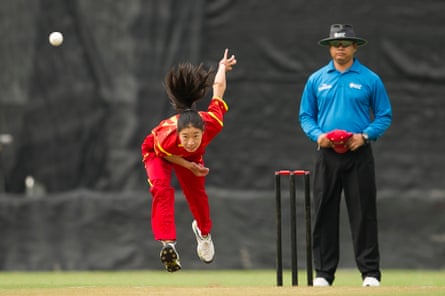
The glittery dividends have become clear. In the last four summer Olympics – London, Rio, Tokyo and Paris – China have won 143 golds, 62.2% of them around female necks. Women have also made up the majority of the athletes on Chinese teams – peaking at Tokyo, where 69.1% of the Chinese team were female.
Though China won’t make the six male and female teams due to play in LA as cricket returns to the Olympics after a 128-year hiatus (the five highest-ranked nations in Asia, Oceania, Europe, Africa and the Americas plus a global qualifier), the possibility of a future place, if the competition widens, dangles in the wind. While the women’s team are hardly threatening the world order, lying in 45th place in the latest ICC rankings of T20 nations, the men’s team languishes in 91st, squeezed between Saint Helena and Lesotho.
The treatment and self-image of the two teams is such a role reversal of the norm that when He quoted from Chinese players it provoked laughter in the room, a kind of guilty shock that will be familiar to anyone who has read The Power by Naomi Alderman. One Chinese female player interviewed complained that the men “never win a single game in the Asian Games” and another felt that “women deserve more opportunities”. A third, after losing a game, said she “felt better after a teammate told me: ‘It’s all right, men cannot win a single game’.”
Mohammad Ramzan, who played one Test for Pakistan in 1987, and is now the coach of the Chinese men’s team, told He: “We never play any (T20) matches since the 2024 East Asia Cup. Not a single one. Ladies play four or five matches in June (2025) in Japan, and played against some good teams here [at Hangzhou ZPU cricket ground].”
A woebegone male player perhaps summed up the group spirit: “It is rational to invest in women more as men have little hope.” It is a dynamic that He summed up as “group charisma and group disgrace” with female cricketers emerging as the established team, albeit in a sport that is not a priority either for the Chinese Communist party or the people. The worldview was further twisted by a former women’s coach telling He that the ICC are dissatisfied with China’s strategy of “allocating too many resources to women’s cricket” and “not developing cricket seriously”.
This inverted version of the game floated like a lost piece of a jigsaw above the rest of the conference, as a succession of speakers examined women’s cricket in other places around the globe. Delegates were asked to consider whether the professionalisation of the women’s game was going to end up with women being sidelined, as they were when the ECB swallowed up the Women’s Cricket Association, as well as looking at the legacy of this summer’s World Cup and the experience of rapid professionalisation and The Hundred on female players.
There was also an examination of the pinkification of the Women’s World Cup final at the MCG in 2020, by Hannah Thompson-Radford, while Anand Rampersad from the University of West Indies opened the door on the development of women’s cricket in the Caribbean. This included the elbowing out of the West Indies Women’s Cricket Federation pioneers and how the frailty of the women’s game hid behind the triumph of the 2016 T20 World Cup. A narrative that somehow seemed more familiar.
-
This is an extract from the Guardian’s weekly cricket email, The Spin. To subscribe, just visit this page and follow the instructions