2 months ago
74
2 months ago
74
It took me nine months of 20-hours-a-week French language instruction, and the mycelial network of a year spent in Strasbourg, to feel courageous enough to walk into a bookshop to buy something more challenging than Le Petit Prince. I was immediately humbled: there was an entire new universe, just barely linguistically accessible, and I had no idea who was who, who was writing what or what might interest me.
A year later, I came back to France for graduate school after an 11-month interlude working for an NGO in southern Chad, still feeling like an intellectual toddler in my now two-year-old second language. During the first week of courses, I asked a highly bilingual classmate where in the French media landscape I could find long-form narrative reporting with a literary edge – something comparable to the New Yorker. “You have to read XXI,” he told me, and then a few days later brought me a copy.
Now 18 years old and recently rebranded as Revue21, the thick quarterly publication is a major reference point for France’s “mook” (magazine-book) scene, and for French narrative long-form journalism. It specialises in stories that – as its editor, Guillaume Gendron, put it to me – allow the writer to be present in them, acknowledge their own subjectivities and doubts, and in so doing establish a relationship of trust with the reader. Holding the 162-page winter issue in my hands, I feel the effort that went into reporting and drafting these stories. If I’m going to get lost in something, it’s not in one of a hundred open tabs – it’s in the physical pages in front of me.
There is something to this in an age when we’re all suffering from screen fatigue, when the rise of generative AI is removing the last guardrails from our ability to tell what’s real and what’s not, and when legacy media everywhere is falling into an autophagic trap of shortening, simplifying and chasing ever-receding, social media-addled attention spans. Worried voices prophesy the death of reading, the dawn of a post-literate society and even a generational drop in intelligence. I feel the problem myself: the cognitive overload induced by the overwhelming noise of the world. The heightened anxiety that’s there when I spend too much time attempting to keep up. The anger and despondency that result from the endless scrolling, the experience of reading-but-not-reading. The feeling of burnout despite not having even really done anything. The desire to check out in response.
Maybe the doomsayers just need to visit France.
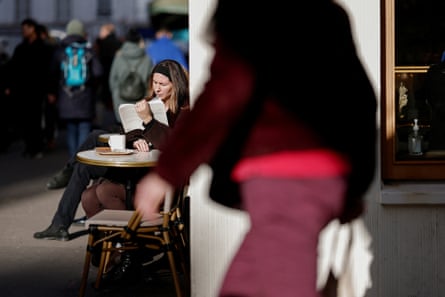
With its 3,000 independent bookstores (more in raw number than in the whole of the US, though France has just a fifth of the population) and 770 news kiosks across 180 cities, I’m always struck by – and adore – the extent to which France is a country that still reads. It’s in the data: 350m books were sold in France in 2025; adjusted for population that’s almost three times as many as in the US (762m), and just under twice as many as in the UK (191m). It’s in the anecdote: the quantity (and quality) of books advertised in the Métro, the number of people reading during their commutes, the way niche publications spawn, stay or are replaced by new ones. Kometa, Glitz, La Déferlante, Usbek & Rica, Le Cri … There’s even an English-language newcomer, Souvenir.
“Print is showing some strong signs of survival,” says Lindsey Tramuta, a Paris-based journalist who recently wrote about the magazine as “an object of fascination – a collectible that carries a point of view and signifies status” for a print-only publication called Beau. Théo Moy, who left his job at the newspaper La Croix to start a new leftwing Catholic magazine, Le Cri (currently on its fifth issue), points to “screen fatigue” and the idea of supporting a mission as two main reasons driving readers to take up print subscriptions.
For Le Cri, which launched with 3,000 monthly subscribers and €150,000 in donations, that mission is gathering leftwing, ecologically minded young Catholics together to give them a louder collective voice against the billionaire-backed Catholic far right. When he tells me it has a monthly print run of 20,000, mostly sold in news kiosks, I’m impressed – but Moy is more circumspect. “We’d need twice that to really start to have an influence,” he says.
Kyle Berlin, a former editor for Rolling Stone who recently launched Souvenir, invokes the litany of writers who, like Hemingway, got their start by writing for small Paris-based literary magazines. Plus, he emphasises, paper is simply better. “Print is a superior technology for the stories I want to deliver,” he says, insisting on the word “technology”.
“Paper [still] carries more weight” than digital media in France, says Gendron, who took over Revue21 at the end of 2025 after running the long-form section of the leftwing daily newspaper Libération. Only the leftwing investigative site Mediapart carries the reputation of a print title while being digital-only, he says. Otherwise, in France, “paper is marble”. Marble. Solid, timeless, with no need to perform its value. If you’re looking at it, then print already has your attention. Because of the production lag time, it is by nature more reflective than reactive. More concerned with the long arc of relevancy than with the immediate hit of going viral.
When I touch print – the glossy cover of Revue21, in the publication’s light-filled offices in the 11th arrondissement, or the two rougher, “eco-friendly” covers of Le Cri that Moy handed me across a brasserie table – I feel as if I’ve touched the solution, or one of them, at least. There are pieces of writing that leave you informed, and pieces that leave you wiser; print more often does the latter. I’m aware of the irony, extolling the virtues of print to you through a screen, and how quaint and retro it sounds to maintain that print isn’t dead. But beyond France, where it never fully surrendered, I think we’re going to be surprised at how quickly the printed word will come raging back.
-
Alexander Hurst writes for Guardian Europe from Paris. His memoir Generation Desperation is out now