2 months ago
55
2 months ago
55
Signing Cristiano Ronaldo, Neymar, Karim Benzema and N’Golo Kanté brought eyes to the Saudi Pro League but, in their bid to hold that gaze and avoid a repeat of what happened to the Chinese Super League, Saudi clubs have implemented a new strategy and targeted a new demographic. Eighteen months ago, the league introduced an extra spot in squads for foreign players, provided they were under the age of 21 when recruited. Saudi clubs honed in on France, where they have found willing sellers and enthusiastic recruits.
French football is not a self-sustaining ecosystem. Long dead is the dream of a €1bn broadcast rights deal, announced before last season. In the end, clubs earned less than €500m. This season, with the withdrawal of Dazn and the launch of the league’s own Ligue 1 Plus, broadcasting rights will total around €270m. BeIN Sports are pulling out of their deal to broadcast a game each weekend, so receipts will be even lower next season. The league’s channel is likely to earn just €120m for the 18 top-flight clubs. Alarm bells have sounded and salvation has come in an unfamiliar form.
Luckily, France sits on what one recruiter with knowledge of the Saudi market calls the “biggest hotbed of talent in the world”. Developing and selling that talent has become the business model. Premier League clubs pay the highest fees, so tailoring players to sell to that market has become common practice in academies across France.
“The only way for French clubs to survive is by selling many more players than we buy,” says Monaco CEO Thiago Scuro. The entry of a new client into the market was described as “positive” by Scuro after Al-Ittihad dug his club out of a hole in the winter. The club needed to make a sale before July or risk Uefa sanctions. The fear was that one of their star players, either Maghnes Akliouche or Lamine Camara, would have to be sacrificed. Ultimately, both stayed and George Ilenikhena, who had started just three Ligue 1 games all season, departed for a €33m fee.
The striker’s move to Saudi Arabia left Scuro with mixed feelings. “We are now good on Uefa rules,” he says. “I had to make the best choice for the organisation. I wanted to keep George. He is a player with a lot of potential. We are happy to have found a solution for the financial situation, but it is also a shame that a young player with a lot of potential to progress leaves.”
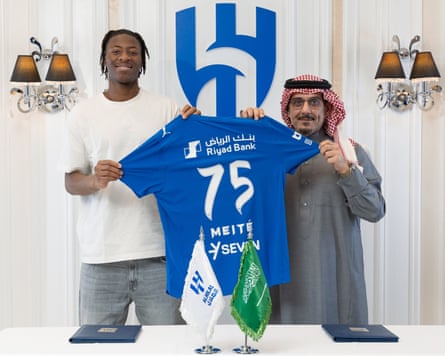
Rennes are familiar with that bittersweet sensation, having sold one of their brightest prospects, Mohamed Kader Meité, to Al-Hilal in January for €30m. He was the second-most expensive arrival in the Saudi Pro League in January, behind Ilenikhena.
His arrival followed a Saudi summer splurge on French talent. Nathan Zézé joined Neom from Nantes for €20m; Valentin Atangana and Amadou Koné (who were born in Mali and developed in the Reims academy) left for a combined €38m fee, a godsend for the relegated club; and Saimon Bouabré moved from Monaco to Neom. His performances have since earned him a €23m move to Al-Hilal.
Bouabré’s agent, Luis Ferrer, says the “intensity” of the Saudi Pro League, coupled with the presence of “big stars and big managers, like Simone Inzaghi”, are attractive to players. But they were not the biggest draws. “The game time wasn’t there at Monaco. He had to go to Saudi Arabia, where that was guaranteed. The priority was football. It wasn’t a question of money,” says Ferrer.
However, the financial incentives to move are obvious. “Everyone is speaking about Saudi Arabia in the dressing room,” says the Paris FC midfielder Ilan Kebbal. “It is difficult to see some young players leave the league, but would we say no if we were in their position?”
As well as offering big salaries, Saudi clubs can afford expensive transfer fees. “When a club comes and offers you these salaries, you don’t necessarily think about yourself – you think about your family,” says the agent of a young French player who has joined the Saudi Pro League. “Even if we want to go to certain clubs in Europe, unfortunately, the only clubs able to pay the fee are the Saudi clubs, so there is not a lot of choice in terms of destination.”
There is also a cultural pull for some players, with one source saying players even “seek it out”. Benzema referenced religion when he joined Al-Ittihad in 2023. “I am a Muslim and it is a Muslim country, and so I want to live there,” he said. “It is very important to be in a Muslim country where I feel as though people love me. It will allow me to have a new life,” added the former France international, who moved from Al-Ittihad to Al-Hilal earlier this year.
Many of the young players leaving France for Saudi Arabia are Muslim. “If it responds to an ethnic, religious orientation favourably, then all of the lights are green,” says Stanislas Frenkiel, a historian at the University of Artois who researches the link between football and immigration. “The fact that more and more young players are leaving for Saudi Arabia will incite others to remove their inhibitions and go and follow them. There are migration channels that are opening. It is attractive for religious reasons and increasingly for sporting reasons, too.”
Sporting reasons remain focal. Most of these young footballers hope to graduate to a top European club one day but they are not yet ready for that step. Saudi Arabia, therefore, is not a final destination but a stepping stone. Ferrer talks about Bouabré coming back to Europe in two or three years “better armed”. Another agent added that “the objective is not to stay there for 15 years.”
The success of this new route may depend on whether Saudi Arabia offers players a way back to Europe. “For French football, we hope that these players can be developed in Saudi Arabia at the same level as in Europe,” says Scuro, who – like other executives at French clubs – has a vested interest in the success of the Saudi Pro League’s new strategy.
The subject of money inevitably permeates conversations about French players moving to Saudi Arabia, but the draw is often for clubs as much as players. “There is less passion in the game,” says Kebbal but passion does not keep French clubs afloat; Saudi Arabia’s intense interest in their talent just might.
This is an article by Get French Football News