2 months ago
57
2 months ago
57
After a diplomatic career spent in the war zones of Afghanistan, Iraq and Yemen, the last place Arthur Snell expected to cheat death was on holiday.
But it was an uncomfortably close brush with a falling boulder while climbing in the Swiss Alps that helped to bring his personal and professional lives together. His beloved mountains were, he realised, becoming less stable thanks to a changing climate. And if physical geography drives the way states exercise their power, as classic geopolitical theory argues, then a heating planet must be dislodging more than rocks.
“You see wars and you think they’re about types of Islam, or whether or not the US has access to oil. But underneath all of that there’s this longer running thing that is becoming more and more important,” says Snell, who left the UK Foreign Office in 2014 and now hosts the podcast Behind the Lines.
That insight led ultimately to his new book, Elemental, which examines how a climate crisis that threatens the planet’s capacity to sustain life is helping to stoke conflicts from drought-stricken Africa to a defrosting Arctic, as well as the rise of far-right populism in Europe and the US. “It’s like rising damp in your house – you don’t know it’s there, but it’s changing everything.”
It’s a tale of a world in flux, as superpowers are forced to confront new vulnerabilities and smaller countries find their natural resources – from habitable land to minerals critical for renewable energy technologies – unexpectedly in demand. (As Greenland has found, that can be a blessing and a curse.) What makes these power shifts unusually disruptive, says Snell, is the sheer pace of them. “Normally, we can say: ‘In so many million years, the map of the world will change.’ Well, it will change in the lifetime of normal people living a normal lifespan. What that does is intensify the geopolitical aspects.”
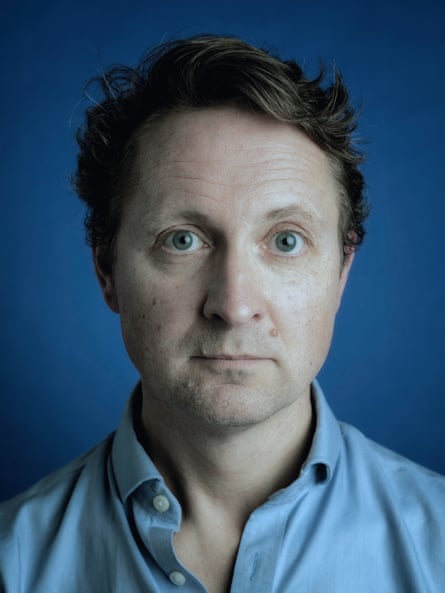
Sitting in the Guardian’s office in a blue shirt, 50-year-old Snell looks remarkably relaxed for someone describing apocalyptic scenarios. But then, over the years, he has encountered a few of them. He joined the Foreign Office after reading history at Oxford, working across security hotspots in Africa and the Middle East, including a 2010 posting as deputy head of the provincial reconstruction team in the Afghan province of Helmand, which was attempting to rebuild after fierce fighting in the Taliban stronghold.
His final posting was as high commissioner in Trinidad and Tobago, which wasn’t as glamorous as it sounds. Despite the public image of diplomats “swishing around, living in terribly grand places”, Snell says the reality is rather different, especially after years of budget cuts. In Helmand, he lived for a while “in a shipping container”; in the Caribbean, he found himself cleaning out the residence’s gutters before public functions. “I didn’t mind; I’m not too grand,” he says quickly. But he did think there might be better uses of his time.
Snell isn’t a climate scientist or an activist, but instead takes the diplomat’s pragmatic view that, having failed to halt rising temperatures, we must now engage with the consequences. That doesn’t include giving up on net zero, he says. “The fact that we’re not going to meet 1.5C doesn’t mean: ‘Well, let’s not bother because four degrees will be fine.’ That would be catastrophic,” he says. Rather, it’s an argument against creeping fatalism. “People say: ‘Oh, we’ll all be dead anyway’ – well, we won’t. I have children who are going to live to the end of this century. And there will be people who, tragically, will not survive the climate crisis, but most people will carry on living through it. So we have to think about what that really means.”
Although Snell’s book includes some chilling statistics on the future difficulty of feeding the planet’s population, he won’t put numbers on how many people risk starvation, because there are too many unknowns – including farming’s ability to adapt. What he will say is that competition for productive land will intensify, potentially driving new forms of mass migration – no longer just from poverty-stricken countries to rich ones, but sometimes the reverse.
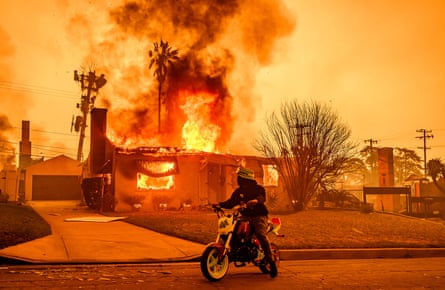
Wildfires licking at Los Angeles; hurricanes battering Florida; summer heat cooking Texas: it’s getting harder for Americans to ignore changing climate, Snell says, with some already being refused home insurance. “It hasn’t yet had an impact – we haven’t seen people clearing out of Miami – but it seems to me that you can’t just assume people will carry on being able to live in those environments.” The logical outcome, he thinks, will be Americans moving north, perhaps even rejuvenating formerly declining cities such as Detroit. But what pressures might that create on the US’s northern neighbour, Canada, which Donald Trump recently suggested he would like to annex?
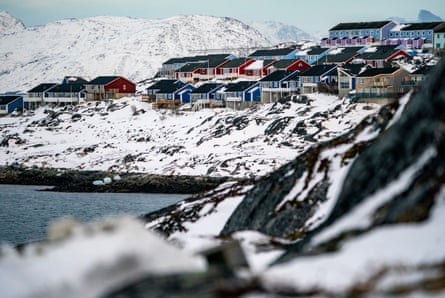
For a climate sceptic, says Snell, Trump seems unusually alert to opportunities created by the unfreezing of the north, which could make food production more economically viable in parts of Canada just as Americans’ breadbaskets begin to suffer. Farther north still, a melting polar ice cap could make Arctic waters navigable in summer, opening lucrative trading routes from Asia to Europe over the top of the globe – and sparking fierce competition for mineral, oil, gas and fish reserves in a natural political flashpoint. “If you were looking down at the north pole, this is where Russia and the US meet. It’s where Russia has borders with Nato members,” he says. It’s also where Russia keeps its nuclear submarines, which in order to threaten the US coast from Atlantic waters must pass Greenland – hence its growing strategic importance.
Still, does Snell really believe the president wants to buy it for such complex geopolitical reasons? “Who knows? It’s the endless question – is he as incredibly stupid as he sometimes appears, or does he have these moments of lucidity?” Perhaps, he concedes, Greenland appeals mostly because “it looks ginormous on the map”. Either way, he expects Trump to keep pursuing it.
Snell anticipates similar pressures in China, where so-called wet-bulb temperatures – combining extreme heat and extreme humidity, which prevents humans from cooling down by sweating – are forecast to reach deeply uncomfortable levels in regions around Beijing. Just over China’s northern border, meanwhile, is a conveniently empty swathe of eastern Russia that was historically considered Chinese territory.
Is he saying they could invade? “I don’t think they need to. Russia is becoming a kind of economic vassal of China. But, over time, you’re going to see these extraordinary shifts of people – economic migrants, but not as we understand it when we’re talking about people in small boats, more people moving because there’s work to do and quite a good lifestyle to be had.” To his chagrin, Snell thinks Russia could emerge stronger from the climate crisis, as its vast expanses of frozen tundra thaw enough to become viable places to live.
But, if some relatively peaceful mutual deal between China and Russia seems possible, Snell sketches a more alarming future for countries, such as Saudi Arabia, facing rocketing temperatures and plummeting demand for the oil on which their wealth and influence depends.
“The Gulf nations are facing catastrophe, because their economic model is ending and also the liveability of where they are is ending,” he says. Although Saudi Arabia’s crown prince, Mohammed bin Salman, is seeking to diversify from fossil fuels into tourism, increasingly punishing heat makes that challenging. For Gulf autocracies traditionally reliant on bribing their subjects into acquiescence, Snell suggests, dwindling coffers could spark unrest across the Middle East – with consequences for western democracies reliant on petrodollars. (In Britain, wealthy Saudis hold stakes in football clubs, prime London property and more.)
When will Saudi Arabia reach a tipping point? “We can say 20 to 30 years. It’s enough time that any normal politician can think: ‘Not my problem,’ but it’s not enough time for someone who’s aged any less than 60 to ignore it.” Already, wealthy Saudis are summering in Europe to avoid the heat. Meanwhile, in neighbouring Yemen – a failed state facing similar temperature rises but without oil wealth – Snell expects extreme heat to cause more of “the irregular migration that drives the populists in Europe”. In other words, more people arriving in small boats.
Snell downplays talk of a mass climate-induced migration from Africa and Asia to temperate Europe, arguing that traditionally most migrants don’t cross continents, settling instead just beyond the border or in safer parts of their home country. But even relatively small numbers of climate refugees could be destabilising for governments already under pressure from the populist right over immigration.
In his book, Snell traces the link between changing weather patterns in Guatemala – driving economic migration to the US – and Trump’s ability in the 2024 election campaign to weaponise pressures at the border. Europe’s equivalent, he suggests, might be the Sahel, the chain of countries stretching across sub-Saharan Africa that includes Mali, Niger (one of his earlier postings), Chad and Sudan, each of which has experienced “some kind of coup or military disruption, political crisis, conflict”.
He argues that drought, crop failure and the resulting hunger have exacerbated old ethnic tensions, drawing in France (a former colonial power) and then Russian mercenaries to try to restore order. Now, foreign powers are vying with each other to tap the war-torn region’s critical mineral resources, while those who can escape the fighting try to do so. The Sahel’s tragedy should be better known for many reasons, Snell argues, but one is the way it has “contributed to rising populism here in Europe, because of the migration pressures that have come out of it”.
What he describes – a world of great powers grabbing whatever they need to survive a changing climate from smaller ones – is essentially a new age of empire, except this time with the formerly colonised US and China waxing as former imperial powers such as Britain wane. “There’s a worldview Trump has signed up to that it’s a bit wet to say: ‘We can cooperate economically, but you’re still a sovereign country,’” says Snell, who notes that the leaders Trump admires – Vladimir Putin and Xi Jinping – are expansionary.
Meanwhile, this new order raises uncomfortable questions for democracies – whose leaders, unlike Putin or Xi, have to win elections – about whether they can gain public consent for the painful sacrifices required. “I don’t want to fall into the trap of saying you need to be an autocracy to deal with the climate crisis, because I don’t see why that should be the case – democracies have dealt with extraordinary crises,” Snell says. “But the current flavour of an intense 24/7 liberal democracy seems to me to be really failing.” In the book, he notes European politicians’ electoral vulnerability even to relatively small shocks, such as recent food-price inflation, and this will probably intensify as the planet heats up.
So, what is Britain’s place in this ruthless world? Assuming the country is spared the worst-case climate scenario – involving the collapse of warm ocean currents, plunging Britain into a deep freeze – Snell thinks it should at least avoid the extreme temperatures and wildfires troubling southern Europe. But although Britain’s Joint Intelligence Committee published a heavily redacted report last year on the security implications of the climate crisis, Snell thinks our planning is behind the curve. “There are probably people who are looking at this stuff, but they’re a long way from being able to brief the prime minister, or empower the resources that flow from the analysis,” he says, adding that Britain hasn’t built a water reservoir for 30 years (although plans are under way).
Is Snell a disinterested observer? After all, he joined the Liberal Democrats in 2005, while he was still working in Baghdad, because of their opposition to a war he felt wasn’t working, then tried unsuccessfully to get selected as a parliamentary candidate after leaving the Foreign Office. Although he quit diplomacy partly for family reasons – he and his wife, a doctor, wanted to put down roots for the sake of their two small children – disillusionment seemingly played its part. Snell is proud of what Britain has done for Ukraine, whose government he was advising until recently, but his first book, How Britain Broke the World, detailed the shameful mistakes he thinks we made in the Middle East.
Working with the Americans in Iraq and Helmand certainly shattered his illusions about a so-called special relationship. “They look on Britain as a useful partner with certain assets and capabilities, but it’s not special – this is a delusion that we continue to pursue for nostalgic reasons,” he says, arguing that Nato members can no longer bank on US support in a crisis.
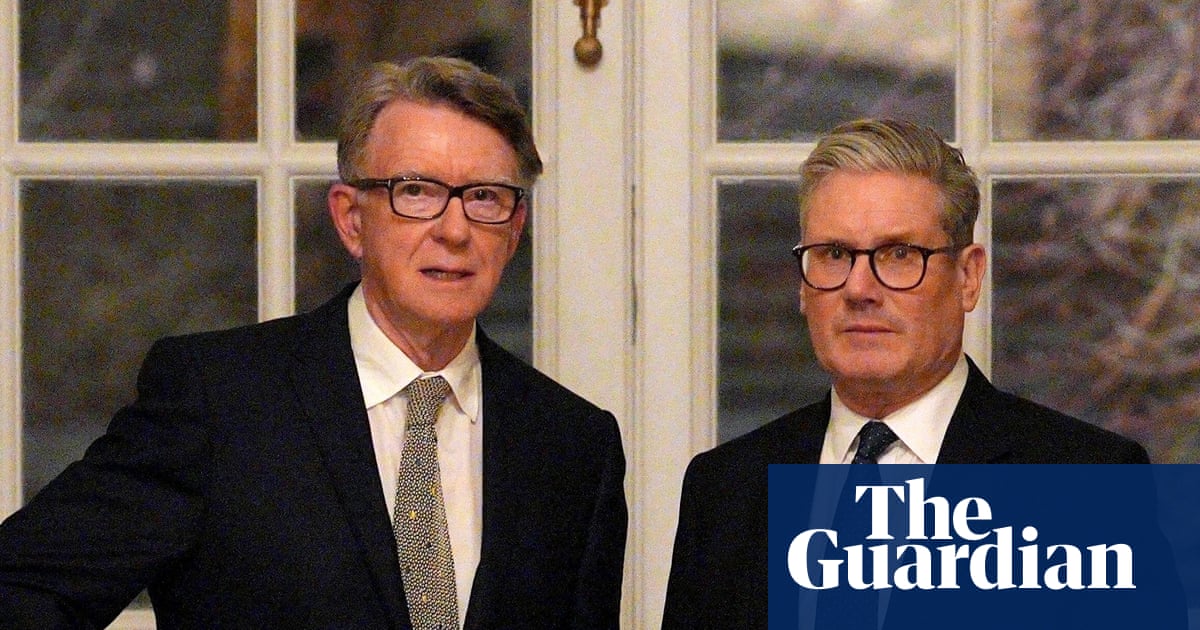
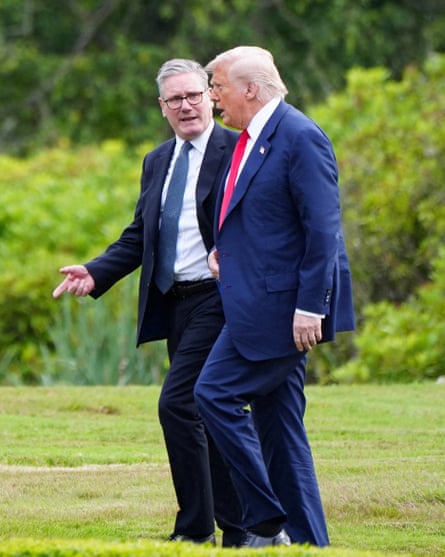
And the current government’s relationship with Washington? “The Keir Starmer approach of outwardly saying: ‘Mr Trump, you’re brilliant and you’re always right,’ would be a perfectly valid strategy if at the same time you were behind the scenes pedalling extremely fast on restructuring your medium- and long-term defence and security arrangement. But I know for a fact we aren’t doing that.” He considered Peter Mandelson’s appointment as ambassador to Washington a mistake long before the Epstein files were released and he argues that the Foreign Office has been weakened by cost-cutting at a time when it needs to boost its global presence post-Brexit.
Yet Elemental does identify grounds for optimism, from the possibility of building solar arrays in African deserts to exploit the relentless sun, to growing cooperation between countries over water supplies or renewable energy. “Some people might say: ‘How is that optimistic? You’re talking about a crisis.’ But the crisis does force cooperation and collaboration. There are very few countries that are saying: ‘This isn’t happening and we’re not interested,’” he says cheerfully. After he leaves, I check his Substack newsletter and take notice of its title for the first time: Not All Doom.