3 months ago
74
3 months ago
74
Thin strips of flesh hang down like rotten tinsel, swaying in the wind. Glistening fluid trickles on to the stone where insects buzz. On the windward side, the odour is masked by the salty air. But step downwind, and you enter a sickly, sour-sweet blend of garbage and rotting fish. A passing couple pull their T-shirts tight over their noses.
On a rock shelf at the southern end of Era beach, the estimated 25-tonne body of a sperm whale rests like a melted candle. Looking down at the rock pools, floating chunks of white fat bob in the water.
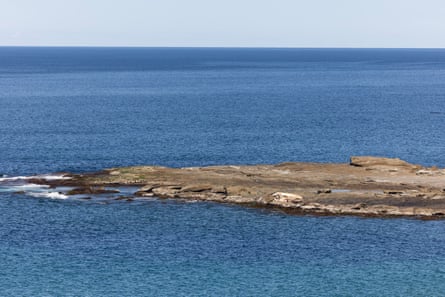
Even lying on its side and missing its lower half, the sheer scale of the decomposing form makes the onlookers, who have scrambled over moss-covered boulders and sharp, jutting rocks to reach it, appear tiny.
For centuries, seafarers relied on swooping seabirds as a sign that land was near. Here, a circling sea eagle and the pungent scent act as a different kind of beacon.
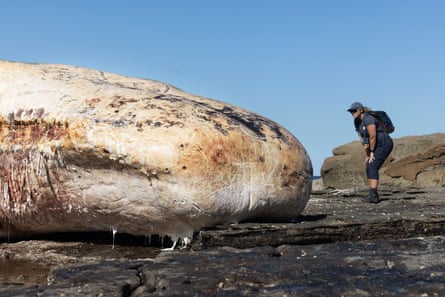
With a weathered fin resting on its side, its torn belly reveals shreds of innards in shades of grey, pink and black.
Since its discovery on Saturday morning, the rotting whale has lured sharks to the coastline, forcing the closure of several beaches in Sydney’s Royal national park.
Surf Life Saving NSW reported a shark sighting at Era beach at 9.28am on Saturday. By Sunday morning, SharkSmart confirmed all beaches within the national park – including Garie, North Era, South Era, Wattamolla and Burning Palms – were closed, and they remained so as of Wednesday.
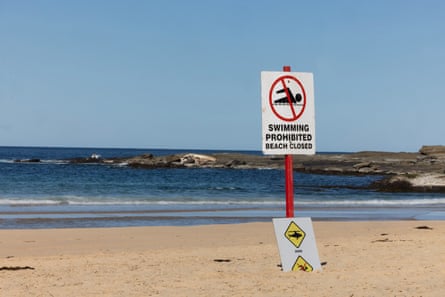
A safety alert issued by the New South Wales National Parks and Wildlife Service (NPWS) warned of an “elevated shark risk”.
The site can only be reached from the water or by a 45-minute trek from the closest car park, but the carcass has been the subject of morbid curiosity – as whales often are.
In just half an hour at the site, the spectacle draws a circling helicopter, a buzzing drone and two tinnies that pull up close to the rock shelf to give their passengers a look.
Hikers cross paths on the trail up steep hills and down scrubby gullies.
“I thought I’d come for a closer look,” says Peter Reid, a local who frequents the park. Like many making the journey, he had never seen a whale carcass. Asked to describe the smell, he deadpans: “Delightful.”
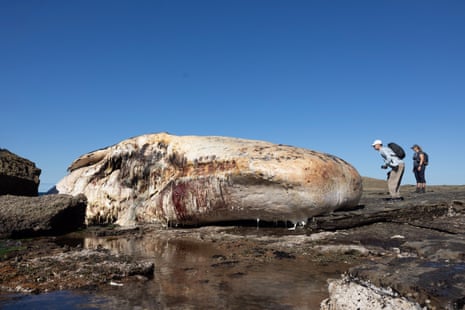
“The smell, you only really get it when you get right up close,” Reid says. “Some of the locals down there at Era were going in the water and said you can actually smell it in the water … which I thought was a brave thing given the number of sharks around.”
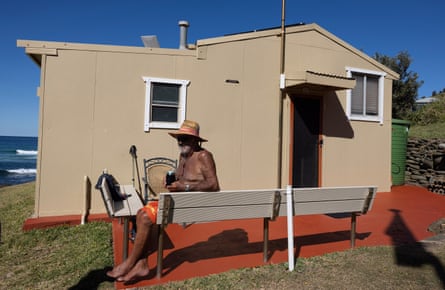
Along the track is a historic beach shack community at Garie beach – mostly built between 1930 and 1950.
Bob, a local resident who asked that his full name not be published, sits out the front of one of the homes. He hasn’t ventured down to the carcass himself, instead receiving dispatches from passersby. “I prefer to see them alive,” he says of whales.
‘We don’t know what happened’
One side of the whale is still smooth and white, with remnants of its once dark skin pigmentation.
Scratches and gouges mark the exterior. Its missing lower half has likely decomposed at sea or served as dinner for the sharks.
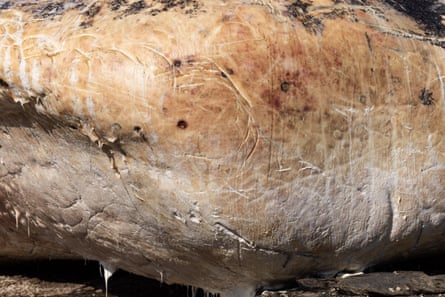
The majestic creature did not beach itself, although whale strandings, including on a mass scale, do occur globally. Experts suggest it died out at sea, its lower half likely lost to the ocean or scavengers before its remains washed ashore.
Dr Vanessa Pirotta, a Sydney-based whale scientist, says it could have died at sea weeks ago. “The flesh is weathered, skin mostly removed. [We] don’t know what happened to it,” she says.
NPWS said in a statement the level of decomposition would prevent further investigation into the cause of death.
Pirotta says “the idea behind removal means that public safety is front of mind”.
“Whales don’t often wash up in favourable locations, sometimes they are hard to access by machines … The longer a dead whale remains in the area, the increased potential for sharks to remain,” she says.
She says decomposing bodies are often eaten by sharks, “a prime example of their important ecological role in the environment”.
For humans, though, the “hazard of the rotting whale” needs to be dealt with, she says – providing there are resources and the access to do so.
She adds that authorities may consult with First Nations communities to ensure any disposal is culturally appropriate.
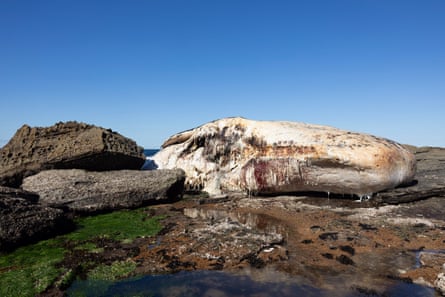
Removing the colossus, however, is proving to be a logistical nightmare. Pirotta says large machinery may be used to remove the whale and take it inland for disposal away from the beach. “Or the body may be taken offshore far away to ensure [sharks] do not return to the beach.”
Organisations around the world have used various methods to deal with the giant carcasses, with varying degrees of success – including the generally discouraged use of explosives. Towing remains out to sea has mixed results, with some returning to the shoreline. Authorities in the coastal NSW town Port Macquarie dug up the carcass of a 12-metre whale after outcry that it was attracting sharks.
Rendering, increasingly used in the UK, involves separating cetacean remains into pieces, boiling them down and combining them with alcohol to create biodiesel.
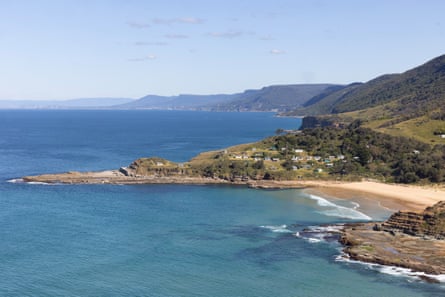
Disposal plans have been delayed until early next week, at least, due to the location and tides.
On Tuesday a NPWS spokesperson said the service was working closely with other agencies to finalise a removal plan. Approaching almost a week since its discovery, no further updates have been issued.
“It’s not going anywhere in a hurry,” Reid says. “It’s well and truly beached up on the rocks and it’s big. I can’t see anything moving it in the near future.”
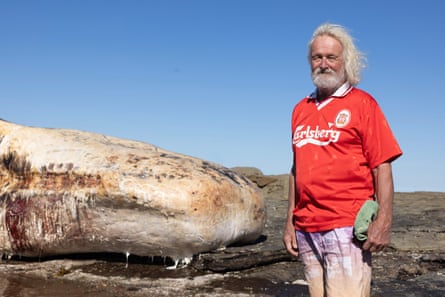
For now, the carcass remains a site of curiosity. Frank, an Era beach local, appears over the rocks balancing perfectly in his flip-flops for his first look at the carcass.
“The other night we were outside having a beer and you could smell it coming up with the breeze,” he says.
Humpback whales are a common sight from the coast during migration season, but spotting a sperm whale is a rarity, he says.
As we leave Era and look back at the idyllic view, a woman is going for a swim, despite the warnings. She sticks close to the shoreline, keeping her distance from the carcass.
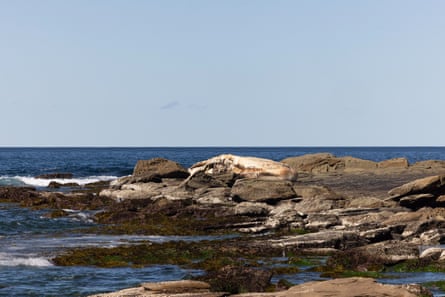
From afar, the whale’s bright white body blurs into the landscape.
It’s hard to reconcile the mound on the rocks with the colossal creature that once gracefully roamed the ocean.