3 months ago
71
3 months ago
71
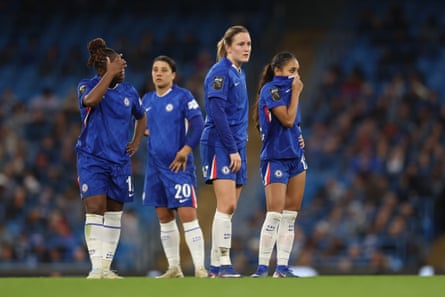
Dejected body language, talk of a crisis, and a 12-point gap ruling them out of the title before the second week of February. For a Chelsea team so used to winning the Women’s Super League, this is uncharted territory after their 5-1 loss to Manchester City.
For Sonia Bompastor, who has had more defeats in her past five league matches than in her previous 104 games in charge of Chelsea and Lyon, this is also an unfamiliar scenario, but Chelsea have placed their full faith in her – and vice versa – by agreeing a new, extended contract with the Frenchwoman and putting their trust in each other that recent results amount merely to a temporary blip, rather than a longer-term downward spiral.
The tone of the past few days’ reaction to the City defeat is a compliment to her track record – not least, winning a treble last term while remaining unbeaten domestically – and to the relentless domestic success Chelsea have enjoyed over the past decade that so much is being made of what essentially amounts to a very bad eight days. Chelsea have lost back-to-back WSL games for the first time since July 2015 but those defeats came against two of Europe’s best, Arsenal and Manchester City, so while the performances have fallen well below the standards expected, they have not suddenly become mediocre.
Chelsea are in the League Cup final, the Champions League quarter-finals – having finished the highest of the English sides in the league phase – and the Women’s FA Cup fifth round. Underestimate them at your peril, and the club will now be hoping that a new deal for Bompastor will provide stability to help them end the season with more silverware.
The signs had looked ominous though, when Bompastor took something of a dangerous strategy in the media by implying her dissatisfaction at Chelsea’s “squad depth” after the City game. It not only risked alienating her superiors but, perhaps more importantly, could offend the players on the bench for the humbling loss at the Etihad Stadium. It also risked the ridicule of WSL coaches on smaller budgets who will have noted that a Fifa report last week showed Chelsea spent the most on international transfer fees of any women’s club in 2025.
This week, several sources close to the squad have said that many of the players are no longer playing for the manager, an argument that becomes believable when you look at the body language of some during the second half at City, and some players are understood to feel they receive far less detailed tactical instructions in Bompastor’s team talks than during Emma Hayes’s tenure. Other sources however have passionately defended and praised Bompastor and feel the blame lies elsewhere, and she has many huge admirers at the club for her professional approach.
Scrutiny is also on the captain, Millie Bright, for whom the phrase “club legend” feels an understatement: she has been present for every major trophy the club have won. It is understood several members of the team and staff were less than impressed in November when Bright declined the chance to defend the Chelsea goalkeeper Hannah Hampton when speaking on her The Rest is Football: Daly Brightness podcast alongside her former England teammate Rachel Daly. Bright’s dismissal of Mary Earps’s criticism of Hampton in Earps’s autobiography as “gossip” did not go down well in the camp, when many hoped she would express support for a club teammate. Bompastor rushed to support Hampton publicly.
Bright is one of more than half a dozen senior players whose contract expires this summer, although her deal includes an option for a further season. Over the years, Chelsea have frequently been praised for their succession planning in the transfer market and effective evolution of the squad that helped them win the past six league titles. This term, perhaps for the first time in the professional era, that planning seems to have gone slightly awry and, as one source close to the club said after Sunday’s defeat, too many players are performing as if they know they are leaving this summer. Major squad evolution looks likely.
Defensively, Chelsea have looked poor recently. They have conceded as many WSL goals this season as they did across the whole of last term. The jury is out on whether their wing-back setup, which Bompastor seemed to abandon last Sunday, is working. Cliques also appear to have developed in the dressing room, although that is not uncommon elsewhere across the WSL or generally in team sport, but this is perhaps the first time in the modern era that anybody has any reason to question the unity within Chelsea’s squad.
Now more than ever they need to come together, with a tricky-looking trip looming to Tottenham on Sunday. Lose and Chelsea will be in serious danger of not qualifying for the Women’s Champions League, a prospect unthinkable two months ago.
Chelsea have not lost three consecutive league matches since 2013, but their fans may be reassured by their track record against Tottenham: Chelsea have won the past 17 meetings. However, only City have a better home record than Martin Ho’s side this term, so if Chelsea play with the same lack of intensity they displayed last weekend, Spurs could punish them and leapfrog them in the table, a concept that would really begin to test the relationships between club and coach.