2 months ago
65
2 months ago
65
China has set its target for GDP growth to a record low of 4.5-5%, the first time since 1991 that the figure has dropped below 5%, reflecting an economic strategy that is shifting away from export-led growth to a model that leaders hope will be more resilient to external shocks.
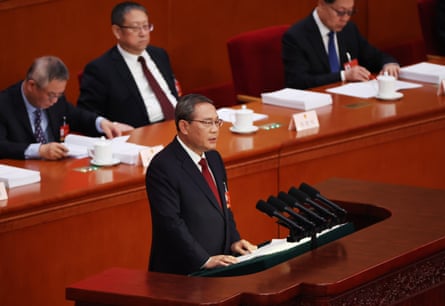
Li Qiang, China’s premier, announced the target for 2026 in the opening session of the National People’s Congress (NPC), China’s annual parliamentary gathering, which began on Thursday.
Addressing the nearly 3,000 delegates gathered in the Great Hall of the People in Beijing, Li described 2025 as a “truly remarkable” year with “profound and complex developments both at home and broad”, according to the text of the government work report.
The NPC will also review the 15th five-year plan, an economic and strategy document for 2026-2030.
The low GDP target was reflective of a shift to what Beijing is calling “high-quality growth” – that which is built on hi-tech industries and structural reform rather than the historic drivers of construction and exports.
China is also grappling with downward pressures on its economic growth, such as an ageing population, an ailing property sector, weak domestic demand and a slowdown that is expected as a country moves up the income scale.
“This year is a pretty important year for structural reform,” said Dan Wang, the China director for Eurasia Group, a political risk consultancy. Wang said that China was taking advantage of the one-year trade truce with the US to focus on reforming its economy away from export-led growth, while the lower target also reflected a “higher tolerance for unemployment”.
Li announced a 5.5% target for urban unemployment and pledged to create more than 12m new urban jobs, targets in line with previous years. But some experts have said that China’s shift to prioritising hi-tech industries may pose a risk to millions of blue-collar workers.
China and the US agreed to a one-year pause in the trade war in October, with further negotiations expected this month before an expected visit by Donald Trump, the US president, to Beijing on 31 March.
Despite the trade war’s disruption to global supply chains, particularly those originating in China, the country ended last year with a record $1trn trade surplus. Li said that “financial and economic discipline” was a priority for 2026.
China also wants to focus on boosting domestic demand, something that economists say is essential to China’s long-term economic stability. Last year an editorial in state media said that consumption should be managed with the “same rigour” as production, a shift from the traditional focus on heavy industry to stimulate growth.
Additional research by Lillian Yang