2 months ago
71
2 months ago
71
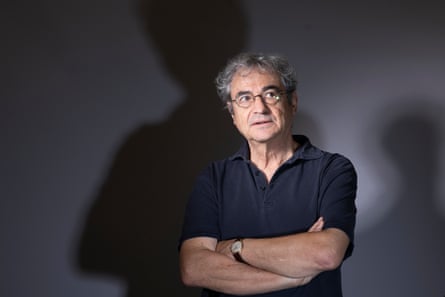
Should European members of Nato be rearming in the face of the Russian threat? And if not, I ask Carlo Rovelli, why not? The Italian theoretical physicist seems a good person to answer these questions since his timely new book, 85 Seconds to Midnight, is subtitled A Physicist’s Argument against Rearmament.
Rovelli, 70, brown eyed, genial, with enviably luxuriant grey locks, removes his glasses before answering. “The idea of the Russian military being a threat to Europe is ridiculous. Russia can’t even get to Kyiv! A few years ago, Russia had 4% of the world’s military spending and Nato had 40%.”
At the same time, though, Russia has more than 4,000 nuclear warheads, making it the planet’s biggest stockpiler. “So we cannot take Russia down,” says Rovelli, “because it would react.” Of the three nuclear superpowers – Russia, US and China – only China has resolved not to be a first-use nuclear state. Russia, like the US, reserves the right to respond to conventional attacks with nuclear strikes.
The real problem, Rovelli suggests, is mutual fear. “We are trapped in a lack of reciprocal trust. We sleepwalk through these patterns of everybody becoming more armed, more aggressive.” He cites what happened a few weeks ago in St Petersburg. “With Nato weapons, Ukrainians bombed St Petersburg and they tried to bomb Moscow. So a country with nuclear weapons is being ‘bombed’ by the British. Not the British pushing the button, but the bombs come from Britain, as well as from Germany and France, with less from the US.”
Why was this so frightening for Rovelli? “It’s the first time a [superpower] with nuclear weapons has been actually bombed. There was a situation in which if you have nuclear weapons, you don’t get invaded. You don’t get bombed. No more.”
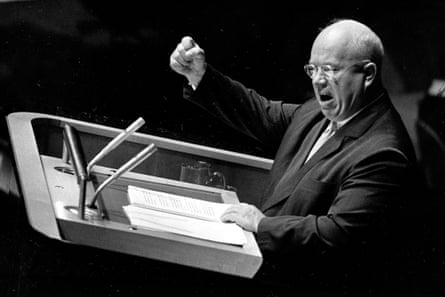
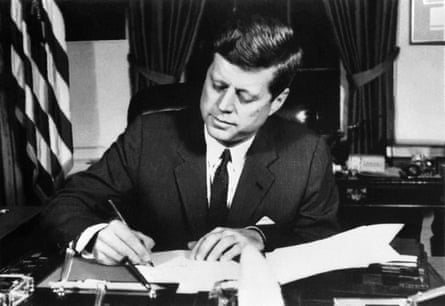
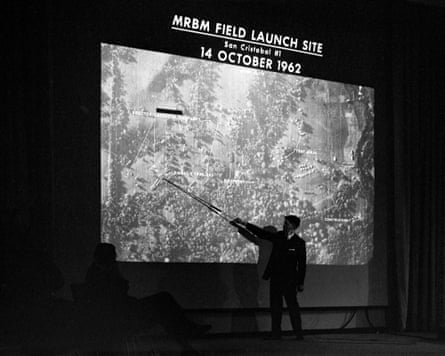
Rovelli invites me to consider what that bombing looks like from the Kremlin’s perspective. Moscow has long feared western aggression, he argues. A key moment came in 1962 when Americans placed nuclear missiles in Turkey. That, he argues, prompted then Soviet premier Khrushchev to put nuclear weapons in Cuba, the US’s back yard.
True, the Cuban missile crisis was de-escalated by Khrushchev and US president Kennedy, but Russian fear of western invasion persists. That’s why, Rovelli suggests, Putin is so terrified of Ukraine becoming a member of Nato: that would enable the west to place nukes in the country. Hence, Rovelli argues, Putin embarking on his full-blown invasion four years ago.
Rovelli believes this Russian aggression has caused a whirlwind of fears and clamours for rearmament in western Europe. “You have the French government saying French people should be ready again to sacrifice their children; the British government saying we should be ready for war because it might happen; the German government saying all this anti-war sentiment in schools is not good and we should change education, make war more acceptable. This is motivated by the idea that Russia is invading Europe. It’s nonsense.”
But isn’t it sometimes right to be fearful? Indeed, isn’t the lesson of the second world war that western European countries should have rearmed sooner to counter a demagogue bent on expansion? “I think everybody should read Mein Kampf,” he replies, referring to Adolf Hitler’s 1925 autobiography and manifesto. “Mein Kampf does not say, ‘We are German, we are the strongest, we are going to run the world, we are great, we are white, we are Aryans, whatever.’ It says, ‘We are weak. And the only way we have to survive is to become stronger and overcome the others.’ So what fuelled the violence of nazism was fear.”
Today’s Middle Eastern conflict has a similar basis, Rovelli contends. “What fuels the aggressiveness of Israel is fear. What fuels the aggressiveness of Hamas is fear. They are going to destroy us in Gaza unless we are aggressive. To answer fear with fear, to escalate, seems to me disgusting.”
But isn’t this naive? Putin isn’t just acting out of fear, surely, but is prompted by some warped sense of historical destiny to claim Ukraine. “That’s obviously nonsense. You create these narratives that fuel tribal ideology. And that’s exactly what we don’t want. I don’t think anybody has any natural historical right to anything.”
Why should we listen to what theoretical physicists have to say about rearmament? Yes, Rovelli is the go-to guy to explain loop gravity, the theoretical framework that merges quantum mechanics with Einstein’s general theory of relativity. He is also a great populariser of difficult ideas in such books as Seven Brief Lessons on Physics and The Order of Time. But when it comes to war and realpolitik, theoretical physicists have often proved themselves utter boobs.
“We physicists,” Rovelli concedes, “did create this thing [nuclear weapons]. It is our poisoned gift to humankind. But historically, the voices of scientists – raising awareness about the nuclear risk – have been effective.” It was thanks to the wisdom of scientists and other intellectuals, he argues, that Gorbachev and Reagan were convinced to sign the now defunct 1991 Strategic Arms Reduction Treaty (Start).
Equally true, though, is that theoretical physicists have been disastrous for humanity. Rovelli cites his countryman Enrico Fermi who in 1934 found a way to shatter atomic nuclei – giving humanity a new source of energy. “But the gift is too great,” writes Rovelli. “A small bit of uranium can release energy to demolish cities, burn alive millions of human beings and destroy civilisation itself.”
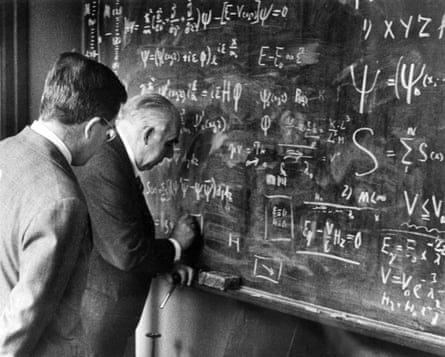
Consider too what happened in Copenhagen in 1941 when two great theoretical physicists, the Dane Niels Bohr and the German Werner Heisenberg, met. Bohr, who soon after the meeting was spirited to the US, came away from the meeting convinced that Nazi Germany was making a nuclear bomb to win the war.
Rovelli takes up the story: “Once in the US, Bohr said, ‘Look, this is a sketch given to me by Heisenberg of an atomic bomb.’ And it was definitely not. It was a sketch of a peaceful nuclear reactor. One of the outcomes of that was that the Manhattan Project was motivated by a belief that Nazi Germany was close to having nuclear bombs, which was completely unfounded.”
The unintended consequence, as Rovelli puts it in his book, was “the burning alive of 200,000 men, women and children in Hiroshima and Nagasaki”. Not, as some have argued, to end the war more quickly but as an immense demonstration of US power – or as he puts it: “The scream of the gorilla beating its chest and telling the forest that it is the strongest.”
Surely there were other and possibly better rationales to dropping nuclear weapons on Japan than that? I remind Rovelli of a conversation at Princeton he had with his friend and mentor, the late relativity theorist John Wheeler, who worked on the Manhattan Project. Wheeler believed bombing Hiroshima and Nagasaki was justified to spare the enormous number of American lives that would be lost in a mainland invasion.
“John was one of the people I admire most, and half of my thinking is based on what he did,” recalls Rovelli with a sad chuckle. “He was the one who first recognised my work.” But when Wheeler invited the young Rovelli to Princeton, the pair fell to talking about Hiroshima and Nagasaki. “I found the argument he used – it’s OK to kill many hundreds of thousands of Japanese civilians to save the lives of a few American boys – disgusting. Not a few American boys in America living a life – but sent there to conquer an island which is not American. Japan had already lost the war.”
Rovelli’s early years help explain his revulsion for rearmament. He was jailed as a student for refusing the draft in Italy. “I’m Italian and we remember fascism grew with the idea that war is beautiful. War is what makes us great. War is fantastic.”
Let’s talk about Iran, I suggest. Isn’t it entitled to have nuclear weapons if Israel and the US do? “I don’t think we should think in terms of absolute right,” says Rovelli. “We have to live together, so we have to find compromises. If Iran did not feel under threat, it probably wouldn’t feel the need to go nuclear.”
The title of Rovelli’s book comes from the 2026 edition of the Bulletin of Atomic Scientists that set the Doomsday Clock at 85 seconds to midnight, the closest we’ve ever been to nuclear catastrophe. For Rovelli, the stupidity of our leaders has increased that risk. He thinks that everybody – from Trump, Putin and Netanyahu to the leaders of Nato and Iran – lacks the good sense shown by Khrushchev, Kennedy, Gorbachev and Reagan each of whom, he believes, helped pull humanity back from Armageddon.
As we finish, Rovelli asks me: “What politician has the courage to say, ‘Rather than making my own country stronger, I want to make humankind better’?’” Perhaps it’s not just my shortcomings but the nature of humanity’s plight in 2026 that no one comes to mind.