2 months ago
65
2 months ago
65
A terrible boredom stalks the land. Across the nation’s television studios and podcast armchairs, wearied men grizzle accursedly with forked tongues into branded microphones: entombed by a game they despise and yet are paid so generously to discuss. Out there in the wild digital beyond, the sickness festers still deeper. The game has gone, they type into a little white box. This is not the football I once loved, click send. The beautiful game is broken, pleads the Telegraph. They think it’s all over, and perhaps it always was.
Arne Slot is no longer enjoying himself, and presumably a good proportion of the Liverpool fans at Molineux on Tuesday night know exactly how he feels. John Terry is no longer enjoying himself. Yaya Touré is “disappointed”. Ruud Gullit is so disgusted he has decided to stop watching. Chris Sutton thinks Arsenal will be the ugliest winners in Premier League history. Mark Goldbridge is bored out of his mind, albeit nowhere near as bored as you would presumably need to be to watch a Mark Goldbridge livestream.
Deep down we know what they mean, or at least we think we do. It’s full-blown grappling at corners. It’s the little towels they leave by the touchline for long throws. Ninety seconds to take a set piece. Everton hoisting the ball skywards, rugby-style, straight from kick-off. It’s Arsenal scoring against Chelsea from a corner, then conceding from a corner, then scoring from a corner. It’s the erection you can no longer get without pharmaceutical assistance. No, hang on. Sorry, that was meant for a different thread. I’ll delete that.
The first thing to say is that this is not a debate that can ever really be settled, or proven or disproven with stats, because ultimately it is based on a feeling. It makes no odds to point out that the England team Gareth Southgate took to the semi-finals of the 2018 World Cup were celebrated for their mastery of set pieces, for their embrace of shithousery. It is of no consequence at all that Arsenal score plenty of open-play goals too, that the moral panic over wrestling in the penalty area goes back decades, predating even the Daily Mail’s short-lived “Hands Off In The Box” campaign of late 2014.
Nor does it really help to remind everyone that a concept such as “good football” is essentially a subjective judgment, one that in common with its close cousins “entertaining football” and “beautiful football” overlaps and contradicts itself on myriad planes. You want goals, but not those goals. You enjoy possession football, but not like that. You want speed and directness, but not like that. Physicality is an intrinsic part of the game that should not be overpoliced, but also has spiralled out of control to the point where something fundamental has to be fixed. Don’t worry. It’s a feeling, and feelings don’t have to make sense. I’m more interested in where the feeling comes from, and what may be driving it.
Because for all the dramatic changes the game has undergone over the decades, one thing has remained largely constant: the procession of men of a certain age complaining that things are never as good as they used to be. “The game has become tense and bound in fears” (Bill Nicholson, 1958). “Professional football is no longer a game, it’s a war” (Malcolm Allison, 1973). “Individuality has had to be subordinated to teamwork” (Herbert Chapman, 1934). “Because the game has become more physical, creative players have been kicked out” (Arsène Wenger, 2021).
Not all complaints about the modern game are based on hopeless nostalgia. Rather the common thread here seems to be dislocation, the subtle reordering of norms, the sense that you used to have a grip on this thing, and now you don’t. Perhaps it is even possible to see in this endemic declinism a kind of cry for help, a crisis of meaning, a generational unhappiness. You’re not enjoying football as much as you used to? Other things you’re not enjoying as much as you used to: television, music, books, shopping, exercise, sex, the dentist, the internet, politics, travel, socialising, going to the toilet, the world in general. Does unloading all this calcified angst on Anthony Taylor or Nicolas Jover make you feel any better? A little, but not really.
We live in a world defined increasingly by instability and insanity. It’s utterly bewildering. A man in a red baseball cap is sitting in a room assassinating foreign leaders like he’s playing a video game. Children die and nobody cares. You don’t know if that photo is real. You don’t know if that news really happened. You seem to spend half your life punching in six-digit authentication codes. The YouTube video you want to watch comes with 50 seconds of non-skippable adverts. The lane assist on your car keeps fighting you. Politicians of all stripes insist “it didn’t used to be like this”, and everyone nods in recognition.
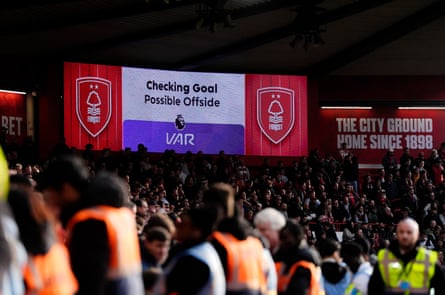
Football used to be our refuge from all this, but now simply reflects the maddening iniquities and inequities of the world right back at us. VAR is like trying to get hold of your bank at weekends. The new Champions League format is the six-seven meme. We have a World Cup in which one of the participants is having the shit bombed out of it by one of the hosts. We have footballers getting booed for the sin of being Muslim. We have mysterious betting sponsors. We have dynamic ticket prices. In short, this is a malaise that cuts deep, that has disfigured our relationship with football in lots of complex ways, and somehow I don’t think banning attacking players from standing in the six-yard box at corners is going to cut it.
“Football is nearly always disappointing,” the literary critic Ian Hamilton wrote a generation ago. “The spectator is conditioned to expect the second-rate.” Does this still hold true in a world of “the product”, where the old rituals are eroding and football is increasingly being redefined as an infinite content stream, something you put on in the background while scrolling through your phone? Does it matter that football on some level has always been awkward and physical, always been boring in large parts, that it has always been in a constant process of evolution and tactical flux?
Perhaps football’s bleak modernist turn, the sense that nothing can ever be good again, will end up consuming it whole. Perhaps the future really is just an endless litigation and relitigation of whether flair players like Ronaldinho would still cut it today. Perhaps some combination of dislocation and dissociation and cynical scheduling and VAR chaos and choreographed throw-ins will kill it entirely.
But I still want to believe. I believe in the good bits and I’m prepared to put up with the bad bits because the high is still like nothing else on Earth. I want to believe this game is still beautiful. I want to see the miraculous save Jordan Pickford made at the weekend, and Alex Iwobi’s goal against Tottenham, and pretty much everything Bruno Fernandes is doing at the moment. I want to feel the joy of the already relegated Rob Edwards on a Tuesday night, and hear the way the Stadium of Light rises when Sunderland go on the counter. Boredom is a choice, and so too, I guess, is beauty.