3 months ago
62
3 months ago
62
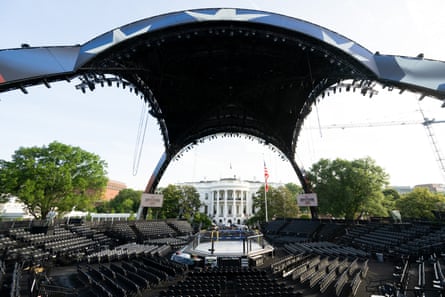
Rising from the South Lawn of the White House is a 92ft-tall skeletal structure known as “the Claw”. Beneath it sits an octagonal cage surrounded by sponsor logos, temporary grandstands and thousands of seats for a mixed martial arts card on Sunday night to celebrate Donald Trump’s 80th birthday and the Ultimate Fighting Championship brand.
The event has prompted comparisons to Idiocracy, Mike Judge’s satire of a future US where politics, entertainment and corporate branding become indistinguishable. Others have gone further, dismissing it as a “kleptocratic spectacle”.
Either way, the commercial trappings are difficult to overlook. Even commemorative “Freedom 250” coins bearing Donald Trump’s likeness are being marketed in tandem with the event at price points ranging from roughly $250 to $12,000.
Strange things are afoot at 1600 Pennsylvania Avenue, all of them giving rise to an obvious question: how did we get here?
The keys decoding this particular extravaganza lead to one man. If it feels like you’ve been seeing Dana White everywhere in the weeks leading up to Sunday’s event, you’re not wrong. The UFC chief executive has appeared on NPR, sat for an interview with David Remnick on the New Yorker Radio Hour podcast, landed a lengthy feature in Rolling Stone and appeared on the cover of Time magazine. It marks a striking turn for a fight promoter who has spent most of his career farming influence outside the traditional centers of power and respectability.
White has become the most recognizable carnival barker in American life since Don King. Unlike King, however, his influence extends well beyond the realm of the fight game. Over the past decade, White has evolved from sports executive into something rarer: a cultural power broker, political surrogate, Meta board member and one of Trump’s most trusted advisers.
And as White’s company stages its improbable White House takeover on Sunday night, the more revealing story may not be the surreal visuals of a private, for-profit sporting event on federal land but the man who helped make it possible. How did Dana White become one of the most influential figures in American politics without ever holding office?
A valuable demographic
The White House event rests on an origin myth that has become central to both men: Trump threw the UFC a lifeline when nobody else would.
The story begins in the early 2000s, when both White and Trump were at their professional low points. The UFC was a fringe spectacle banned in 36 states that the senator John McCain had branded “human cockfighting”. It was struggling to find venues willing to host its events. Trump, meanwhile, was navigating the fallout from his casino troubles and remained years away from the reality-television comeback that would restore his celebrity.
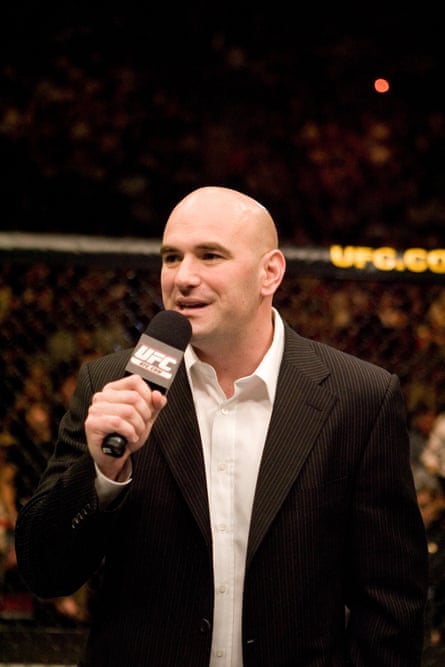
Their interests converged on the Atlantic City boardwalk. Trump’s Taj Mahal casino needed customers. The UFC needed legitimacy. When much of the sporting establishment wanted little to do with MMA, Trump’s resort hosted three events from 2000 to 2001 at a moment when the promotion was still fighting for acceptance.
Today, White tells the story as if the road from the UFC’s outlaw years to the White House lawn runs directly through the Taj Mahal. In reality, for much of the UFC’s rise from fringe attraction to multibillion-dollar powerhouse, Trump was almost entirely absent from the story the UFC told about itself.
That changed starting in 2016. As Trump became the leader of a political movement and White one of its most visible allies, the Atlantic City episode was retconned from a largely forgotten business arrangement into a foundational chapter in their mythology. The friendship may be genuine, but the centrality of the story is a more recent development.
The UFC, now valued at more than $12bn, is often presented as one of the great turnaround stories in modern sports business. The more consequential story, however, may not be the growth of the company itself but the audience that grew alongside it.
Boxing and MMA are typically grouped under the common banner of combat sports. Unlike boxing’s traditional fanbase, which skews older and more heavily Black and Hispanic, the UFC cultivated a younger audience that came of age on WWE, reality television and internet culture. Many consumed information through podcasts, YouTube channels and streamers rather than newspapers, network television or cable news. One industry executive years ago summarized the company’s core demographic to the Guardian as “white kids from the suburbs who grew up watching pro wrestling and aren’t married yet” – a demographic that would soon become one of the most coveted constituencies in American politics.
While other professional sports leagues pursued legitimacy through traditional broadcasters and corporate partnerships, White invested heavily in podcasters, streamers and internet personalities. No figure embodied that evolution more than Joe Rogan, whose rise from UFC commentator to one of the world’s most influential media personalities mirrored the growth of the promotion itself. The Nelk Boys, Barstool Sports, Theo Von and Adin Ross were not peripheral figures but central characters in a growing alternative-media ecosystem that commanded the attention of millions of young men.
By the time the political-consultant class caught up and began hand-wringing about podcasts and “the manosphere”, White had a two-decade head start in cultivating one of its most valuable audiences. That helps explain why Trump’s appearances at UFC events – he’s attended four as a sitting president – felt different from his appearances elsewhere. He was not entering hostile territory or attempting persuasion, but stepping into a community whose media habits, cultural references and distrust of traditional authority often aligned with his own political appeal.
The overlap extended beyond audiences and media platforms. Over time, White and Trump came to share a similar relationship with the press. Long before politicians began speaking of “fake news”, White was treating journalists less as intermediaries than as adversaries. He publicly feuded with reporters, mocked unfavorable coverage and frequently portrayed criticism as evidence of bias rather than scrutiny. Reporters who crossed the promotion risked losing access, while others became targets of public ridicule.
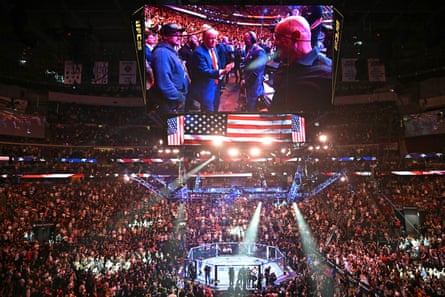
The hostility was not identical to Trump’s, nor is it clear who influenced whom. But the tactical parallels became increasingly difficult to ignore. By the time Trump emerged as the dominant force in Republican politics, he and White were operating from remarkably similar playbooks.
The similarities don’t end there. Trump built his reputation as a dealmaker while facing decades of complaints from contractors and vendors who said they were never fully paid. White built the UFC into a global powerhouse while fending off criticism from fighters who argued they received too little of the sport’s revenues. Operating in different industries, both men developed a similar reputation: relentless promoters who created empires, and critics who argued they kept too much of the value for themselves.
An American spectacle
The relationship, largely dormant and out of public view, moved to the foreground during Trump’s 2016 presidential campaign. White emerged as one of the candidate’s most loyal surrogates, speaking at the Republican national convention and vouching for a nominee many establishment Republicans still viewed with suspicion. He returned to the convention stage in 2020 and again in 2024, becoming a fixture in Trump’s political orbit.
As Trump’s influence grew, so did White’s usefulness. The UFC’s audience increasingly overlapped with a demographic both parties struggled to reach. When Trump sought appearances with Rogan, Theo Von and other podcast hosts during the 2024 campaign, he was moving through a media universe White had spent years helping legitimize, connect and amplify through the UFC.
During the 2024 campaign, Trump credited White with helping facilitate the Joe Rogan appearance that became one of the defining media moments of the election. White occupied a position few political operatives could match.
That helps explain the significance of White’s recent media blitz. In many of the interviews ostensibly promoting Sunday’s White House card, White spent as much time discussing Trump, politics and cultural influence as he did the fighters themselves. The shift is revealing. Dana White is no longer merely promoting fights. He occupies a rare position at the intersection of entertainment, politics and alternative media, helping connect figures who increasingly shape how millions of Americans consume information. The UFC increasingly functions as a parallel campaign arena: a place where Trump performs strength, bypasses traditional media and reaches voters who may never watch a cable news broadcast.
Which brings us to Sunday night. The temporary arena covering the South Lawn resembles something between Close Encounters and a giant arcade claw machine. More than $60m has reportedly been spent transforming one of the most recognizable pieces of public land in the United States into a venue for cage fighting. Viewed in isolation, the spectacle is easy to dismiss as another Trump-era curiosity.
But the White House card reaches far beyond the sports pages. It is the culmination of several trends that have been converging for decades: a quarter-century relationship between Trump and White, the rise of an alternative media ecosystem, a political alliance forged through mutual benefit and a sports promotion that has grown into a $21.4bn empire following its merger with WWE. In that sense, the White House’s semiquincentennial cage-fighting spectacular is not a departure from the US but a reflection of the new normal: loud, gilded, hypermediated and impossible to untether from politics.
The White House says the UFC is covering the costs of the event, which is expected to cost more than $60m to stage while commanding the resources of seven federal agencies. Yet the expense is best understood as an investment in a spectacle from which nearly everyone involved stands to benefit. The UFC gains unprecedented exposure while Trump gains a made-for-television celebration that coincides with both the 250th anniversary and his milestone birthday – a spectacle it appears even the G7 summit was willing to adjust its schedule for.
On Sunday night, fighters will make their entrances from the Oval Office to an octagon erected on the grounds of the White House. They are scenes that would have been unthinkable even five years ago, but they are the visible endpoint of a relationship that helped reshape our new world.