2 months ago
117
2 months ago
117
Mikael Robertsson and Olov Lindberg did not set out to build one of the pre-eminent monitors of global airspace. In a bid to draw more eyes to their Swedish flight price comparison portal, the entrepreneurs added a page charting air traffic.
That page became Flightradar24, the portal that people around the world now turn to when there is chaos – and drama – in the skies.
“Very soon this flight tracker … became more popular than the price comparison [tool] itself,” recalled Robertsson, who spoke to the Guardian from the firm’s office in Stockholm. In 2010, when the eruption of Iceland’s Eyjafjallajökull volcano released a vast cloud of ash that grounded flights across Europe, millions turned to Flightradar24 to monitor flight movements (or lack thereof) in real time.
It was the first time the platform attracted an influx of curious users, keen to watch a major event unfold in real time. It wouldn’t be the last.
“You can pick any kind of major aviation event you want after that,” said Fredrik Lindahl, chief executive of Flightradar24 – from the disappearance of Malaysia Airlines Flight 370 in 2014 to the onset of the Covid pandemic, which crippled the travel industry in 2020.
While crises affecting millions can trigger a sharp increase in the platform’s audience, so too can the flight of a single individual. When the late Russian opposition activist Alexei Navalny was evacuated to Berlin to be treated for suspected poisoning in 2020, and when he returned to Russia in 2021, users followed both journeys live in their droves.
In recent days, as the US-Israel war on Iran rapidly cleared the airspace over the Middle East, prompting widespread travel chaos that disrupted hundreds of thousands of travellers, viewers from around the world gravitated to the platform.
On Saturday, after the US and Israel launched airstrikes on Iran, and Iran deployed a barrage of retaliatory missiles across the Middle East, countries across the region swiftly shut their airspace.
On Flightradar24 the impact on aviation was clear. With large swaths of the Middle East closed to air traffic, two narrow flight corridors emerged, crammed with little yellow plane symbols – the first to the north of Iran, through the Caucasus, but below Ukraine’s closed airspace, and the second to the south, through Egypt, Saudi Arabia and Oman.
“For each big aviation event, we do get a big traffic spike, and then it sort of dies down,” Lindahl said. “But the traffic stays slightly higher than it was before.”
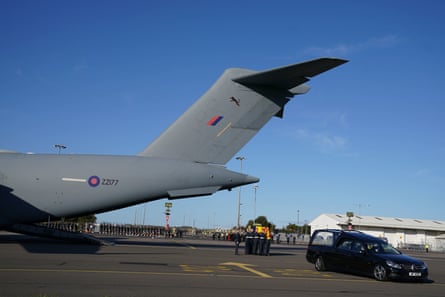
No event has yet drawn more attention to Flightradar24 than the journey of the late Queen’s coffin in 2022, when 4.8 million people followed the plane’s short journey from Edinburgh to Northolt.
How does it work?
Flightradar24 tracks all this through a network of about 58,000 radio receivers, including a dozen in Antarctica.
It started with just two, installed by Robertsson and Lindberg on their respective homes, after they learned it was possible to monitor airspace with devices bought from the UK.
“It sounded like something impossible,” said Robertsson. “Like, how can you track air traffic with a small box? I would probably classify it as scam if I found something like this today.”
Every aircraft has a transmitter, sending out flight information – its callsign, position, direction, speed and altitude – which is collected by receivers.
By early 2010, up to 40,000 people were visiting Flightradar24 each day. When Eyjafjallajökull erupted that April, it spewed out a gigantic ash cloud which closed over 300 airports, grounded more than 100,000 flights – and gave rise to an extraordinary surge of interest in global airspace. “I think we had, like, four million visitors in a couple of hours,” said Robertsson.
As war broke out in Iran and the surrounding region on Saturday, visits to Flightradar24 were more than double the norm.
“Saturday was a spike, then we went down a bit on Sunday, and then a bigger spike on Monday,” said Robertsson. “And now we’re slowly, slowly, losing some traffic again.”
Flightradar24 has built a business around this intermittent audience, marketing a premium tier with more data to its most avid users. Subscriptions account for about 70% of its revenue, and it also sells commercial packages to industry operators, as well as advertising.
The platform is reliant on aviation enthusiasts. “We’re really trying to have a very strong free product because … what underlies all this is like the crowdsourced aspect of Flightradar24, with people around the world hosting our receivers,” said Lindahl.
To maintain a reliable map, “we need to have a strong product, that a lot of people are exposed to”, he added. “And then, some of them will become interested enough to maybe think ‘oh, maybe I should host one of these receivers.’”
Today Flightradar24, which sold a 35% stake to Sprints Capital, a London-based venture capital firm, in September 2025, has a base of more than 1.5 million paying subscribers, and typically attracts about 60 million free viewers to its website each month.
“It will definitely be higher in March,” said Lindahl.