2 months ago
81
2 months ago
81
“At this point, it’s Israel/Palestine. Rangers/Celtic. No one remembers how it got started. All they know is, ‘I like this team and I don’t like that team.’ The whole country’s gone fucking mad. It’s what happens in a civil war – everyone starts thinking with the blood.”
In a new play simply titled The Battle, those words are spoken by a fictionalised Damon Albarn, as he leads his band Blur into a contest with Oasis for a summer No 1 and the de facto kingship of Britpop. But then he recoils as he wonders what on earth he has got involved in. Musical considerations inevitably take second place to sales figures, as the brief, superficial friendship between the two groups curdles into a poisonous loathing, mostly on the Oasis side. And, ironically, the band that has a thoroughly uncomplicated relationship with fame and success – the one fronted by the dependably mad-for-it Gallagher brothers – ends up losing out to a quartet whose victory instantly fills them with angst and emptiness.
The Battle – two hours of vivid, knockabout pop-cultural history, which I just saw at Birmingham Rep, ahead of its move to Manchester – is the work of John Niven, the former musician and music industry insider who recently published a profoundly moving family memoir titled O Brother, but is still most renowned for his grimly comic 2008 record-biz novel Kill Your Friends.
Turned into a film in 2015, the story drew on all the excess and venality of the period The Battle is set in. What this new work most vividly deals in, though, is the eternal British fixation with class, which the Blur-Oasis clash was steeped in, something proved by a skip through the mountain of press coverage.
As well as comparisons with the Beatles and Rolling Stones, this subtext was everywhere. The Guardian’s most pointed headline was, “Working-class heroes lead art-school trendies”, while in the eyes of the long-defunct Today, “Clean-cut middle-class southern boys” were fighting it out with “Rebellious working-class northern lads”.
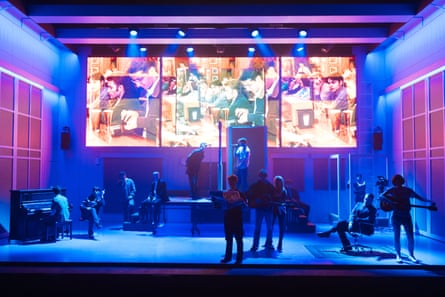
Niven’s script is full of sharp signifiers of this stuff. When Liam Gallagher tells Noel he fancies Justine Frischmann (Albarn’s then-girlfriend and the leader of the three-quarters female quartet Elastica), he’s told he should stay in his social lane: “Her and Damon, right, they’ve got degrees and that. They’re sat round reading the Sunday Times and making fucking risotto or whatever.” Risotto, described by Noel as “rice cooked in Bovril”, soon becomes a running joke. Most of all, it is class that explains the deep difference between the songs created by Noel and Albarn: when it comes to the common people, says one character, Albarn “writes songs about them”, whereas Noel “writes songs for them”.
As Albarn’s “thinking with the blood” soliloquy suggests, there is a sense here of cultural premonition. Once the giddy, carefree 1990s had passed, Britain slowly moved into the regional division and seething polarisation that was symbolised by the Brexit referendum of 2016, and arguably still defines its national condition. There are plenty of moments in The Battle, in fact, when latterday divisions (Leaver-Remainer, woke v unwoke) are seemingly projected on to the events of 30 years ago. In that sense, what really hits home is the somewhat tragic sense of a comparatively innocent Britain where such differences could be entertainingly played out in a thrillingly daft clash between two bands, rather than through a country actually tearing itself apart.
At three decades’ distance, it has to be said: the Blur-Oasis fight centred on two singles that hardly number among either band’s best. The former’s Country House was an outwardly straightforward pop song that hid a lyric about depression (witness not just a reference to Prozac, but the crestfallen middle section: “Blow, blow me out, I am so sad I don’t know why”) which was hard to discern in all its oompah-oompah merriment. Roll With It, meanwhile, was a poor relation to Noel’s best work as a songwriter: its energetic nod to early Beatles was combined with the leaden vibes of Status Quo, something mockingly pointed out by Albarn during an interview with Chris Evans on Radio One’s breakfast show.
But, inevitably, artistic considerations didn’t matter. The race for No 1, which climaxed on Sunday 20 August 1995, was the perfect story to fill the usual summer news vacuum, while bringing even more money into the coffers of a music industry that Britpop had spectacularly revived.
The clash was the result of Blur’s people receiving word that Oasis were releasing Roll With It a week before Country House, and fearing it would keep their band off the top spot. As the late Andy Ross, co-founder of Blur’s record label Food, later told me: “We thought they were being mad. But the thing is, a No 1 record tends to have a better-than-evens chance of being No 1 the week after, just because it’s on Top of the Pops and all the kids hear it. We had to move the release date. We could have pushed it back a week or two, but that would have looked like chickening out.”
And so, amid plenty of ill-advised bravado, the battle commenced. I was 25 at the time. I’d spent three years at the New Musical Express, for which I interviewed both bands. (A single titled Wibbling Rivalry, a recording of the verbal dust-up between Liam and Noel that defined my encounter with them, reached No 52 in the singles chart in 1996.) I had just taken a job as features editor at Q magazine, which was busily moving away from pre-90s pop and rock aristocracy – Chris Rea, Dire Straits, Simply Red – and embracing Britpop.
Our offices were in the same block as the HMV shop near Oxford Circus. I remember two things about the week Roll With It and Country House came out: daily visits downstairs to try to suss out which single might be in the lead; and running into Alan McGee, president of Oasis’s label Creation, after buying Country House. I showed him what I’d purchased and excitedly said it felt like voting. He shrugged and said: “The whole thing’s mad.” I could tell he really was bamboozled.
So were a lot of other people. In the run-up to the supposedly big week, there was a sense of the two bands twisting themselves into contorted and unbecoming shapes. In Blur’s case, the competitive drive that had first set Albarn against grunge music, then his arch-enemies Suede, then Oasis, not only got the better of him, but temporarily distanced him from Graham Coxon, the guitarist and artistic partner he had known since school. Meanwhile, in an interview with the Observer’s Miranda Sawyer, Noel decided to illustrate his loathing of Albarn and Blur’s Alex James in the most awful way imaginable: “The bass player and singer, I hope the pair of them catch Aids and die, cos I fuckin’ hate them two.”
Such was Oasis’s unstoppable momentum that this incident – which Niven’s script combines with homophobic talk from Liam that sits awkwardly with the play’s sense of levity – was quickly forgotten. Partly because Blur put out a second CD of Country House, their song sold 274,000 copies, while Roll With It managed 216,000. But as anyone over 40 knows, having lost the battle, Oasis then comprehensively won the war.
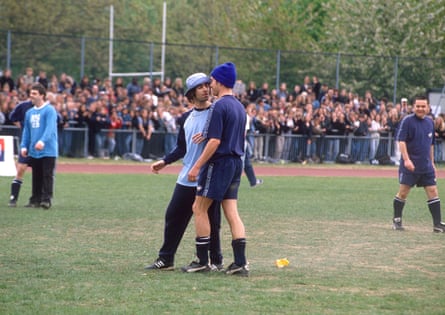
By the end of 1995, Wonderwall had taken them into an orbit that was theirs alone, and (What’s the Story) Morning Glory?, their second album, was selling huge amounts, not just in the UK, but in the US, a market Blur had never managed to break into. “The end of that year was the Wonderwall Christmas, wasn’t it?” James later reflected. “I remember Damon coming round to my flat one evening, with real fear in his eyes. I think he’d been told he was a wanker and thumped six times on his way round. He was the uncoolest man in Britain at that point.”
To its credit, The Battle is true to the breathless, cartoon-strip sense of the time, full of knowing lines and a deep appreciation of the characters who speak them. For anyone familiar with the real-life story, some of the casting will seem rather off: Mathew “Gavin and Stacey” Horne plays Andy Ross as a calculating svengali rather than the self-deprecating, wily man he was; and why the famously urbane Frischmann speaks in an adenoidal estuary accent remains a mystery. But the portrayal of Noel and Liam Gallagher by two unknowns – respectively, Paddy Stafford and George Usher, who has never acted professionally in a theatre before – is perfect. Stafford is all furrow-browed purpose and control, whereas Usher completely inhabits a role defined by the lack of any brake or filter.
Liam could perhaps behave like that because, by modern standards, the Britpop generation’s world was so small. There was no social media. Careers were made by the weekly music press and Radio One. If 1995 did see “civil war” and “thinking with the blood”, it was largely pantomimic. As the audience filed out of the production I saw, you could sense what was coursing around their minds: the feeling that, in every conceivable way, such a battle will never, ever happen again.