3 months ago
73
3 months ago
73
Sports people can be more than the sum of their athletic achievements. Lewis Hamilton stands unquestionably as one of the greatest drivers in the history of Formula One having delivered both records and outstanding performances that will be hard to surpass. Yet it is indicative of his character that the seven-time world champion rates them all as sitting only alongside what might ultimately be his most significant and long-lasting legacy. His Mission 44 foundation is making an indelible impact on the makeup of motorsport.
“Talent is everywhere, opportunity isn’t and that’s what we’re here to change. Setting up Mission 44 is one of the things I’m most proud of,” Hamilton says, reflecting on the foundation he created five years ago. “I’ve been working in F1 for 20 years and I know first-hand how important it is to have representation in our sport, and how difficult it is for young people to get an opportunity.”
Mission 44 came about because Hamilton was acutely aware of the lack of representation of black people and those from disadvantaged backgrounds in motorsport. In 2021 he established the Hamilton commission to investigate the causes and subsequently created Mission 44 to address them. The foundation supports schoolchildren facing poverty and a lack of role models encouraging a pursuit of science, technology, engineering or maths (Stem) skills and careers in motorsport.
Hamilton put his money where his mouth is by investing £20m in the project and its impact was felt immediately. Focusing on grassroots investment to make education more inclusive and to help young people into Stem careers, there have been 550,000 young people involved across the world and 50,000 helped specifically in the Stem and motorsport areas, with over £9m awarded in grants.
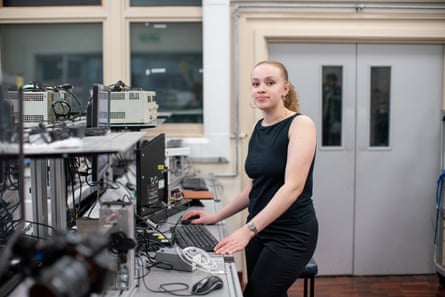
Yet alongside the numbers are the human stories. In order to directly influence motorsport, in 2022 Mission 44 launched its scholarship programme in partnership with the Royal Academy of Engineering, which would meet the costs of scholars from black or mixed black backgrounds to study for a master’s degree in motorsport engineering. This year it will fund them to the tune of up to £43,000 per person, as well as offering vital mentoring, networking and career support. It has proved to be life-changing.
Of the 13 students who have taken part in the first two years, all completed their master’s and eight now work in F1 or motorsport. Lily Owuye is one of them. The 23-year-old was part of the second cohort of Mission 44 scholarship students and now works as a performance and simulation engineer for Red Bull Advanced Technologies as part of their graduate scheme, the Red Bull engineering academy.
Owuye, from Warwick, studied at Imperial University and having decided she wanted to go into motorsport needed to specialise in automotive engineering at master’s level. Mission 44 helped make it happen.
“I can 100% say it wouldn’t have been possible from a financial perspective if I didn’t have the support of the scholarship,” she says. “Without the financial support, I wouldn’t have been able to study a master’s. It’s as simple as that.”
In the same cohort as Owuye was Chris Tagnon, who was backed by Mission 44 to take his master’s at Cambridge. He then went on almost immediately to take a role as the engineering associate to the managing director of the special projects division of Aston Martin performance technologies, the commercial engineering arm of the Aston Martin F1 team.
Tagnon grew up in Paris with his F1 fan father who took him to his first race when he was four in 2007 at Magny Cours. It was the year Hamilton made his extraordinary debut in the sport and highlighting the importance of role models. Hamilton has been part of Tagnon’s life ever since.
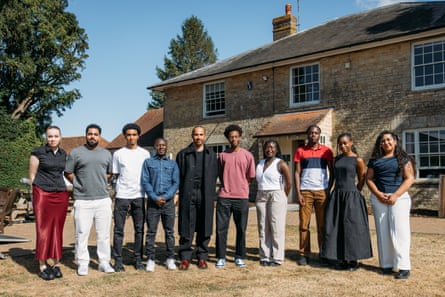
“I often get asked about kind of representation in the sport and: ‘How did you know that you could go into it?’” he says. “It’s never really been a question I’ve asked myself just because Lewis has always been there, my first memories was his rookie season, so my entire life Lewis has been in the sport.
“I have been used growing up and going into my career to being the only black person in the room and company and around. It’s something that you feel slightly less lonely in when you have a role model like Lewis Hamilton, who’s also the only one but that doesn’t necessarily stop him from being the best.”
Tagnon too is clear about the difference the backing of Mission 44 has made and that it extends way beyond the financial.
“It’s been a gamechanger. Frankly, I wouldn’t have gotten this role if it wasn’t for the scheme,” he adds. “The access which it granted that wouldn’t have been possible without the scholarship and the exposure the scholarship gives is something that’s going to continue to follow me probably for the rest of my career.”
Both Owuye and Tagnon met Hamilton at the British Grand Prix last year, when he spoke to all of the scholars privately, a moment both treasure, but they believe it is his role in creating opportunity for which he deserves most praise.
“Lewis’s impact has definitely been major in waking up the industry, building that awareness in the industry that those problems exist,” says Tagnon. “Putting his name, his reputation behind those initiatives has definitely given them a lot of thrust, a lot of impulse to move forward.”
Unsurprisingly then, the foundation has not remained static in its ambitions. Owuye notes perhaps the greatest barrier she experienced was her background – state educated and with parents she describes as not having professional jobs and who had not attended university.
“A defining factor or an obstacle in all of the things that led to this point would be socioeconomic background over anything else and being working class,” she says. “Formula One as an industry historically has tended to hire from, and still do, the kind of elite universities and there’s not a great deal of socioeconomic diversity at those universities. So naturally, as a result, you see that underrepresentation filter into the industry.”
While this has changed more in the last decade in terms of gender and racial mix than it has in the previous 60 years, it has been tortuously slow and there is an awfully long way to go.
As a result this year the motorsport scholarship will be open to 12 students and has been widened to also include, alongside those of black or mixed black heritage, women and those from lower income backgrounds regardless of ethnicity, with applications open until 6 May.
For Hamilton these success stories are only the start. “It’s inspiring to see the impact it’s already having and to watch Lily and Chris begin their journeys in Formula One,” he says. “Their ambition is a powerful reminder of why this work matters. Because the future of our sport depends on who we open the doors to today.”
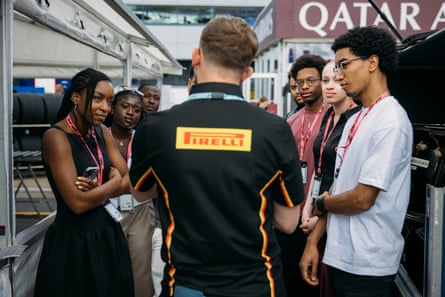
Hamilton returns to the day job with Ferrari this weekend at the Miami Grand Prix as he looks to build on his mighty sporting record but he will also be hosting a trackside experience day and a Q&A with young people from Miami, as part of the Mission 44 program in the US.
“Lewis himself has always known what it has felt like to be the only one from his background, whether it be like racial or socioeconomic, so I guess he will never lose that drive to want to see the change happening, full stop,” says Owuye. “It just comes from Lewis having the selflessness of not wanting others to have to face the same barriers.”