3 months ago
69
3 months ago
69
12 The Poorhouse Fair (1959)
Inspired by and drawing on three British novels (HG Wells’s The Time Machine, George Orwell’s Nineteen Eighty-Four and Henry Green’s Concluding), Updike’s debut imagines a near future where the residents of a care home stage a revolt in which two antagonists, John Hook and Stephen Conner, struggle for supremacy. A curio.
Updike tropes Religion, death
11 Seek My Face (2002)
Over the course of a single day, 79-year-old painter Hope Chafetz endures the determined attention of Kathryn D’Angelo, a young, ambitious art journalist. Updike had by this point been on the receiving end of many such encounters and the novel, told almost entirely from Hope’s perspective, bristles with resentment at the presumptions and blind spots inherent in the situation.
Updike tropes Art, religion
10 S. (1988)
An epistolary novel that draws on Nathaniel Hawthorne’s 19th-century story of adultery and hypocrisy, The Scarlet Letter, to ironise faith and fidelity in the 1980s. As revealed in her letters and tapes, Sarah Worth has abandoned her family to find herself in an Arizona ashram led by the guru Arhat Mindadali. The form allows for a fragmented narrative in which the facts Sarah conceals from her husband and daughter are as telling as the facts she details.
Updike tropes Sex, religion
9 Gertrude and Claudius (2000)
A prequel to Hamlet that focuses on the tangled love lives of the prince of Denmark’s father, mother and uncle stops short before Shakespeare’s bloody denouement. Gerutha (Gertrude) is married off in her teens to the coarse Horwendil (Hamlet senior) while harbouring a reciprocated passion for Feng (Claudius). The omens are not good. As with Tom Stoppard’s play Rosencrantz and Guildenstern Are Dead, the deeper your knowledge of Hamlet, the more you will enjoy Updike’s embellishments.
Updike tropes Sex, family
8 Memories of the Ford Administration (1992)
The reader will learn very little about Gerald Ford, the 38th president of the United States, from this novel. James Buchanan, the 15th president and something of a minor obsession for both Updike and his narrator Alfred L Clayton, is given slightly more room but what concerns Clayton most is his overboiled erotic memories. Clayton is a history professor well aware that there is no correct interpretation of the past. Clayton’s account of his infidelity and the failure of his marriage is appropriately partial, misleading and self-regarding.
Updike tropes Sex, family

7 The Centaur (1963)
Chiron, the wise centaur with a fatal wound, stands as an allegory in this novel for the teacher George Caldwell. His son, Peter, recognising his father’s suffering and frustration, determines to escape a similar fate through art. Updike himself achieved the escape that Peter dreams of but, as this early novel demonstrates, he would mine the memory of small-town life for the rest of his career.
Updike tropes Religion, family
6 The Witches of Eastwick (1984)
Adapted into both a film with a stellar cast (Cher, Susan Sarandon, Michelle Pfeiffer, Jack Nicholson) and a successful musical, the novel is strong enough to stand apart from those glitzy distractions. The arrival of Darryl Van Horne in a tight-knit New England enclave stirs diabolical feelings in Alexandra, Jane and Sukie, the eponymous sorceresses. Fatal mayhem naturally ensues. With its gossipy tone, the story doesn’t take itself too seriously and neither should the reader.
Updike tropes Sex, death
5 Of the Farm (1965)
The publication of Updike’s immaculately crafted fourth novel served notice that a once-in-a-generation talent had arrived. Joey Robinson brings his new wife and her child from a previous marriage to the Pennsylvania farm where he grew up to meet the matriarch who struggles to manage the place alone. Through a painstaking accumulation of telling details Updike reveals the tensions between the three adults and the inexorable reality of change.
Updike tropes Sex, family
4 The Complete Henry Bech (1993)
This edition gathers together short stories – Bech: A Book (1970), Bech Is Back (1982) and Bech in Czech (1987) – featuring peripatetic Henry Bech in a fictional mashup of Jewish writers Norman Mailer, Saul Bellow and Isaac Bashevis Singer (with a dash of Waspish JD Salinger). Our antihero lives in the shadow of his own celebrity, gives speeches behind the iron curtain, accepts awards at prestigious universities, and spreads the message on the “Cultural Situation of the American Writer” to readers in Ghana, Korea, Venezuela and elsewhere. The irony is that such far-flung adventures are inimical to the writer’s creative process, generating existential anxiety. Updike carries off the satire with a light touch, affectionately sending up literary squabbles and personal rivalries.
Updike tropes Religion, sex, death

3 Couples (1968)
This is the novel that made Updike rich and famous and put him on the cover of Time. Readers who look into it hoping to find graphic depictions of middle-class adultery will not be disappointed, but they will also get beautifully wrought accounts of religious doubt, vivid descriptions of commonplace life and sharp observations of social mores in early-60s America. The plot involves the tortuous romantic machinations of 10 couples. At the heart of the action is Piet Hanema, whose need for extramarital sex is matched by his desire for communion with the divine. His life will be shattered by both.
Updike tropes Sex, religion
2 Roger’s Version (1986)
When this novel was published, its premise that the existence of God could be proven through a computer programme seemed cutting edge. If that now strikes the reader as quaint, the author’s virtuoso upending of his reputation for social realism remains enthralling. We are trapped in the head of Roger Lambert as he obsessively conjures an affair between his wife and a young student, describes his own scandalous relationship with his half-sister’s daughter, and proudly displays his familiarity with the Latin scholarship of the early Christian theologian Tertullian. How much is real and how much can we rely on the omniscient voice of Roger?
Updike tropes Sex, religion, adultery
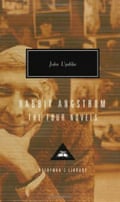
1 Rabbit Angstrom: the four novels (1995)
The author’s supreme achievement – if you have never read any of these novels, jump right in at the start and work your way through to the heartbreaking finale. To rank each work in turn, they go: Rabbit at Rest (1990), Rabbit Is Rich (1981), Rabbit, Run (1960) and Rabbit Redux (1971). A separately published novella, Rabbit Remembered (2001) , is a disappointing misfire. Taken as a whole, the tetralogy offers an unforgettable portrait of the life of the white middle-class American male in the last century. Harry “Rabbit” Angstrom is priapic, patriotic and prone to bouts of religious introspection. When we first meet him, he feels trapped in a stale marriage, his days as a feted high-school baseball player behind him, long years of existential emptiness ahead. Those years will cover the counterculture explosion of the 1960s, the monied excess of the early 1980s and the bitter realisation by the close of that decade that unbridled materialism has poisoned the body corporeal and politic. Updike’s gifts for vivid description and apt metaphor have never been surpassed.
Updike tropes Sex, religion, death