2 months ago
56
2 months ago
56
Researchers led by the Australian scientist Tim Flannery have made a once-in-a-lifetime discovery: that two charismatic marsupial species that had been thought extinct for 6,000 years are alive in rainforest in remote West Papua.
The pair are rare examples of “Lazarus taxa” – species that disappeared from fossil records in the distant past that are later found to have survived.
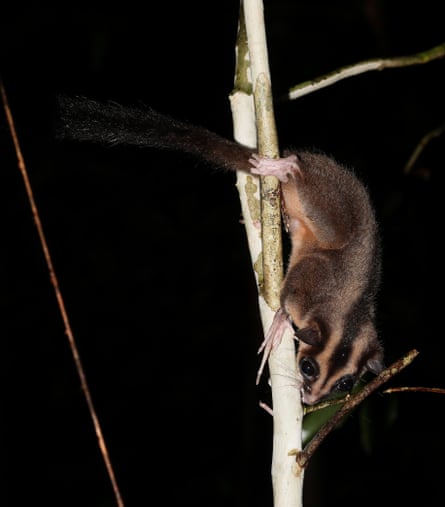
One of the species is a striped possum with an extraordinarily elongated fourth digit, twice as long as the rest of its fingers, that it uses to extract and feed on wood-boring insect larvae. Fossil records had previously indicated the species, known as the pygmy long-fingered possum (Dactylonax kambuayai), lived in Australia’s central Queensland region about 300,000 years ago but seemed to have vanished during the ice age. Before the recent discovery, it was last known to have lived in West Papua until about 6,000 years ago.
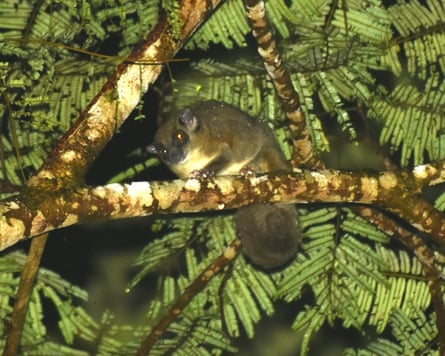
The other is a ring-tailed glider (Tous ayamaruensis), closely related to the Australian greater glider, but with unfurred ears and a strongly prehensile tail used for gripping. It was first described by the late Australian zoologist Ken Aplin, who pieced together fossil fragments found in West Papua late last century. Flannery’s research team found the species was still living in the rainforest and identified it as part of a newly described taxonomic group, or genus, of marsupials. Other species from the genus lived in eastern Australia and New Guinea hundreds of thousands of years ago.
Flannery is best known as a climate campaigner and the author of the international bestselling The Weather Makers, but he made his name in science as a mammalogist and palaeontologist working in New Guinea and Pacific islands. He says the likelihood of finding one mammal species that had been thought gone for millennia was “almost zero”.
The chances of finding two? “It’s unprecedented and groundbreaking, really, to find two Lazarus taxa,” Flannery says.
The 70-year-old says the identification of a new genus, in particular, felt like a “lifetime achievement, shared with all our many other co-authors”. It is the first new genus of New Guinean marsupial described since 1937.
“We’ve been able to finalise two pieces of work that are incredibly important from a biological and a conservation perspective, documenting the existence of rare marsupials in an area under threat,” Flannery says. “It’s sort of a crowning glory in my career as a biologist.”
Both species live in lowland mountain forests on the sparsely populated Bird’s Head peninsula, also known as the Vogelkop, in the north-west of the Indonesian-controlled part of New Guinea.

Their existence was established through photographs taken by local researchers, fossil fragments and, in the case of the long-fingered possum, a museum specimen that was collected in 1992 but initially misidentified and used for teaching. The discoveries are detailed in a special edition of a peer-reviewed journal published on Friday by the Australian Museum, where Flannery is a distinguished visiting fellow.
They are in part a result of Flannery’s repeated trips to the Vogelkop, where he works with Indigenous elders, researchers from the University of Papua, the Global Wildlife Fund and the Minderoo Foundation to protect forests from logging and leave them in the control of traditional owners. He says the research underscored the importance of preserving the area’s unique environment.
David Lindenmayer, an ecologist and professor at the Australian National University who was not involved in the research, says the revelations are “amazing stuff”.
“It’s fantastic to see new species still being discovered, and it shows the importance of some of these rainforests in very remote parts of the world where there hasn’t been much study in the past. I think it’s quite remarkable,” he says.
The ring-tailed glider is considered sacred by some Vogelkop clans, who believe it is a manifestation of ancestors’ spirits. Rika Korain, a local Maybrat woman and a research co-author, says the species could not have been identified without the help of traditional owners. “This connection has been essential,” she says.
Flannery says the discoveries are evidence the Vogelkop was once a part of the Australian continent that had later become part of New Guinea. The link is the subject of another paper in the journal, and may have wider implications. “Its forests may shelter yet more hidden relics of a past Australia,” he says.