2 months ago
92
2 months ago
92
One of the best parts of following football across the world is the way it drags you into special places, local shrines, objects of profound cultural connection. The US, of course, has these holy spaces too.
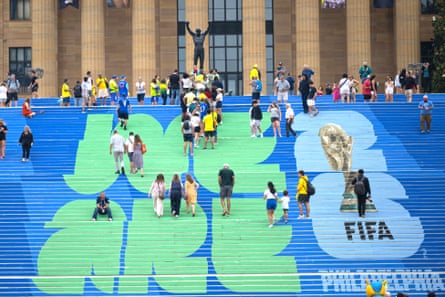
The queue of pilgrims in Philadelphia on Thursday morning stretched down the sun-blasted steps to the plaza at the bottom. Edging forward, the people in their ritual colours approached the figure at the top, arms outstretched in supplication, in a state of hushed deference. Called finally for his moment of communion, the man at the front of this line straightened his Ronaldinho shirt, clenched his fists above his head for the ceremonial Insta pic and shouted: “Adrian! I did it.”
This is of course the Rocky statue, the most popular public visitor site in the cradle of US history, and the only place in town for thousands of Brazil and Haiti fans, visiting for their Group C fixture and looking for the chance to grab a little pure Americana.
The Rocky statue is all about those clenched fists above the horizon, cradling the high rises below, holding America’s first city in his human-sized hands. I have a theory about the US and hands. So many of the great self-mythologising American creations have been hand-sized. The Hamburger. The .45 Colt. The baseball mitt. The onanism industry of Big Porn. The chocolate chip cookie, which was produced so workers could carry them to their fields and factories.
All of these creations are designed to fit the hand, in a way that is scalable and democratising, with the suggestion that this vast and brutal land can be cut down to human scale, that you can hold a piece of it in your palm. All the Cokes are the same and all the Cokes are good. The settler’s dream is nonexclusive. All you need is a pair of hands.
This is of course not true. The US is also a violently stratified place, built on slavery, with centralised power, vicious edges and a recent history of blood-soaked economic colonialism. As opposed to, say, just being about doughnuts. But that’s the thing with dreams. They’re deceptive and confusing, but they may have just a little bit of truth in them.
This theory goes on to conclude that the moment the US began to lose the run of itself and fall into cultural decline was when it lost this connection to hand-sized scale. Suddenly the US is assailing its citizens with food so big you can’t even hold it, the vast and tumorous burger that explodes all over your face, the bin-bag-sized packet of crisps, the three-gallon container of vanilla Sprite. It’s out there inventing ways to further alienate not just itself, but the entire world, handing power to a weird coterie of tech gods, shifting our shared existence into a limbless digital space.
The end of the US won’t lie in political revolution or tanks on the hill. It’s choking to death on a basketball-sized M&M behind the non-wheel of your self-driving car, while on the White House lawn a cloud-based AI president tosses a virtual non-football around with its armless robo-offspring. And before you raise a hand to rail at this wild anti-US Euro propagandism, you might want to look down. You don’t have any hands.
What does this have to do with the World Cup of Mexico, Canada and the US, 11 days into what we have been assured is the greatest event staged by humanity? It is customary at this stage to assess proceedings on the football side. Attendances, goals per game and host-nation logistics will be graded and frowned over.
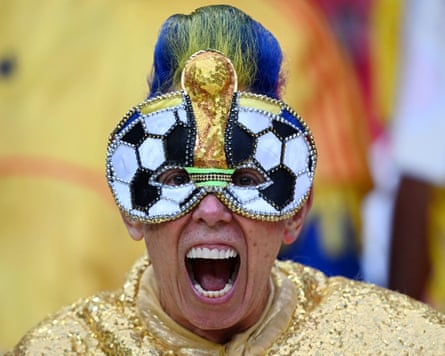
It isn’t hard to compose a list of don’t likes. Bad: the wretched and mendacious mid-half advert break. The boggle-eyed posturing of the Fifa president. The fawning over irrelevant celebrities. And the good: American cities, American stadiums, the warm and functional diaspora feel, and the games themselves, which have been breezy and fun.
But this World Cup was never really about all that. As with the last one in Qatar, it will be a success on its own terms whatever happens. These are: to make $14bn (£10.6bn) via the marketing of 300 hours of television content; to turn its face away from the pre‑converted saturation of Europe and to reach into the world’s greatest leisure market; and to shore up Gianni Infantino’s unassailable war chest before his acclamation for a third term.
As such, this World Cup has always really been about the US, and the wider question of what you should feel about this place and what it actually is: still the world’s most powerful cultural and economic force, but newly hostile and inward-facing, and now out there battering the world’s favourite shared spectacle into its own shape.
The World Cup in the US has so far revealed one interesting and unexpected thing. Travelling across the country in those opening two weeks from California to Texas to New York, it seems deceptively simple. But here it is. Maybe the World Cup will actually bring the best out of the United States, not the worst.

And yes, nobody actually believes the standard big-sport guff about connection, unity and hands across the volleyball net. London 2012 did not transform the nation. The opening ceremony optics – Paul McCartney breakdancing on top of a giant cheddar cheese – did not create a newly confident and inclusive Britain. There is no legacy, unless you extend this to include becoming much more depressed and angry in the years that have followed.
But maybe this World Cup will be different. Not just because this is a sport that literally models ideas of connection and togetherness. But because of the specific nature of the US’s alienation from the rest of the world.
The most notable part of being here is the confirmation of just how much people around the world do reflexively despise the US now, or regard it solely as a frightening and hateful entity, an agent of only bad things.
There are sound fact-based reasons for this. The US entered this World Cup having recently murdered the head of state of the second-ranked team in Group G, not to mention offering support to a conflict of annihilation in Palestine. The Trump administration is toying with crashing the world economy. The ICE immigration militia is persecuting its own population. Even the World Cup itself is an act of economic violence, priced out of any sensible human scale.
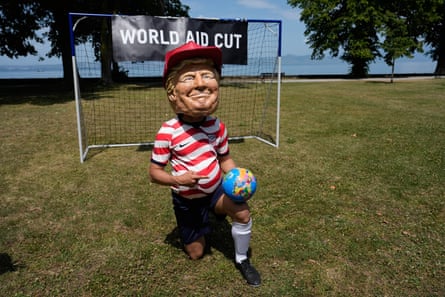
But hatred of the US as a single entity is also a confusing idea, albeit one that fits a certain monotheistic world view, where there can only be devils and angels. It involves demonising as a single failed entity a hugely diverse and varied nation with elements of every kind of people and every kind of culture, the great human experiment, with all its freedoms and flaws; and doing so based on the actions and pronouncements of a few governing Maga Republicans.
If America has become this single thing in so many people’s minds, it is perhaps because this is the way we experience things now. Everything is flattened, foreshortened, turned into sound and noise. Never underestimate the effect of the hive mind, that constant third space we carry around with us. This World Cup is the first global event to take place so deep inside that online space, experienced in peeled-eyeball detail through a screen as a set of images and shouted ideas.
This is how our flow of information works now, and indeed how Donald Trump took power, flooding the zone, shouting the simplest message above the noise. The US may feel like an expression of violence simply in its daily existence, an endless amplification of human talent, greed, desire, cruelty, where nobody is ever really in charge, they’re just out there riding it like a runaway bronco. But the US is also not Trump. Seventy‑seven million people voted for him, 272 million did not. A nation of 350 million people with more than 100 significant immigrant cultural groups cannot be one thing.
The US is the world in a very large and varied grain of sand, endlessly rich in all its beauty, energy, flaws and vices. To hate this is a baffling idea. If you don’t like America, what do you like? This is what humans are.
And like everyone else, Americans are oppressed too, right here in their own nation, by a tier of unelected technology overlords, and by an angry and divisive regime. This is a place that has been poisoning its own people for a hundred years, if not with violence and division, then with food, drugs and mental sludge.
For what it’s worth, the gathering of people under the banner of Fifa’s horribly compromised World Cup has provided a reminder of other things. Meeting people in the real space: this is pretty much an act of revolutionary dissent, a refusal to accept the loss of scale.
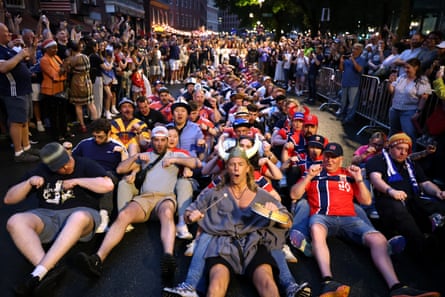
The reception at this World Cup from everyday people has been warm, anecdotally, and on the immediate evidence it is also striking how often people here want to talk about how their country is viewed by the rest of the world, to apologise and explain, to rage against Trump’s isolationism.
Who knows, perhaps the basic mechanics of sport can help point to something else. So many teams model the exact opposite of separation and division. The diaspora XIs of Curaçao and Cape Verde, for example, which are literally telling you what countries are, how they got this way, how they have interacted with the world, and who are now out there sharing moments of theatrical joy and agony, bumping into each other, coexisting.
Does this have any actual value? Nobody really knows. But Egypt and Iran will play in Seattle at the end of June on the Friday of the city’s Pride celebration, two nations where any kind of diverse sexuality is illegal, but who will just have to lump it and take it in; and this is the best of sport, making people confront each other in the real world space, to appreciate that they are not simply cyphers or hostile entities.
Football isn’t going to unite the world but it may just hold up a useful little hand mirror. This is a show that still provides a model of the best, not the worst, of what the US is supposed to be: a place on the human scale, an idea that fits into your hand. And a reminder that feeling hatred for this place, like hating anywhere else, is to fall into the trap of those who seem very happy to weaponise it.