2 months ago
71
2 months ago
71
Introduction: Oil heading for biggest weekly gain in four years
Good morning, and welcome to our rolling coverage of business, the financial markets and the world economy.
The oil price is on track for its biggest weekly gain in four years, fuelling fears of an inflation spike that will reignite the cost of living crisis and hurt growth around the globe.
The Iran conflict has driven Brent crude, the international benchmark, has soared by 17.65% this week to over $85 a barrel. That would be the biggest jump since the week to 4 March 2022, after Russia invaded Ukraine.
Oil has been driven up to the highest levels in 19 months by shortages worries, following attacks on refineries in the region by Iran this week, and on ships in the region.
Ship traffic in the strait of Hormuz has ground to a near-complete halt, according to the Joint Maritime Information Center, the multinational naval advisory group.
The JMIC said in a note that only two confirmed commercial transits had been observed through the strait in the past 24 hours, which were cargo ships and not tanker vessels.
In normal times, around 138 vessels would pass through the strait in a 24-hour period. Now, though, a high concentration of vessels remain at anchor, drifting and at berth in the Arabian Gulf ports, it says.
JMIC’s security threat rating for the area remains “CRITICAL”, which indicates an attack is almost certain.
The agenda
-
7am GMT: Halifax house price index for February
-
1.30pm GMT: US non farm payrolls employment data for February
-
1.30pm GMT: US retail sales report for January
Key events Show key events only Please turn on JavaScript to use this feature
‘Geopolitical uncertainties’ amid Iran war could slow fall in mortgage rates, says Halifax

Mark Sweney
Halifax has warned that the US-Israel war on Iran could slow mortgage rate decreases this year, as it said that house price growth eased dramatically in February.
Halifax, which is part of Lloyds – Britain’s biggest mortgage lender – said the conflict in the Middle East was likely to affect global economies, stoke inflation and reduce the likely rate of interest rate cuts that influence borrowing costs for homebuyers.
The lender said the value of a typical UK home rose 0.3% in February to £301,151.
However, this is a significant dip in the rate of growth compared with the 0.8% recorded in January that fuelled average house prices passing the £300,000 mark for the first time.
House price growth slowed from 0.8% in January to 0.3% in February on @HalifaxBank's HPI. This however pushed annual growth up 1.3%, its strongest in four months. Growth was once again driven by Northern regions; Northern Ireland saw average prices rise +6.3% over the past year.… pic.twitter.com/6C3KWlHJW9
— Emma Fildes (@emmafildes) March 6, 2026Seafarer: ‘We’re powerless … and hoping nothing hits us’:
The Guardian spoke to a crew member on one of the stranded tankers in the Gulf, that typically ferries vast quantities of oil from the Middle East to ports around the world.
They told us:
“When [Donald] Trump said Iran had 10 days to agree to his deal or bad things would happen, I did the math and thought we might get stuck here. And we did.
From a cabin below deck, they explained how the crew watched explosions light up the sky as they loaded the vessel with crude oil at an industrial complex in the Gulf. More here.
UK interest rate cut in March now looking highly unlikely
The chances of a cut to UK interest rates soon are continuing to dwindle.
A cut in March is now just a 16.5% chance according to the City money markets – down from 80% last week before the Iran war began.
The markets are now pricing in just 21.5 basis points (0.215 percentage points) of cuts by December, meaning that a single quarter-point cut is no longer fully priced in either.
Oxford Economics’s Michael Saunders, a former Bank of England policymaker, says central banks want to push back against risks that energy price shocks feed through to inflation expectations.
Saunders writes that the length and magnitude of the energy spike is highly uncertain, adding:
Our updated assumptions assume the energy price shock is relatively short-lived, but the effects on inflation and risks of second-round impacts will be greater if the conflict is more drawn out.
Against this backdrop, the Bank of England’s Monetary Policy Committee is likely to remain on hold for now, keeping policy in restrictive territory.
The oil price is creeping up again this morning.
Brent crude is up 0.37% at $85.75 a barrel, appoaching the $86/barrel level hit yesterday for the first time since July 2024.
The Iranian war has also led to a sharp increase in the amount of crude stored on tankers at sea, as this chart from RBC Capital Market shows.
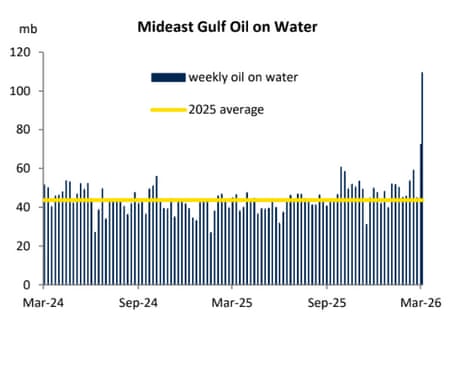
RBC Capital Markets explain:
This week’s Strait of Hormuz closure has driven a scramble for alternate supplies and supported the dramatic surge in tanker rates, Brent-Dubai EFS spreads, and oil-on-water in the region.
Asian markets are some of the most exposed to the ongoing disruption, with the lion’s share of both crude and product cargoes in the Strait historically heading to APAC (though Europe also relies on the Middle East for major portions of its jet and diesel imports).
In fact, the latest sanctions measures against Russia had driven India’s crude buying and Europe’s product imports further towards the Middle East leading up to the conflict. Among changing trade flows, there will be incentives for India and China to shift towards discounted oil (i.e., Russia).
Reports this week had indicated Indian refineries and Russian officials were subsequently eyeing increasing trade, which is now seemingly supported by Washington, with the White House announcing the temporary paring back of punitive measures for the sale of some Russian oil to India.
The jump in energy prices makes it less likely that central banks can cut interest rates, points out Jim Reid of Deutsche Bank:
With oil prices continuing to rise, investors grew more doubtful about central bank rate cuts this year, with the prospect of hikes even coming into view.
That was particularly clear for the ECB, where a hike by December moved up to a 63% chance by the close [yesterday], which is the first time in 2026 that it’s been above 50%. A 55% probability of a cut was priced in as recently as last Friday.
Gold, traditionally seen as a safe-haven asset, has dropped this week.
Gold is down over 3% since the Iranian war began, partly due to a rally in the value of the US dollar.
Today, gold is up 0.7% at $5,112 an ounce.
IMF: 10% oil rise for a year would add 40bps to inflation
International Monetary Fund managing director Kristalina Georgieva has warned that a 10% increase in energy prices that persists for a year would push global inflation up by 40 basis points and slow economic growth by 0.1-0.2%.
Speaking to Bloomberg TV, Georgieva said:
“The world economy has been remarkably resilient. Shock after shock, and yet growth is at 3.3%.
But this resilience is being tested yet again.”
Another energy development: the US has granted Indian refiners a 30-day waiver to buy Russian oil after the US-Israel war on Iran sparked fears of a supply crunch
The US treasury secretary, Scott Bessent, insisted this temporary waiver, designed “to enable oil to keep flowing” into the market, “will not provide significant financial benefit to the Russian government”.
Our main Iran war liveblog has more details:
After a volatile week, Asia-Pacific stock markets are on track for their worst week since the Covid-19 pandemic struck.
MSCI’s broadest index of Asia-Pacific shares outside Japan was on track for a 6.6% drop for the week, Reuters reports, which would mark its steepest weekly drop since March 2020.
Today, Australia’s S&P/ASX 200 index has dropped by 1%, but Japan’s Nikkei is 0.6% higher, and Hong Kong’s Hang Seng is up 1.6%.
Introduction: Oil heading for biggest weekly gain in four years
Good morning, and welcome to our rolling coverage of business, the financial markets and the world economy.
The oil price is on track for its biggest weekly gain in four years, fuelling fears of an inflation spike that will reignite the cost of living crisis and hurt growth around the globe.
The Iran conflict has driven Brent crude, the international benchmark, has soared by 17.65% this week to over $85 a barrel. That would be the biggest jump since the week to 4 March 2022, after Russia invaded Ukraine.
Oil has been driven up to the highest levels in 19 months by shortages worries, following attacks on refineries in the region by Iran this week, and on ships in the region.
Ship traffic in the strait of Hormuz has ground to a near-complete halt, according to the Joint Maritime Information Center, the multinational naval advisory group.
The JMIC said in a note that only two confirmed commercial transits had been observed through the strait in the past 24 hours, which were cargo ships and not tanker vessels.
In normal times, around 138 vessels would pass through the strait in a 24-hour period. Now, though, a high concentration of vessels remain at anchor, drifting and at berth in the Arabian Gulf ports, it says.
JMIC’s security threat rating for the area remains “CRITICAL”, which indicates an attack is almost certain.
The agenda
-
7am GMT: Halifax house price index for February
-
1.30pm GMT: US non farm payrolls employment data for February
-
1.30pm GMT: US retail sales report for January