3 months ago
65
3 months ago
65
Yangang Xing had never heard of organ-tuning books, but his colleague Andrew Knight often played the pipe organ at churches as a teenager.
When the pair, who are researchers at Nottingham Trent University, set out to study how environmental conditions in churches had changed over time, Knight explained that all over the country many organs had notebooks full of data tucked away in their recesses.
“I would sit at the organ between hymns, or between weddings,” said Knight. “Quite often, the only thing to look at between services was this little red book that sat in the corner.”
Xing realised organ-tuning books were troves of data that might span decades. “We said, ‘Oh, this is a goldmine,’” he recalled.
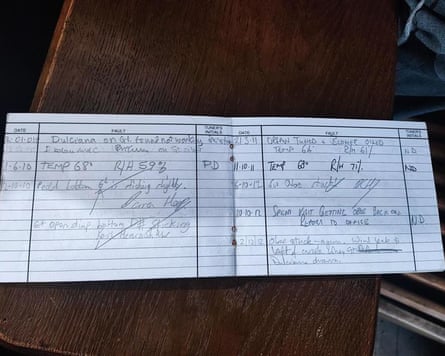
Organ tuners make brief records of their visits and often jot down observations, including the temperature and humidity inside the building. Materials within organs are sensitive to climatic changes, which can knock the majestic instruments out of tune.
Earlier this month, Xing, Knight and their colleague Bruno Bingley published a paper in the journal Buildings & Cities, with preliminary data gleaned from 18 organ-tuning books associated with churches in London, Nottinghamshire and Derbyshire. The records date back to 1966 and indicate a rise in average temperatures inside churches since then, during winter and summer periods.
It reflects that churches are being heated, artificially, to a greater extent today than in the past but also that these old buildings are getting warmer even in summer months when heating systems are more likely to be turned off – a “hint” of global heating, said Knight.
The average summer temperature for urban churches in the sample was 17.2C during the late 1960s. By the 2020s it had reached 19.8C.
“It quantifies what we’ve seen,” said Andrew Scott, the managing director of Harrison & Harrison, a Durham-based company that builds and services pipe organs. “A rise of internal ambient temperature through the unheated summer months due to rising temperatures outside.”
Organ-tuning records could be useful for climate studies, said Neil Macdonald, a professor of geography at the University of Liverpool. “As somebody that’s worked on a lot of historical records of climate and weather, I’ve never come across this,” he said. “I was fascinated.”
It is possible that summer temperatures in churches could be influenced by factors besides climate breakdown, he noted – perhaps some churches were ventilated more frequently in years gone by, for example.
Organ tuners care about temperature because it affects the expansion and contraction of materials such as wood and metal, commonly used in organs, Scott said.
Humidity plays a role, too. One remark left by a tuner and noted by the researchers relates to a church organ in Nottingham. Part of the instrument appeared damaged and more difficult to tune than last time. “Weather? Misty,” the tuner wrote.
While many churches are large, difficult-to-heat stone buildings – making them refuges for some during heatwaves – hot summer weather can still trouble an organ. A change of just one degree celsius may alter the pitch of one of these instruments by 0.8 hertz, said Scott.
That means if an organ is tuned at 16C, for example, and then the temperature later rises to 20C, the notes the instrument produces can be perceptibly different.
Scott’s company has tuned organs all over the world, including in Nigeria, Malaysia and India. In hot countries, keeping an organ in tune is already challenging – climate breakdown threatens to make it harder still. And besides weather, powerful heating systems in churches can affect pipe organs even more profoundly, he added.
Xing said he and his colleagues hoped to analyse more organ-tuning book data and he urged anyone who owned such records to contact him. “If we can find older ones, it would be fascinating,” he said. “I hope people realise the value of tuning books.”
-
This article was first published by The Reengineer