3 months ago
73
3 months ago
73
It was all going a little too easy for Lindsey Vonn, wasn’t it? All of the nervous apprehension, the paternalistic concern, the arch skepticism and hushed snickers that had rippled through the sports world when she announced her comeback from a six-year retirement had long since gone silent. A once-unthinkable fairytale ending at the age of 41 on the slopes of Cortina d’Ampezzo was practically within touching distance.
Back in November 2024, having been chased from the sport in 2019 by a battered right knee worn down by a string of gruesome crashes and multiple surgeries, Vonn proposed a return to a high-risk sport where no woman had ever won a race past 34. There’s a history of comebacks like these going brutally wrong and even Vonn’s most dedicated fans were bracing themselves for the worst. Think Louis getting battered through the ropes and on to the ring apron by Marciano. Or Borg returning to the tour in the early 90s with a wooden racket, defiantly flailing through a sport that had moved on without him.
But a funny thing happened on the way to Vonn’s presumptive humiliation. In the first two months, she finished 14th in a super-G at St Moritz, before improving to sixth and fourth in her next two races at St Anton. Then came this Olympic season. Vonn reached the podium in all five World Cup downhill races she entered – two wins, a second place and two thirds – seizing the red bib as the discipline’s season-long leader and reestablishing herself, against all odds, as one of the fastest skiers on the planet. Conspicuously absent were the injuries and surgeries and chronic pain that had become the familiar punctuation of her career. What could go wrong only one week out from the Olympics?
It turns out plenty. At last week’s final World Cup downhill before the Games, Vonn lost control after landing a jump high on the course in Crans-Montana, Switzerland, skidding sideways into the safety netting as snow fell steadily and visibility deteriorated. Her airbag deployed on impact and she remained down for several moments before she was helicoptered off the course to hospital. Scans later confirmed a complete ACL rupture in her left knee, along with a bone bruise and meniscal damage.
It’s never come easy for Vonn, the 84-time World Cup winner and three-time Olympic medalist, including downhill gold in 2010. Maybe it never was supposed to for the Kima Greggs of the piste: sometimes things just gotta play hard.
All eyes will be on Vonn, the biggest star at the Milano Cortina Olympics, when the women’s alpine skiing begins on Sunday at the Tofane Alpine Skiing Centre with the downhill the first of five medal events. A top-three finish would cap a remarkable comeback rendered even more improbable by the injury. It would also make history, moving her past France’s Johan Clarey – also 41 when he won downhill silver in 2022 – as the oldest Olympic alpine skiing medalist. (She became the oldest woman to medal eight years ago in Pyeongchang.) The setting only adds deeper meaning: Vonn has piled up a record 12 World Cup victories in Cortina, making it one of the defining backdrops of her career.
Her shredded knee passed the first test on Friday afternoon when she posted one of the faster times without obvious hesitation in a downhill training run on the Olimpia delle Tofane course. Even her coach, the two-time Olympic champion Aksel Lund Svindal, sounded cautiously impressed. “She was smart. She didn’t go all in,” he said afterward. “The rest looked like good skiing. No big risk. To me, it looked symmetrical – and that’s what we were looking for today.”
Allow Instagram content?
This article includes content provided by Instagram. We ask for your permission before anything is loaded, as they may be using cookies and other technologies. To view this content, click 'Allow and continue'.
That word – symmetrical – may be the most important medical and competitive data point of her imperiled Olympic campaign. But Svindal went further. “She’s tough,” he said. “If she skis well, she can win. From what I saw today, she could possibly bring that on Sunday.”
By Saturday, the evidence had grown stronger. Vonn clocked the third-fastest time in the second downhill training session, reaching a maximum speed of 78.7mph (126.7km/h) and finishing 0.37 seconds behind leader and US teammate Breezy Johnson, another indication that Sunday’s start will be for more than a participation trophy.
Not everyone is convinced the story is quite that simple. On Friday, an online exchange between Vonn and a sports medicine doctor briefly became its own subplot. The doctor suggested publicly that her knee might have been functioning as if the ACL were already compromised before last week’s crash – the kind of chronic tear elite athletes sometimes learn to stabilize around – framing her comeback as remarkable but perhaps not quite unprecedented.
Vonn’s response was characteristically direct.
“Lol thanks doc,” she wrote. “My ACL was fully functioning until last Friday. Just because it seems impossible to you doesn’t mean it’s not possible. And yes, my ACL is 100% ruptured. Not 80% or 50%. It’s 100% gone.”
The chippy repartee did little to alter the competitive reality. Vonn spent the hours after Friday’s run posting video of heavy squats and box jumps, equal parts rehab update and message to anyone still wondering what the human body is built to withstand. But it’s her capacity to reset mentally that remains almost inexplicable, even after all these years. If a neurologist studied her brain, they’d likely discover a Honnoldian lack of the circuitry responsible for producing what the rest of us experience as fear. Vonn would probably disagree with that framing. She just metabolizes it differently.
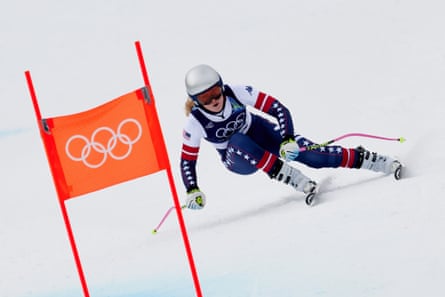
“I’ve never been afraid,” she said this week. “I’ve always been the kid that climbs the tree. My grandpa always called me a daredevil. That’s why I’m a downhiller. I like risk. I like going fast. I like pushing myself to the limit.”
That has always been embedded in her mythology. Vonn was never the smooth, untouched prodigy gliding above the sport. She was the one who crashed, who broke, who rebuilt, who came back angrier and faster. Pain was never a detour in her career; it was the road itself.
What makes this chapter different is the arithmetic. At 25, you crash out and rehab and convince yourself there is unlimited runway ahead. At 41, every race carries the faint understanding that there may not be another tomorrow. That reality has never seemed to slow her. If anything, it has sharpened the edges of everything she does: the line choice, the risk tolerance, the willingness to trust a body that has betrayed her too many times to count.
The Olympics have never been the neatest chapter of her story. Vancouver was triumph. Sochi was the one that got away. Pyeongchang was grit dressed up as a swansong. Milano Cortina has become something else entirely: a reckoning with time itself.
There is a version of Sunday where physics and biology reassert themselves and this becomes another entry in the long, unsentimental history of sport moving on from its ageing heroes. There is another where Vonn holds it together for 90 seconds on a mountain she knows as well as anyone on the planet and forces the sport to reckon, one more time, with the possibility that the normal rules do not apply to her. Either outcome would be consistent with the career she has lived.
The truth about Vonn was never that she was untouchable. It was that she was willing to go back to the same dangerous place, again and again, long after most people would have stopped answering the call. On Sunday, in what may be the appointment viewing of the entire Olympics, she will push out of the start gate knowing exactly what this costs. The pain. The risk. The infinitesimal margin between triumph and catastrophe. The only part that has never changed is the decision. And as long as there is a mountain in front of her, she will point herself straight down it.