2 months ago
85
2 months ago
85
Corky, Bound
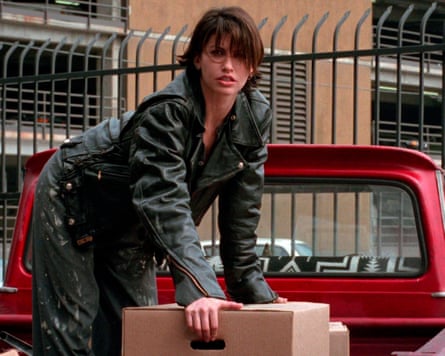
Forget about dimly lit period dramas where miserable women with no access to electricity gently sob in their heaving corsets and accidentally-on-purpose brush hands in the trembling candlelight; overblown, bombastic heist-capers and brooding, butch anti-heroes are far more up my street when it comes to lesbian cinema. What, after all, could be more intensely gay than immediately committing to a life of crime with someone you’ve only just set eyes on? My favourite of the entire bunch has to be the swaggering ex-con turned plumber Corky, who helps to save Violet from the clutches of her mob boss husband in 1996’s cult classic Bound. Though we first meet Corky trussed up in a literal closet, the metaphor doesn’t play out how you might expect: unapologetic and visible in a time when few films explored queerness full stop, she flexes a labrys tattoo, spends her down time swigging beer in grotty dive bars, and eventually drives off into the sunset, her new partner-in-crime in tow, in a beaten-up Chevy pick-up. The sheer simplicity of Corky as a queer heartthrob was, somehow, ridiculously ahead of its time, and her magnetic influence has played out everywhere from Bottoms to Love Lies Bleeding. El Hunt
Eric Hunter, Edge of Seventeen
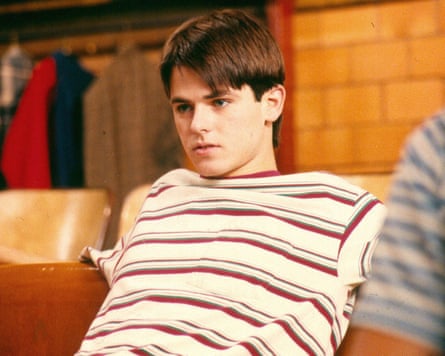
The lead of this undersung romantic comedy can be pretty corny: a suburban Ohio teen trying his best Boy George lewks at the local gay bar (they don’t work) and driving miles to surprise a one-time hookup and see if he’s still down. It’s far from abjection or self-ridicule – rather bursting with the emblematic charm of 90s’ New Queer Cinema that didn’t bother to explain itself – but Eric’s messiness is what makes it so real. The brilliance of Todd Stephens’ autobiographical, ’80s-set script is its twinning of queer people’s dual rebirths, coming out and coming of age. Eric’s not just figuring out life beyond his family, but actively creating how he’ll look and act within his chosen new one. In its earnest, unassuming way, and through Chris Stafford’s tender performance, the film captures the thrill of self-fulfillment, jumping from stanning a left-of-center pop act to creating a life to meet its fantasy. Juan A Ramirez
Frank Dillard, Mrs Doubtfire
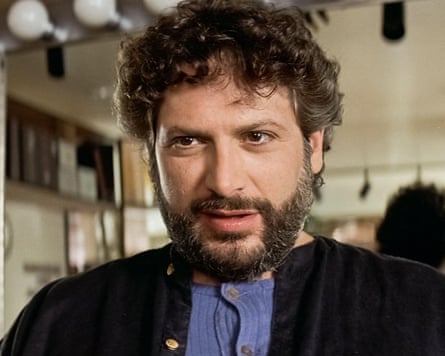
When I think of Mrs Doubtfire, I don’t just remember Robin Williams’s hilariously inconsistent Scottish(-ish) accent, but the raspy tones of the actor Harvey Fierstein. In the 1993 movie, Fierstein plays Frank Dillard, the flamboyant gay brother of Daniel Hillard (Williams), a slightly manic divorced dad who stages an elaborate octogenarian drag act so that he can spend more time with his kids. Frank is a makeup artist who helps his brother transform using wigs, prosthetics, makeup and a wardrobe of tights and cardigans. I remember finding it groundbreaking that there was a film like this in 1993 – a time of moral panics around HIV/Aids – which featured a gay character who wasn’t a sad or tragic figure. (Frank was in a happy relationship with a man who his nieces and nephews adorably called “Aunt Jack.”) And it was also quietly radical that the gay brother was the “expert” in this scenario, tasked with helping his brother assimilate into a femininity. Mrs Doubtfire is a film about strained family relationships, but creating custom prosthetics to help your brother to transform into an eightysomething British woman? That’s real love. Louis Staples
Divine, Pink Flamingos
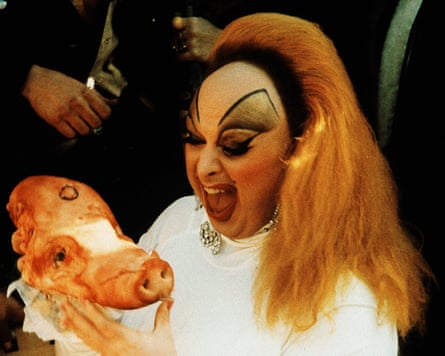
Few onscreen characters are as likely to brazenly emboss themselves onto your eyeballs as the high-eyebrowed (but unapologetically low-brow), beehive-haired, mermaid-flared Divine. Known now as the flamboyant linchpin of John Waters’s “Trash Trilogy”, Divine is the drag persona of Harris Glenn Milstead, who erupted into the Baltimoron counterculture at the tail-end of the 60s. Here, she has the title of the “filthiest person alive”, figuratively and literally: a murderess and thief steering a merry band of misfits, deviants and rogues on a veritable tour of vulgarity, with grisly stop-offs including oodles of eggs, stolen babies and turds. Trouble arrives when two nasty nitwits, the Marbles (David Lochary and Mink Stole), conspire to oust Divine from her foul throne and claim the title for themselves. But they cannot beat her to such levels of sheer outrageousness, nor has any character since – and Pink Flamingos still wears the crown in terms of cinematic notoriety. Miriam Balanescu
Barbara Covett, Notes on a Scandal
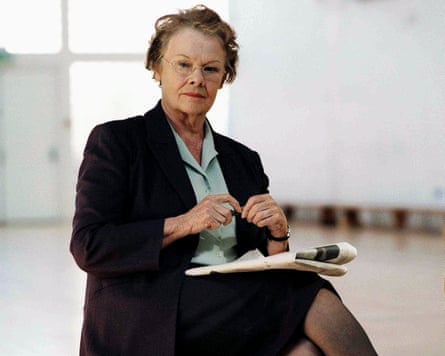
While it will always be particularly warming to see queer characters who might represent us at our most tender and vulnerable moments, there’s also something specifically thrilling about watching them speak to us at our nastiest too. Neatly disguised as prestige Searchlight Oscarbait, 2006’s Notes on a Scandal was instead a depraved little surprise, a darkly amusing and entirely scabrous thriller about a character who could, in the wrong hands, be a grotesque cliche – the bitter, sexually frustrated older lesbian. But with the bracingly nasty yet keenly specific words of Patrick Marber and a never-better, or freer, Judi Dench in the driver’s seat (the actor once called it one of her favourite roles), repressed and reviled schoolteacher Barbra Covett was both entirely, offensively uncensored and, at times, disarmingly, pathetically relatable. Her actions, and diaries, might be morally indefensible (even if falling in love and lust with Cate Blanchett might be understandable to us all) but the tragedy of never coming to terms with who and what you are as a queer person and how that then might curdle your every want and impulse remains effectively stinging to the film’s bitter, and refreshingly cynical, end. Barbra might be the worst of us but it doesn’t make her any less real. Benjamin Lee
Helen Cooper, Kissing Jessica Stein
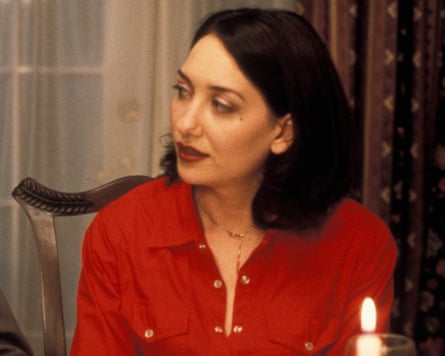
Kissing Jessica Stein is one of my favourite queer films – and not because of the titular Jessica (she’s cute, but too vanilla for my tastes). Rather, it’s her spiky, spunky love interest Helen who will forever reside in my personal Hall of Fame of fictitious women. When we meet Helen, not only is she wearing a pleather, pinstripe blazer, we see her return from a roll-around with one of her multiple boyfriends to eye-fuck a butch-y lesbian guest and gossip with her gay guy friends. In short, she is living my dream life. Helen is direct, sexually empowered, and would probably choke on her martini if anyone called her “wifey material”. She’s here, she’s queer, and she never fitted into the confines of hetero-monogamy. She’s a reminder that, contrary to retro stereotypes that bisexual women are patriarchy pick-mes, bisexuality is the ultimate disruption to the status quo. Megan Wallace
Albert Goldman, The Birdcage
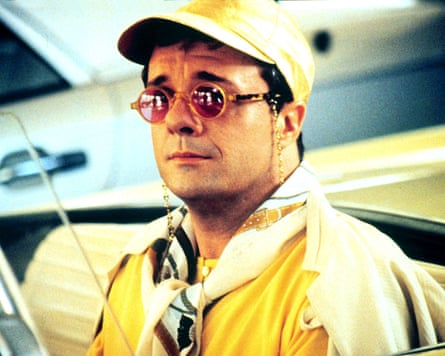
There is a moment in The Birdcage, when Armand (Robin Williams) tries to teach his partner, Albert (Nathan Lane), how to spread mustard on toast “like a man” – smearing it with gritted teeth rather than dainty hand movements. Albert fails hilariously, piercing the toast and descending into hysteria. The couple, who are desperate to convince their son’s ultraconservative future in-laws that Albert is just an uncle, quickly realize that plan might be futile. It’s a perfect scene that captures the absurdity of performative masculinity and the brilliance of Albert. An aging drag queen with impeccable taste, Albert is never the butt of the joke. Instead, Lane plays him with such unapologetic self-hood that he is the source of nearly all the laughs in Mike Nichols’s joke-a-minute comedy of errors. Albert commands every room, even when decked out in a wig and pearls to try and pass as his son’s mother. It was the first film I saw featuring two men living in bliss. While they are forced to hide their relationship for much of the film, every re-watch proves their bond is the truest thing in the movie – and most of the mess is just straight people drama they are forced to clean up. Shrai Popat
Megan Bloomfield, But I’m a Cheerleader
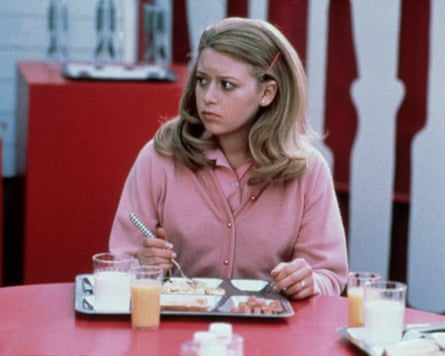
Jamie Babbit’s incurably campy satire of conversion therapy is centerpieced by Natasha Lyonne’s pitch-perfect performance as Megan Bloomfield, who desperately wants to be a normie in spite of her undeniable queerness. Megan tries so hard to be a high school cheerleader and kiss her hunky boyfriend, but it’s just not her, and one day her family stages an intervention and ships her off to the most hilariously ineffective conversion camp imaginable. What makes Bloomfield sing is her naivete – literally everyone realizes she’s a lesbian before she does – and that in turn powers the utter ridiculousness that makes But I’m a Cheerleader so memorable. And there’s a lot of it – RuPaul as a camp enforcer who sports a “Straight is Great” T-shirt but is clearly gay himself, obsessive fealty to gender norms in hopes that enough pink will make a girl straight, and Megan herself finding lesbian love while at the conversion camp. A wonderful addendum to Lyonne’s performance is that 25 years later she has again become iconic, this time for her quietly queer performance as Charlie Cale in the ongoing series Poker Face, giving us as idea of what an again Megan might have matured into in due time. Veronica Esposito
Sérgio, O Fantasma
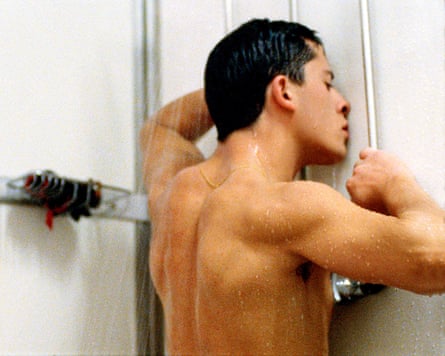
Sérgio is a garbage collector with the body of Saint Sebastian and the sex drive of a dog in heat. He is all id and proudly so, prowling the outskirts of Lisbon by night, pawing through the trash of a sexy biker, having (unsimulated) sex with strangers in a gimp suit, and choking himself with a shower cord while masturbating. Is he turned on by the memory of last night’s hookup or getting off on the feeling of being leashed? The low-lit city streets might not immediately feel like the loveliest landscape, but in director João Pedro Rodrigues’s hands, a back alley illuminated by a garbage truck’s brake lights can look like a painting. I love O Fantasma for its totally unsanitised portrait of ennui and social detachment of a true freak who refuses to fit in. Pride Month is a good time for queer people to remember that we don’t have to. Owen Myers
The Babadook, The Babadook
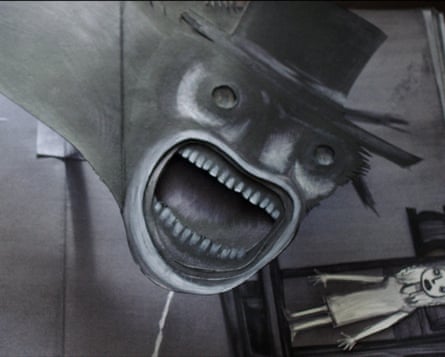
This year marks a significant 10th anniversary for the LGBTQ+ community. In 2016, according to queer folklore, Netflix accidentally placed Australian indie horror The Babadook – a film about a mother and son whose grief at losing the boy’s father manifests as a monster in a top hat – in its LGBTQ+ section. A screenshot of this purported error went viral, and, gay presto, the dapper but horrifying character – somewhere between Papa Lazarou from League of Gentlemen and a Edward Gorey illustration – became a fixture at Pride parades across the globe. While it’s unclear whether Netflix were actually at fault, or if the screenshot was a mockup based on an already existing “the Babadook is gay” meme, the fact remains that queer people have embraced this weird little guy in the way that they have done so many weird little guys before him. That is to say; with gusto. And whether or not director Jennifer Kent intended, the Babadook is for sure non-binary, and for sure in a polycule with Pennywise, Count Orlok and that thing from Pan’s Labyrinth with the eyeballs on its hands. Eleanor Margolis