2 months ago
87
2 months ago
87
On the evening before he won the US Open for a second time in four years, Wyndham Clark marched up the 18th fairway at Shinnecock Hills to put the finishing touches on a third round that would leave him six shots clear of the field. He had spent the past three days patiently defanging one of the crown jewels of American golf, building the third-largest 54-hole advantage held by a US Open leader since the second world war. The title was his to lose.
Yet when Clark arrived at the final green on Saturday bathed in golden-hour light, one thing was conspicuously absent: the crowd. Most of the spectators had left or were leaving and the grandstands around the green were only thinly populated. It was a remarkably muted backdrop for America’s once-and-future champion golfer as he stood on the doorstep of a rare wire-to-wire US Open victory.
“It was kind of unfortunate that we’re finishing in the dark and people weren’t really out there,” Clark said almost sheepishly. “Because there were some obviously key, big moments, and it did kind of get a little flat, so yeah, unfortunately.”
Golf’s chattering class spent the night debating the exodus. Some blamed the location, pointing to the lengthy Long Island Rail Road commute back to Manhattan. Some blamed the World Cup, though it’s difficult to imagine large numbers of Hamptons dwellers rushing away from a US Open at Shinnecock to make the kick-off for Ecuador v Curaçao. Others blamed the USGA’s scheduling decision to send out the final pairing at 3.45pm on Saturday. Mostly, though, they blamed Wyndham Clark.
“Hopefully, tomorrow there’s a bunch of fans and stuff, but for me, it’s still really important, and I still felt the moment,” Clark continued. “It’s just maybe unfortunate that there weren’t all the people there.”
Be careful what you wish for. Less than 24 hours after the grandstands sat half-empty, Shinnecock was overflowing and the monkey’s paw didn’t take long to curl. The 32-year-old spent much of Sunday being treated as the villain in his own coronation, a role he had spent the better part of a year trying to outrun. Ever since he did a Keith Moon on that locker room at Oakmont, Clark has been out to repair a reputation that once seemed as fast-rising as his game. For nearly four and a half hours on Sunday, playing alongside the popular Scottie Scheffler, the grandstands and six-deep galleries packed around Shinnecock made it clear just how far he still has to go.
It really was rough out there. They cheered when Clark’s tee shot at the second found the rough and again when his approach rolled off the green. They erupted when a bunker shot at the fourth came off the hosel and bounded over the gallery ropes and across the only paved road on the property. When he somehow salvaged par, the place went silent. Fans who hurled abuse at him were removed from the grounds. On the seventh, the cheers grew loud when he hit a six-iron off the tee into the front bunker and even louder when he missed a three-foot par putt. If the 32-year-old escaped trouble, the reaction was hushed disappointment. If he found more of it, Shinnecock burst to life. By the time he tapped in to win on the 18th, the subdued reaction suggested not a crowd celebrating a champion so much as one coming to terms with him.
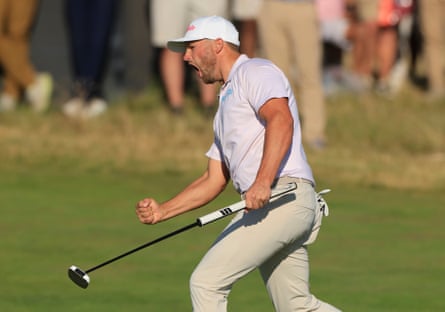
“New York didn’t really like me. I love you guys,” Clark told the smattering of fans who stuck around for Sunday’s trophy ceremony near the 18th green. “But I get it.”
Neither beloved nor especially charismatic, Clark wasn’t the most popular player on tour even before he smashed two of Oakmont’s 121-year-old lockers after missing last year’s cut by a stroke. Since then there was the driver launched through a sponsor sign at Quail Hollow, a series of minor rules controversies, and enough public displays of frustration to reinforce an image he has spent much of the past year trying to soften. In a post-LIV landscape increasingly short on genuine antagonists, he has become one of the few players people seem to feel strongly about.
Not every athlete arrives pre-wired for public affection. In 1986, Sports Illustrated famously described Ivan Lendl as “The Champion Nobody Cares About” on a cover that has not aged particularly well. But what unfolded at Shinnecock was stranger. This was not a foreign star with a frosty public image. It was an American dog-walking the US Open field on home soil and attracting cool indifference and outright hostility.
The version of Clark that arrived at Shinnecock was not the same one who left Oakmont a year earlier. He spent the intervening months rebuilding both his game and his headspace. The sports psychologist Julie Elion, a part of Clark’s team since 2022, helped him navigate the crisis of confidence that followed. On Sunday afternoon, as Clark prepared to defend a six-shot lead a couple of hundred feet from the baying galleries that awaited, Elion stood beside him on the driving range, helping steer his attention back toward the process that had carried him into contention.
At the same time, Clark went looking for answers in his swing. He began working with Cherry Hills instructor Pat Coyner after a prolonged slump that had left him searching for the form that once made him one of the game’s fastest-rising stars. By the time he reached Shinnecock, both rebuilds were beginning to bear fruit.
Clark later described the months after Oakmont as a period when his inner circle effectively built “a little cocoon” around him. Missing out on the Ryder Cup only deepened the wounds. But the isolation, technical tinkering and mental reset gradually produced something that had been absent for much of the past year: self-belief. Clark now says the rage that once fuelled episodes like the Oakmont tantrum has largely disappeared, replaced by a perspective shaped by better form, greater contentment away from golf and the realization that he had become consumed by things that ultimately did not matter. Good for him.
What spectators at Shinnecock saw over the weekend was the finished product: a player who had rebuilt his swing, rebuilt his confidence and learned to function without the approval of the masses. You do not have to like Clark. But after passing golf’s toughest test for a second time in four years – first by staring down Rory McIlroy, then by holding off the world No 1 with the whole property rooting against him – whether fans embrace him or not is beginning to feel beside the point.