2 months ago
66
2 months ago
66
Supreme court due to rule on birthright citizenship, one of Trump's core policies
Today, the US supreme court is due to rule on one of Trump’s core policies: the right of almost anyone born on US soil to have citizenship. The right is enshrined in the 14th amendment to the US constitution. The amendment was passed after the US civil war to determine the citizenship of American-born people who had been enslaved.
Signing a presidential executive order on the first day of his second term in office, Trump is attempting to withhold citizenship from the children of undocumented immigrants and some temporary US visitors. His administration has argued that birthright citizenship stems from a misunderstanding of the 14th amendment.
But Trump’s executive order was immediately met with legal challenges, with several federal judges ruling that the order violated the constitution, and federal circuit courts of appeals upholding injunctions to block the order from going into effect.
Trump has been vocal in his disdain for the policy of birthright citizenship. On social media earlier this year, he incorrectly said, “We are the only Country in the World STUPID enough to allow ‘Birthright’ Citizenship!”
There are around 30 countries that grant citizenship to those born within their borders, according to the Pew Research Center.
Key events
The supreme court’s decision to reject Trump’s attempt to fire Federal Reserve governor Lisa Cook yesterday is part of a long-running battle over the independence of the central bank.
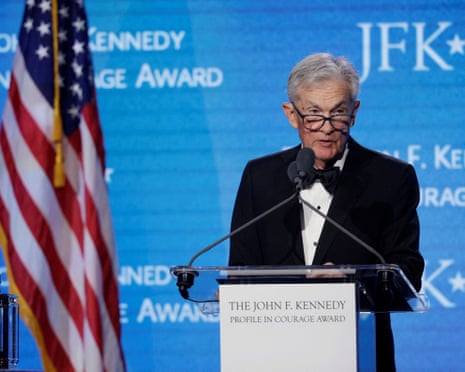
Trump repeatedly attacked former chair Jerome Powell for not lowering interest rates fast enough, calling him a “moron” on social media. Powell’s term ended in May this year, and he was succeeded by Trump nominee Kevin Warsh.
Powell said last month that political interference in the central bank would destroy the Fed’s credibility. “The public would lose faith that the central bank will make decisions based only on what’s best for all Americans,” he said.
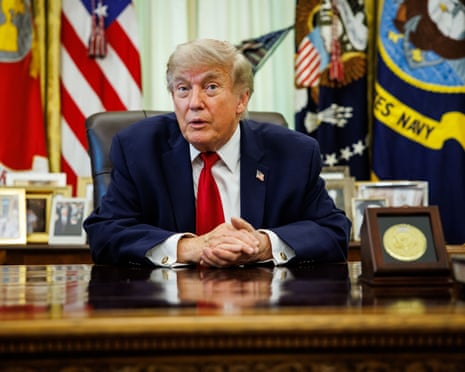
On Monday, Trump insisted that the case was “sent back” by the supreme court on a “strictly procedural basis”. The president said that the administration would tak “appropriate action immediately to make sure that someone who has committed wrongdoing will not be making vital decisions concerning the Welfare of the United States of America!”
However, the court said in a 5-4 opinion that Cook can stay on as a governor while she fights unproved allegations of mortgage fraud made by the Trump officials. This was a move that ultimately protects the central bank, compared to its opinion that expands presidential power and allows the president to fire Rebecca Slaughter, a Democratic commissioner on the Federal Trade Commission.
Supreme court to issue opinions in final cases of term
As we noted earlier, all eyes will be back on the supreme court today, when justices will issue their latest and final decisions of this term at 10am ET.
One of the most pivotal cases we’ll be watching is Trump v Barbara – a challenge to the president’s attempt to gut birthright citizenship. But there are two other decisions we’re waiting for. These include bans in two states prohibiting trans girls and women from taking part in female sports.
We’ll also be looking out for the justices’ opinion on whether to uphold a lower court ruling that limits spending by political parties in support of their candidates.
Donald Trump doesn’t have any public events today. He’ll spend the morning in executive time and policy meetings. The president will later speak at a Rose Club garden dinner at 7pm ET, but right now that is not open to the press.
We’ll keep you updated if anything changes.

Robert Tait
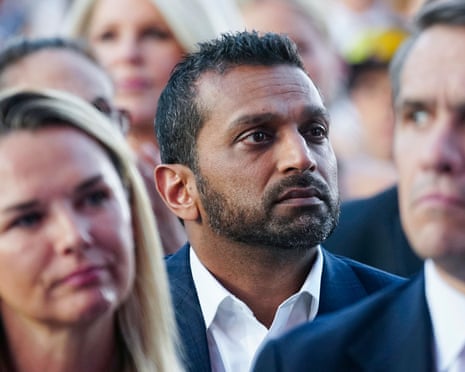
FBI director Kash Patel has attracted criticism for sharing the details on social media of five arrests in an investigation carried out in conjunction with the Secret Service.
Patel may have flouted legal constraints and the FBI’s disciplinary code in prematurely divulging the arrests in an alleged plot to attack this month’s Ultimate Fighting Championship bout at the White House, bureau veterans have alleged.
It subsequently emerged the inquiry was sealed by a court order, theoretically constraining Patel from publicly disclosing it.
Maanvi Singh
For a primer on birthright citizenship and why the stakes of the supreme court’s decision today on the issue are so high, here’s my colleague Maanvi Singhi’s reporting:
A ruling in favor of the Trump administration would cataclysmically redefine what it means to be an American.
In practical terms, it would mean that an estimated 250,000 babies born in the United States each year would be stripped of their citizenship. Some would be stateless. Legal experts warn that this outcome could pave the way for casting off citizenship from millions of people who already have it.

Sam Levin
After a series of blockbuster rulings, the supreme court is set to make a decision today on another major legal battle which could have national ramifications, this time on LGBTQ+ rights.
Guardian reporter Sam Levin did a deep-dive back in January on the cases the supreme court is considering on the participation of trans girls in school sports, and the potential consequences of the court’s decision. Here’s what he’s had to say:
The court is hearing oral arguments in two cases brought by trans students who challenged Republican-backed laws in West Virginia and Idaho prohibiting trans girls from participating in girls’ athletic programs.
Those bans were both previously blocked by federal courts, but the states appealed to the supreme court, which is hearing a case on trans people’s access to sports for the first time. If the court’s conservative supermajority sides with the states and upholds the bans, the rulings could have significant ripple effects, paving the way for the enforcement of a range of anti-LGBTQ+ policies.
If the rulings are broad, civil rights advocates warn, the supreme court could make it easier for lawmakers and school officials to ban trans students’ access to appropriate bathrooms and facilities, restrict LGBTQ+ youth’s ability to use chosen names and pronouns, enforce strict dress codes, limit protections against anti-LGBTQ+ harassment, and further deny access to accurate identification documents.
“It’s really scary. The supreme court is poised to tell us whether dislike and moral disapproval of a specific group can be a real basis to make law,” said Cathryn Oakley, senior director of legal policy for the Human Rights Campaign, an LGBTQ+ rights group.
A top United States government official has been celebrating Iran’s departure from the World Cup.
Iran came close to making the final 32 teams, but were narrowly eliminated after drawing all three games in the group stages.
The US department of homeland security secretary, Markwayne Mullin, said during a World Cup security briefing: “I’m just glad they’re done, and they’re not coming back. I was so happy when we were able to pull their visas and said they could leave the US soil.”

A woman known as Jane Doe 4 in the Jeffrey Epstein files is “staying off the grid” and lives in fear of retaliation from the Trump administration amid an escalating controversy over its handling of her case, according to a family member.
“Trauma is brutal. Chronic trauma destroys,” said the relative, who described the woman’s life as layers of abuse dating back to early childhood. “She’s coping as best she can.”
The woman had four interviews with FBI agents in 2019 that keep resurfacing in the Epstein sex-trafficking scandal.
Supreme court due to rule on birthright citizenship, one of Trump's core policies
Today, the US supreme court is due to rule on one of Trump’s core policies: the right of almost anyone born on US soil to have citizenship. The right is enshrined in the 14th amendment to the US constitution. The amendment was passed after the US civil war to determine the citizenship of American-born people who had been enslaved.
Signing a presidential executive order on the first day of his second term in office, Trump is attempting to withhold citizenship from the children of undocumented immigrants and some temporary US visitors. His administration has argued that birthright citizenship stems from a misunderstanding of the 14th amendment.
But Trump’s executive order was immediately met with legal challenges, with several federal judges ruling that the order violated the constitution, and federal circuit courts of appeals upholding injunctions to block the order from going into effect.
Trump has been vocal in his disdain for the policy of birthright citizenship. On social media earlier this year, he incorrectly said, “We are the only Country in the World STUPID enough to allow ‘Birthright’ Citizenship!”
There are around 30 countries that grant citizenship to those born within their borders, according to the Pew Research Center.
'Disastrous': anger at supreme court ruling expanding presidential powers
Hello, and welcome to the US politics live blog.
In a significant victory for the president on Monday, the court granted him the ability to fire leaders of some independent US agencies at will, in a move one advocacy group called “disastrous.”
The decision to expand presidential powers overturns a precedent set in 1935, rowing back a guardrail put in place to protect agencies against corruption and political interference.
“Our authoritarian president was just handed the keys to be even more authoritarian, and the long-term consequences will no doubt be disastrous,” said Rachel Rossi, the president of Alliance for Justice, a progressive judicial advocacy group.
Supreme court justice Sonia Sotomayor has blasted the decision, calling the ruling “egregiously wrong,” and “the one thing that does appear to be clear going forward is that chaos will follow.”
During his second presidential term, Trump has successfully fired the leaders of several agencies, including Gwynne Wilcox, the first Black woman to serve on the National Labour Relations Board.
Trump failed in his bid however to remove Federal Reserve Governor Lisa Cook, with the court ruling in a 5-4 opinion that Trump’s attempt to fire her from the Fed was unconstitutional. Trump has targeted Cook, the first Black woman to serve on the Fed’s board, over unproved allegations of mortgage fraud.
The court also rejected Trump’s attempt to change rules for late-arriving mail-in ballots. Trump has claimed that such ballots are vulnerable to fraud. The states that currently count postal ballots which arrive late mostly lean towards the Democrats.
On Tuesday, the supreme court is poised to make a decision on another of Trump’s key policies: his push to remove birthright citizenship, which grants US citizenship to almost anyone born in the country, regardless of their parents’ status. On the first day of his second term in office, Trump issued a presidential order overturning the practice set out in the 14th amendment to the US Constitution.
The court is also set to publish rulings on a Republican challenge to campaign finance limits and state restrictions on transgender athletes competing in school and college sports.
In other developments:
-
The supreme court rejected Trump’s request to review a 2023 verdict from a New York jury that found him liable for sexually abusing and defaming the writer E Jean Carroll.
-
Trump announced that he is nominating Keith Sonderling to serve as US secretary of labor, a role he is now filling as acting secretary after Lori Chavez-DeRemer’s announced her departure in April. As acting secretary, Sonderling threatened to withhold administrative funds from states for the first time in history, warning that there will be no tolerance for “blatant waste, fraud, and abuse”.
-
The US military is racing to vaccinate new recruits after a two-month halt on mandatory flu shots – but it’s a temporary reprieve, as the shots will soon expire and new doses will not be available for months.