3 months ago
72
3 months ago
72
When New Zealand’s political leaders gathered to speak at the Waitangi treaty grounds where Māori chiefs and the British Crown forged a nation 186 years ago there was a striking absence: the public.
As a light rain fell on the green peninsula in the far north of New Zealand on Thursday, fewer than 100 people gathered to watch the leaders welcomed onto the grounds, and only a handful of people heckled ministers as they spoke.
The muted tone on the eve of Waitangi day, which commemorates the signing of the nation’s founding document the Treaty of Waitangi, marked a dramatic shift from a year earlier. In 2025, protesters turned their backs on government ministers and twice removed a microphone from David Seymour, the Act party leader and architect of the divisive treaty principles bill that sought to radically alter the way the treaty was interpreted. A year earlier, the rightwing coalition government faced record crowds and heated protests over their policies that many fear are undermining the treaty and rolling back Māori rights.
The absence of protest does not necessarily mark a shift of sentiment in favour of the coalition government, which faces an election in November. Rather, it signals fatigue within the Indigenous population, a breakdown in trust in the government, and a desire to refocus attention towards Māori communities, visitors to the grounds tell the Guardian.
“People are tired,” says Edward Ellison, an esteemed leader from the southern tribe Ngāi Tahu. “We’ve been beavering away on submissions, select committees … and the pace, rate and persistent aggressiveness on the treaty – it hasn’t lowered the passion – but there is that exhaustion.”
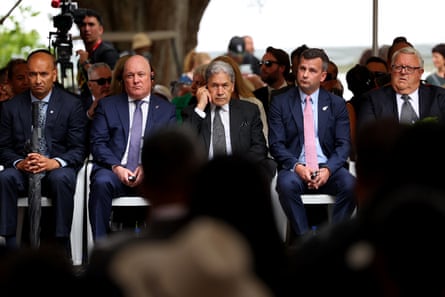
Ngāi Tahu chose to forgo its usual celebrations in the South Island to attend Waitangi for the first time in years as a mark of solidarity and unity with northern iwi, or tribes.
“It was the events of this government, the impact they are having on the treaty and our people, the divisive approach they are taking and pitting New Zealanders against New Zealanders,” Ellison says.
Kassie Hartendorp, the director of community campaigning organisation Action Station Aotearoa, says protests have partly subsided because the government had already shown Māori “exactly who they are” and Māori were sick of their time and energy being taken up.
“This coalition government largely doesn’t care what Māori think of them … if they did, we wouldn’t have had this absolute onslaught of anti-tiriti [treaty] policies.”
The treaty, signed by Māori chiefs and the British Crown in 1840 is considered New Zealand’s founding document and is instrumental in upholding Māori rights. It has been commemorated as a public holiday on 6 February since 1974, with events around the country, and a formal multi-day celebration held at the Waitangi grounds.
On Thursday, prime minister Christopher Luxon acknowledged the atmosphere surrounding Waitangi Day had “sometimes been very heated”.
“New Zealand must continue to evolve in a way that empowers iwi and Māori while steadfastly protecting the unity of the country,” he said, while listing the articles of the treaty and how his government’s policies were fulfilling its promises
The leader of the opposition, Labour’s Chris Hipkins said the prime minister’s speech was “a missed opportunity … to speak specifically to the theme that we were given, which was working together and bringing people together”.
‘Time for us to celebrate each other’
Ellison, meanwhile, found the politicians’ speeches were mostly “underwhelming”.
“I was disappointed with the kōrero (talk) from the politicians – it didn’t inspire confidence that they had a way forward or a clear path that unites us or brings the best out of us,” Ellison said.
On Friday, the mood shifted from muted to celebratory at the treaty grounds as tens of thousands descended to revel in the festivities. It is as much a time for celebration, music, food and community as it is a forum for political discussion about sovereignty, equality and history.
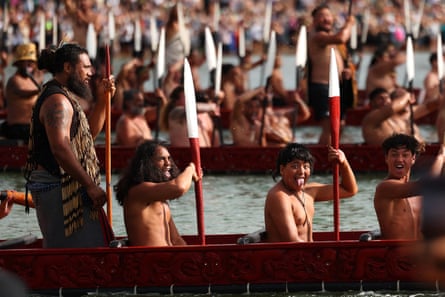
At the dawn ceremony, thousands of visitors nursing hot drinks and wrapped in rugs, spilled over the peninsula. Some held tino rangatiratanga flags – symbols of Māori sovereignty – while others took the chance to boo Seymour, as he delivered a prayer. Later as the sun broke over the bay and the formalities gave way to festivities, the attention turned elsewhere – to music, community and a celebration of Māori culture.
As Hartendorp spoke with the Guardian, waiata (traditional song) rang out from a large forum tent behind her. Stalls selling traditional food, woven bags and carved jewellery heaved with customers. Children darted between their family members and elders fanned themselves in the shade of gazebos. In the bay, thousands lined the banks to watch waka – traditional canoe – slip through the water.
“That’s the beauty of Waitangi, we can come here and be exactly who we are and not have to fight and question it,’ Hartendorp said.
“We’ve already had hundreds of thousands of people hīkoi [march], we’ve already broken historical records of submissions, we are a political force … and right now is a time for us to celebrate each other.”