2 months ago
63
2 months ago
63
One day, in February 2021, Amy Goddard woke up and went for a run. On her return home she took a shower and then looked in the mirror before brushing her teeth. That is when she realised the left side of her face had dropped.
Goddard, who was playing for Crystal Palace semi-professionally in the Championship at the time, went to the hospital and was diagnosed with Bell’s palsy. The illness, which she had not heard of until her diagnosis, causes sudden and typically temporary weakness or paralysis of the muscles on one side of the face. The condition affects one in 70 people in their lifetime in the UK.
Goddard, who is now at WSL 2 side Southampton, says it was a “petrifying” time for her and that it not only affected her physically and mentally but also her football career.
Now fully recovered, the 27-year-old tells her story during Facial Palsy Awareness Week, which runs until Saturday, to help others. In particular she wants to highlight the mental health effect the illness and side-effects of the medication can have on Bell’s palsy patients. Not everyone experiences the side-effects, but the steroids affected her mental health and she worried that people would judge her appearance.
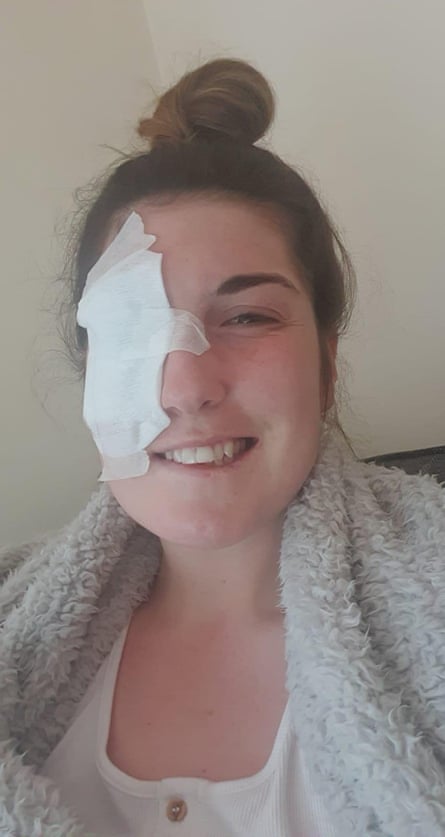
“It was really hard at that time, I have never been in such a dark place before,” she says. “I feel like the steroids made me feel alone. I have such a supportive family, but it put me in a pit and I didn’t know how to get out of it.
“I had insomnia and I know that is an effect from the steroids, but I didn’t realise how much I would be affected by it. Insomnia didn’t help because when you’re not sleeping, you are not recovering properly and you’re not thinking straight.
“People with facial palsy, it’s not that you are not beautiful or anything like that. In terms of how I was at the time, I went from being my normal self to having that and that is what I struggled with.
“My partner, Ewan, had to drag me out of the flat to make me go out for walks. I love being active [but] I was so paranoid even though no one would be looking at me and no one would be thinking anything of it. I didn’t like myself to be viewed in that way when walking down the street if people looked at me or judged me.”
Goddard says she was up some nights crying and that the side-effects took her by surprise. “When you take tablets you always know there is going to be an effect on something and it’s very individual in terms of your side-effects, but I was never made aware of the extent it could impact. When I was experiencing these things, my partner did look into it and that you can get insomnia and depression. I wasn’t aware of that.
“I genuinely never thought in a million years I was going to feel that way. Even now I would be scared to go back to that place. I will be open and honest and say I have been having therapy sessions for that. I started it this season.”
Goddard spent three months out of football and then decided not to re-sign with Palace, instead joining Bridgwater and later Oxford in the third tier. She decided to drop to the National League in order to rebuild her confidence on the pitch, something that was hard as she had played in the top two flights of English football throughout her career.
She took two years building herself back up and then moved back into the Championship: “I got a full-time contract with Sunderland [in 2023] and then moved to Southampton two years later. It has been a whirlwind. Career-wise it is not what I planned, but I always say to everyone: ‘Trust your own journey’ – and that is something I always stand by.”

Goddard signed for Southampton last July and as well as therapy she plays golf to blow off steam away of football. She runs social media accounts to document her new hobby. “It is helping with my mental state,” she says. “Recovery is so important. Football is important and something I have sacrificed a lot of things for, but at the same time having that bit outside does mentally prepare you and make sure you are ready to perform the next day.”
As well as highlighting awareness for the illness, it is the different elements patients have to deal with that is the lasting message Goddard wants to leave. “To realise it is not just a physical impact, it is the mental impact that can affect you,” she says. “Not to feel you should feel bad with the way you are feeling, it is OK to not be OK. I know that is a very cliche thing to say, but it is genuinely true.”
If you want to discuss anything raised in this piece please contact Facial Palsy UK on 0300 030 9333 or visit facialpalsy.org.uk.
Get in touch
If you have any questions or comments about any of our newsletters please email [email protected].
-
This is an extract from our free email about women’s football, Moving the Goalposts. To get the full edition, visit this page and follow the instructions. Moving the Goalposts is delivered to your inboxes every Tuesday and Thursday.