2 months ago
84
2 months ago
84
Iranians woke up on Thursday to a new round of explosions in Tehran, on the sixth day of war since the US and Israel launched attacks that have so far killed more than 1,200 people, including the country’s supreme leader, Ali Khamenei.
The casualties include 168 children who were killed at a school in the southern province of Hormozgan; thousands more people have been injured.
-
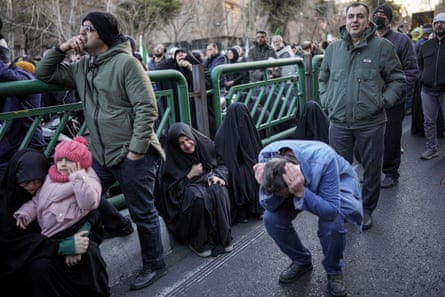
People mourn the killing of Ali Khamenei along Enghelab Street in Tehran on Sunday
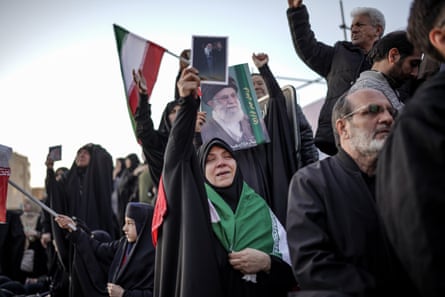
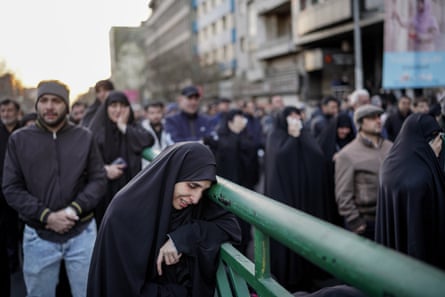
Washington has vowed to hit targets “deeper” in Iran, while Israeli officials said they had dropped more than 5,000 bombs since the start of the assault.
Iran has retaliated with missiles and drones, hitting targets across the Middle East, including in Israel, the United Arab Emirates, Qatar and Saudi Arabia, with the Iranian president, Masoud Pezeshkian, vowing the country would defend itself.
Just a week ago, Iran’s foreign minister, Abbas Araghchi, was in Geneva for a third round of nuclear negotiations where he said Tehran and Washington had moved “closer to agreement”. Two days later, Israel and the US launched a war without a clear legal mandate or basis, and with minimal consultation with Congress or the American public.
Tehran, home to about 10 million people, has been burning since, with civilians bearing the brunt of the conflict. Mohammad Mohsenifar, an Iranian photographer, has been covering the destruction.
-
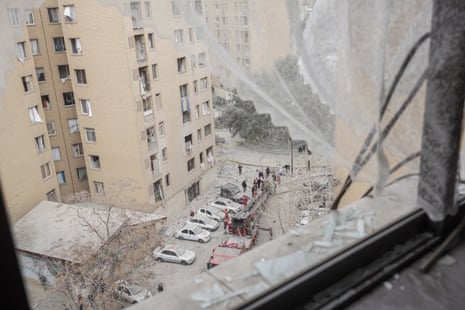
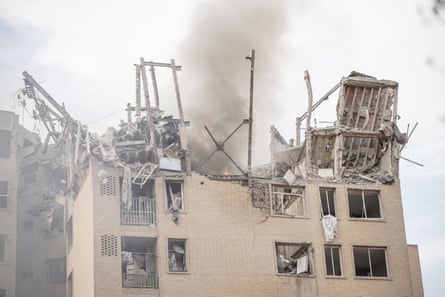
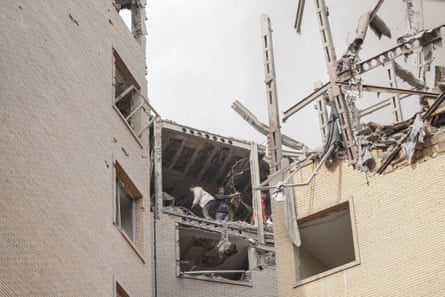
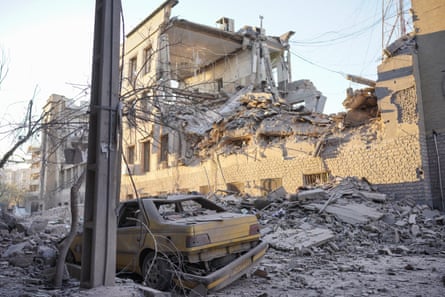
The Shahid Boroujerdi residential complex in south-east Tehran was struck, leaving two apartment blocks completely destroyed and five others badly damaged on Wednesday
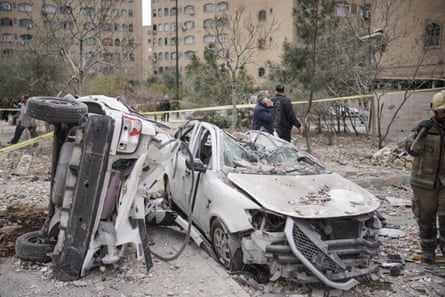
On Wednesday, a residential complex in south-eastern Tehran was struck, leaving two apartment blocks completely destroyed and five others badly damaged. “Residents have evacuated their homes,” a distressed man said, explaining that his sister lived nearby.
-
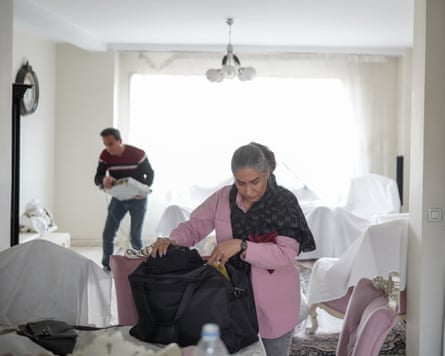
Residents in their apartment and belongings on the ground after the strikes
Smoke still billows from the ruins as first responders carry away the dead and treat the injured. Firefighters spray water on to what remains of a building reduced to a twisted skeleton of concrete, brick and rebar. People cry, and the cold air is thick with smoke, making it harsh to breathe. The Alborz mountains surrounding the city trap not only the winter smog, but now also the choking smoke of airstrikes.
-
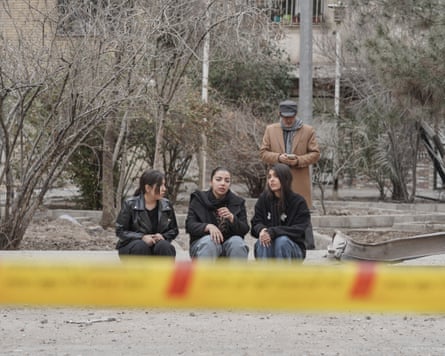
A group of teenage girls sit by the roadside
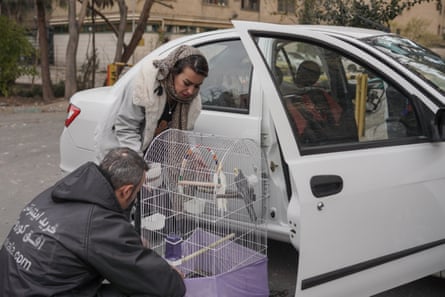
The scene here in south-eastern Tehran is chaotic. A group of teenage girls sit by the roadside, their faces blank as people run past. A woman hurriedly shoves a few of her belongings into a car, carefully placing a cage with her two cockatiel birds on the passenger seat. Others rush back into damaged apartments to grab what they can: documents, electronics, a few valuables.
-
A woman hurriedly shoves a few of her belongings into a car
Blankets are thrown over furniture and sofas to cover and protect them; most things are left behind as families abandon their homes to seek shelter with relatives outside the city, towards the mountains of Gilan or the Caspian Sea.
-
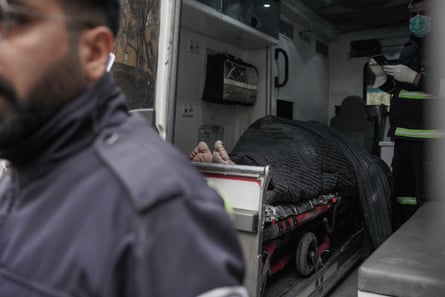
First responders at the scene
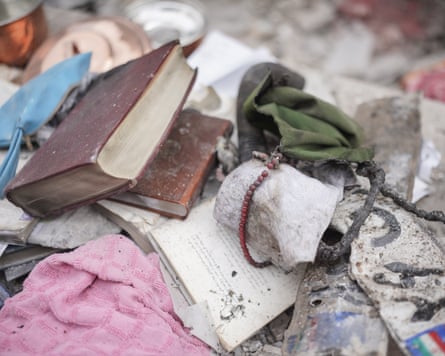
Nearby, first responders lift a body into an ambulance. A white stuffed rabbit, grey with dust, lies among the debris. There are books, prayer beads, shattered glass.
And then there is blood. Thick strands of hair. Pieces of bodies scattered through the rubble, collected into plastic bags.
“One of the worst things are the second strikes,” said Mohsenifar, adding that sometimes new blasts hit minutes after first responders have arrived. “This has increased the number of casualties, but has also made rescue teams hesitant to approach a scene right after a blast, as they often anticipate a second explosion,” he said.
-
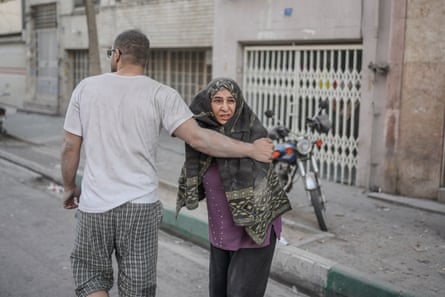
People on the streets on Tuesday after a strike
Despite the war, Tehran – with its sprawling old parks and snow-capped mountains – has not come to a complete standstill. Schools and universities immediately closed on Saturday when the conflict began, but many shops and markets are still open, and some restaurants continue to serve Iftar meals at sunset as Iranians break their fast during Ramadan.
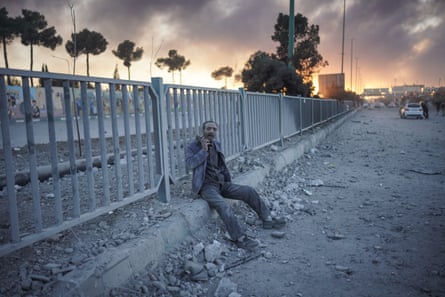
-
An airstrike near Azadi Square on Tuesday
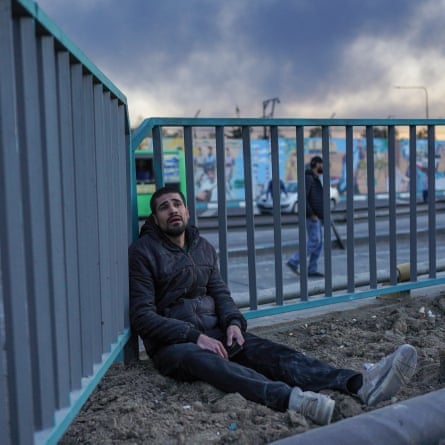
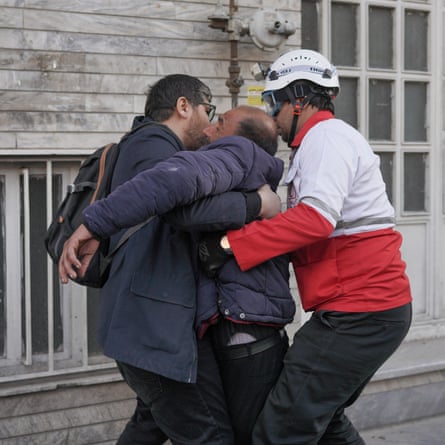
-
A man sits in the street, and another is helped after collapsing
An internet blackout has made it essentially impossible for many to reach family members and friends.
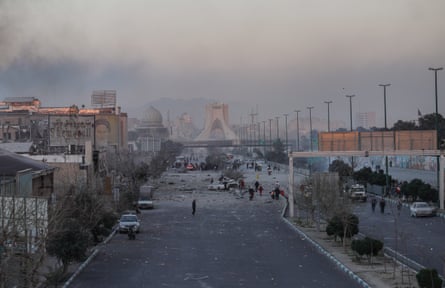
On Tuesday, a strike landed near Azadi Square, briefly shutting the highway that links the capital to the eastern provinces. The same day, a police station was hit near Enghelab Square in the heart of the city, an area that in recent days had been filled with mourning crowds after the death of the supreme leader, Ayatollah Ali Khamenei, was announced.
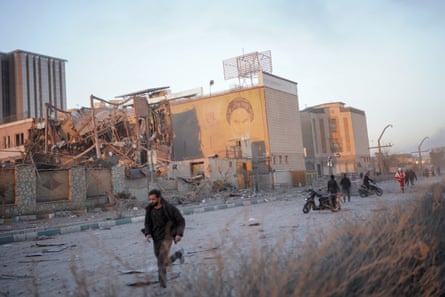
-
A man runs in the street after an airstrike near Azadi Square on Tuesday
-
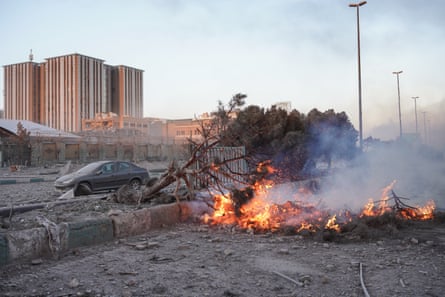
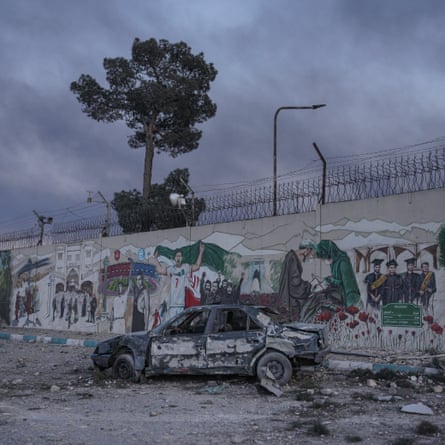
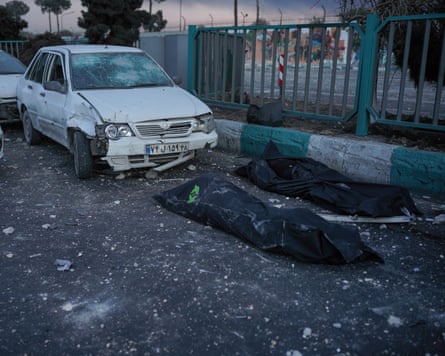
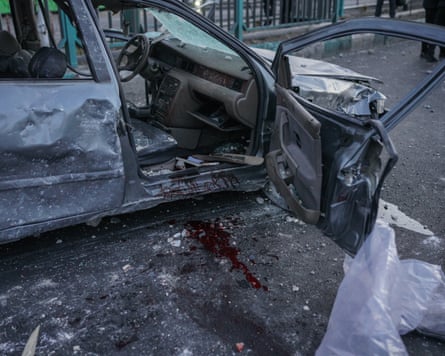
Bodies on the ground and burnt-out cars in the aftermath of the strike near Azadi Square on Tuesday
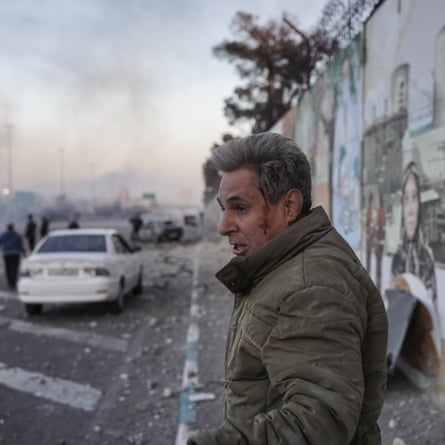
“Several citizens passing through Azadi Square in their cars were injured by the blast, and I saw the bodies of two people who were killed,” Mohsenifar said.
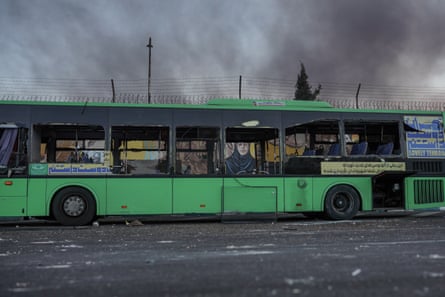
The scene after the explosion was chaotic: charred cars lined the roadside, people rushed past, some visibly injured. A man collapsed. A green city bus, its windows shattered, stood by the curb, black smoke rising behind it. A large sticker on the side read: “Lovely Tehran.”
-
‘Lovely Tehran’ read the words on a bus near Azadi Square after an explosion on Tuesday
-
A destroyed taxi in the street
Earlier this year, this area saw anti-government protests that swept across the country, with reports suggesting casualty numbers ranging from 5,000 to 20,000, according to the UN special rapporteur Mai Sato.
-
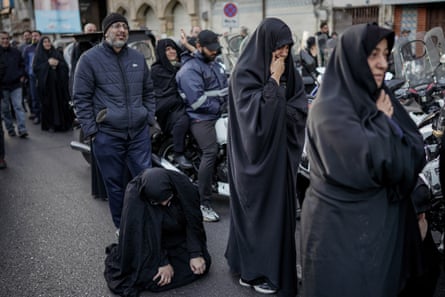
People mourn the killing of Ali Khamenei along Enghalab street in Tehran on Sunday
Some people still venture on to the streets to queue for bread or check on relatives, but they move with caution. Few cars are on the road and journeys are limited to those that are absolutely necessary.
-
The aftermath of a strike on Tuesday
Mohsenifar, who grew up in Tehran, said one of the most frightening moments on the road was when the traffic lights turn red and a driver is forced to wait. The city’s once lively, traffic-jammed streets are now eerily quiet. Explosions echo in the distance, without warning.
“Stopping feels dangerous, but driving feels just as risky, because there’s no safe place in Tehran any more,” he added.